


BAC and Autodesk Unveil 'BAC Mono' Supercar with Reduced Wheel Weight and Increased Power Efficiency
 Published2020.03.31 09:57
British supercar manufacturer Briggs Automotive Company (BAC) and an Autodesk research team have unveiled the BAC Mono, a supercar built using generative design with the goal of reducing wheel design time and weight.

▲ BAC Mono <Photo by Autodesk>
Generative design is provided in Autodesk’s integrated CAD/CAM/CAE software Fusion 360 and is a design solution that generates various design options based on artificial intelligence and cloud computing technology to match conditions entered by the user, such as durability, flexibility, and weight.
Using this, the two companies conducted tests on wheel manufacturing methods and materials, and as a result, aluminum material and 3-axis and 5-axis machining methods were confirmed to be the most suitable solutions for producing BAC Mono front wheels.
The generatively designed wheel meets all the strict certification requirements required in Europe, while reducing the weight to 2.2 kg, which is 35% lighter than the 3.42 kg weight of a wheel produced by conventional CNC milling. Fusion 360's generative design algorithms execute thousands of operations per minute and provide design options optimized for wheel production in just four hours, contributing to a reduction in work time.

▲ BAC Mono front wheel <Photo=Autodesk>
The newly unveiled BAC Mono has a body weight of 570 kg, which is much lighter than its predecessor, and also achieves 332 brake horsepower (bhp) and over 400 Newton meters (Nm) of torque with its turbocharged engine.
Each body panel is made of graphene-reinforced carbon fiber, reducing vehicle weight while increasing material strength.
Stephen Hooper, Vice President and General Manager of Autodesk Fusion 360 Products, stated, “New technologies are transforming automotive design, and the automotive industry’s efforts to reduce carbon emissions have brought greater innovation to automotive design and manufacturing. We expect that lightweight approaches utilizing generative design, as demonstrated by BAC Mono, will play a pivotal role in the future expansion of the electric vehicle market and the improvement of power consumption.”
Comments
Related news
Ansys and Autodesk Partner to Enhance Automotive Lighting Simulation
Automotive OEMs worldwide must respond to customer demands for increasingly personalized solutions while innovating technology and adapting to rapidly changing regulatory environments. Ansys announced a collaboration with Autodesk, a design and manufacturing software supplier, to address this need. The collaboration was established to enable automotive OEMs to combine visual design review and regulatory compliance verification in a connected workflow. The Ansys Automotive workflow uses Ansys lighting simulation together with Autodesk VRED to provide physically accurate interior and exterior lighting simulation to the design studio.
2019.09.25by 이수민 기자

ADI Battery Management ICs to be Featured in Rimac Supercars
ADI's battery management system IC is set to be installed in the battery management system of Rimac Automobili, which is renowned for its electric supercars. The BMS acts like a brain for the battery pack, not only managing output, charging, and discharging while the vehicle operates, but also providing precise measurement capabilities. Additionally, it provides safety functions that protect the battery from various hazards.
2019.12.03by 이수민 기자
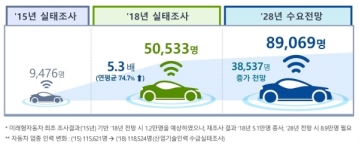
Future Automotive Industry Workforce Demand to Reach Approximately 89,000 by 2028
Industrial technology workforce engaged in future automotive industries such as electric vehicles, hydrogen vehicles, and autonomous vehicles reached a total of 50,533 as of the end of 2018, a 5.3-fold increase from 2015. According to the results of an industrial technology workforce survey conducted by the Ministry of Industry, participating companies are investing 22.9% of total sales in future automotive vehicles, and the autonomous vehicle sector is expected to show the highest annual average growth rate at 8.7%.
2020.03.11by 최인영 기자

[e4ds Tech Day 2026 ⑨] Sim Sang-gyu, Autocrypt CTO: "In the Physical AI Era, Automotive Security Must Extend Beyond the Vehicle"
At e4ds Tech Day 2026, Sim Sang-gyu, CTO of Autocrypt, explained automotive cybersecurity strategies in the era of Physical AI and SDV (Software-Defined Vehicle). Automobiles are evolving as part of an ecosystem connected to AI, cloud, chargers, IoT, and robots, and he emphasized that the scope of security must expand beyond the vehicle interior to the entire connected environment. In particular, AI model tampering, adversarial attacks, OTA updates, and EV charger hacking were identified as major threats. He explained that response measures require zero trust, AI model integrity protection, intrusion detection, Security by Design and Default, and full lifecycle security management, and that proactive security system establishment beyond regulatory compliance is critical for securing future mobility competitiveness.
2026.10.12by 배종인 기자

Practical HIL Construction Strategy for Automotive and Off-Highway Controller Validation
As vehicle E/E architecture transitions to zonal structures and shifts to software-defined vehicles (SDV), the number of controllers (ECUs) requiring validation and software complexity are surging dramatically. Meanwhile, real vehicle testing cannot provide repeated verification under identical conditions and entails lead time and safety concerns. This white paper explains the principles of HIL (Hardware-in-the-Loop) validation and the structure of the NI platform composed of PXI, SLSC, and VeriStand, and through two actual implementation cases—Camera Record & Replay HIL for In-Cabin Monitoring Controller (ICMU) and Forklift Controller (VCU) HILS—describes how controller-level regression testing becomes possible. Additionally, it explicitly states application boundaries and limitations, such as lack of A2B support.
2026.10.12by 편집부











