



SoC Design Verification Simulator Design Center Established in Pangyo
 Published2020.04.01 15:19
In the field of high-performance software simulation
Introduction of full virtualization simulation and verification tools
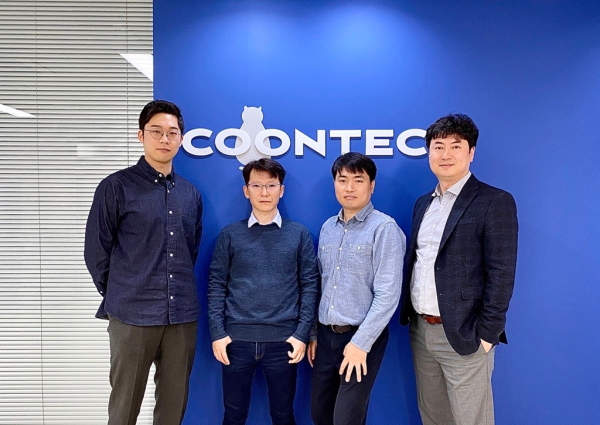
On the 1st, Kuntek announced that it is establishing the 'Koontek Design Center' in Pangyo 2nd Techno Valley, Gyeonggi Province, which is officially certified by Imperas, a leader in embedded virtual machines and high-performance software simulation.
With this establishment, Kuntek is now able to provide virtual platform design services to domestic and Asian customers that can accelerate software development and hardware verification.
Virtual platforms have many advantages over hardware prototypes in that they can be designed in a flexible manner. They can also resolve availability and portability issues that arise during the testing process based on traditional hardware prototypes.
The software models of the key elements constituting the virtual platform are combined to form a single executable system. Processors, peripherals, and interfaces must be developed as software models, and not only must the SoC binaries execute accurately on a virtual platform, but performance issues required during rigorous testing must also be considered.
Architecture designs for next-generation AI or machine learning typically utilize SoC designs based on heterogeneous systems and multi-core processors. In this context, an optimal configuration can be found by fine-tuning hardware structures and software algorithms through a virtual platform approach that leverages demanding workloads based on real-world datasets.
To model the array of nodes deployed in various IoT applications in the form of a digital twin, a design approach at the entire system level is required. In such situations, the utilization of a virtual platform is essential to optimize all hardware and software services of the entire system.
Virtual platform development engineers must collaborate closely with system designers or system developers to provide a link that facilitates smooth communication between hardware and software teams, and establish essential evaluation criteria by providing a comprehensive platform for software testing to verify hardware.
"With the establishment of the Kuntek Design Center, we are now able to provide flexible and comprehensive services, including expert support for virtual platform development projects, as well as necessary training, consulting, and engineering services tailored to the customer's situation," said Bang Hyuk-jun, CEO of Kuntek. "By using the OVP modeling infrastructure, we can offer customers the option to manage projects with a flexible combination of internal and external teams through open-source models and virtual platforms."
Comments
Related news
Mentor & Siemens Platforms Introduced for Custom Circuit Verification and Equipment Noise Analysis
Artificial intelligence processor company Mythic has adopted Mentor Siemens' platform for functional verification of analog and digital logic integrated into its IPU. Mythic's IPU performs calculations required for DNN inference within flash memory arrays using analog computing. For custom circuit verification and noise analysis, Mythic leveraged Analog Fastspice and Symphony mixed-signal platforms.
2020.02.26by 최인영 기자
Infineon Offers Service to Simplify Registration for Microsoft's Azure IoT Hub
Infineon provides device registration services for Microsoft's Azure IoT Hub and IoT Hub Device Provisioning Service. This enables simplified complex device integration while providing a validated pathway for IoT device security from chip to cloud.
2020.03.09by 최인영 기자
"Achieving 100% Coverage Closure Depends on Utilizing PSS"
Many chip verification engineers regard creating sufficient and appropriate test cases to achieve coverage closure as the most challenging task. The widely used constrained random test has the problem that it randomly generates stimulus, making it difficult to create tests suitable for diverse environments. PSS has emerged to address this limitation.
2020.03.31by 이수민 기자

Intel Unveils Next-Generation 'Core Ultra Series 3' and vPro Platform for Enterprise PCs
Intel has officially unveiled the "Intel Core Ultra Series 3" for next-generation enterprise PCs and the latest vPro platform, addressing a wide range of demands from enterprise notebooks to high-performance workstations.
2026.03.26by 배종인 기자

ROHM Launches ESD Protection Diode Compatible with High-Speed Interfaces of 10Gbps or Higher
Semiconductor specialist ROHM has developed the 'RESDxVx series' of ESD (electrostatic discharge) protection diodes capable of responding to next-generation high-speed data communication environments exceeding 10Gbps, simultaneously enhancing both signal quality maintenance required in high-speed interfaces and IC protection performance.
2026.03.26by 배종인 기자











