


Total corporate management data volume in 2019 increased by 40% compared to 2018.
 Published2020.04.02 08:43
New technologies such as containers, cloud native, and SaaS
More companies are adopting the cloud to protect their workloads.
The increase in the total amount of corporate management data and the development of various new technologies are deepening security complexity and increasing concerns about cyber incidents.
[Image = Dell Technologies]
On the 1st, Dell Technologies released the 'Global Data Protection Index (GDPI) 2020 report', which analyzed the data protection status and strategies of companies around the world.
According to the report, the surge in data volume is increasing companies' concerns about system downtime, while the proliferation of new technologies such as cloud and AI is driving an increasing number of companies to seek new data protection strategies.
The GDPI 2020 report is a compilation of surveys conducted with 1,000 IT leaders working in public institutions or companies with 250 or more employees in 15 countries around the world, including 50 IT decision-makers from domestic companies.
According to the report, as of 2019, the number of data managed by companies worldwideThe total amount of data is 13.53 petabytes (PB), which is about 40% more than 9.70 PB in 2018 and a whopping 831% more than 1.45 PB in 2016.
Businesses' perception of the value of data has shifted in a positive direction, with 80% of survey respondents reporting that they are currently leveraging data to their advantage or plan to do so in the future, up 6 percentage points from 74% in 2018.
The number of companies concerned about system failure due to data explosion is increasing.
As the amount of data to manage grows significantly, concerns about cyberattacks, data loss, and system outages are also growing. As of 2019, 82% of companies experienced system failures in the past year, and 68% of those surveyed said they were concerned about experiencing a system failure within the next year.
As the number of companies using multiple data protection vendors increases worldwide, the risk of cyber incidents is also increasing. Cyber incidents that compromise corporate data accessibility occur more frequently in companies that use two or more data protection vendors than in those that use a single vendor.
According to this GDPI survey, 20% of companies using a single vendor have experienced a cyber incident, but 39% of companies using two or more data protection vendors have experienced a cyber incident, nearly twice as likely.
Yet, the number of companies using multiple data protection vendors continues to grow, reaching 80%, up about 20% from a 2016 survey.
Losses due to system failures are also increasing at alarming levels. Losses due to system downtime reached $810,018 (approximately KRW 980 million) in 2019, a 54% increase from $526,845 (approximately KRW 640 million) in 2018. Losses due to data loss also increased from $995,613 (approximately KRW 1.21 billion) in 2018 to $1,013,075 (approximately KRW 1.23 billion) in 2019.
These costs have skyrocketed among companies using two or more data protection vendors. Research has shown that these companies suffer twice as much from system downtime as those using a single data protection vendor, and the cost of data loss is five times higher.
Meanwhile, in the Asia-Pacific (APJ) region, including Korea, the gap in the probability of cyber incidents and the resulting damages between companies using multiple data protection vendors and those using a single vendor was found to be even wider than in the global survey results.
Among companies using multiple data protection vendors in the Asia-Pacific region, 42% experienced a cyber incident in the past year, nearly four times higher than the 11% reported by companies using a single vendor. Furthermore, the cost of system downtime was four times higher for companies using a single vendor, and the cost of data loss was 12 times higher.
The proliferation of new technologies also creates new obstacles to data protection.
With the recent rapid rise of new technologies like cloud computing and AI, companies are increasingly seeking to apply these technologies to their IT systems to create new business opportunities. Surveys reveal that most companies are investing at least a certain level in these technologies. Among these, 'cloud-native applications' are the new technology in which the most companies have invested, with 58% of those surveyed responding that they are investing in this technology.
In addition, ▲AI/ML (53%) ▲SaaS (Software as a service) applications (51%) ▲5G and cloud edge infrastructure (49%) ▲IoT and endpoints (36%) were analyzed as new technologies in which the most companies are investing.
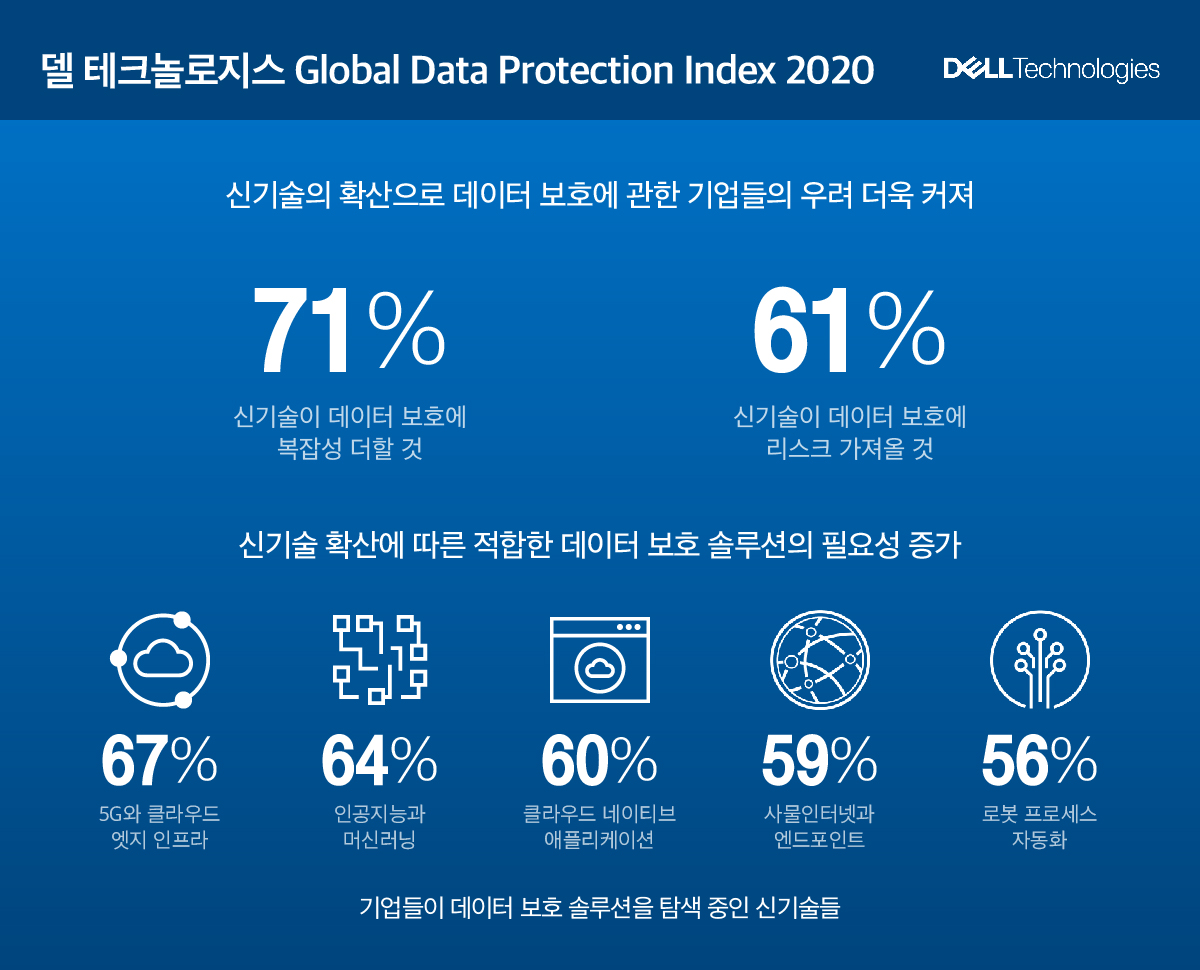
Companies also predicted that new technologies would present new challenges to data protection. Seventy-one percent of companies surveyed predicted that new technologies would add complexity to data protection, while 61% predicted that new technologies would introduce risks to data protection.
Additionally, more than half of companies utilizing new technologies are struggling to find new data protection solutions suitable for specific new technologies, with ▲5G and cloud edge infrastructure (67%), ▲AI/ML (64%), ▲cloud native applications (60%), ▲IoT and endpoints (59%), and ▲robotic process automation (56%) taking up a high response rate among various new technologies.
Finding a data protection solution that fits the changing corporate IT environment is likely to become increasingly difficult over time. A staggering 81% of companies surveyed said their current data protection solutions won't be able to meet all of their future business needs.
Additionally, 69% of surveyed companies pointed out ‘successfully recovering data from cyberattacks’ as the ‘most challenging data protection area’, and many companies also found difficulties in areas such as ▲completely recovering lost data (64%), ▲compliance with national and local data governance (62%), and ▲meeting backup and recovery service level objectives (62%).
More and more companies are adopting the cloud to protect their workloads.
Research shows that more and more companies are adopting the cloud to better secure new workloads, including containers, cloud native, and SaaS applications, along with new application deployments.
Among all surveyed companies, 43% responded that they prefer 'public cloud/SaaS' as the environment for application deployment, followed by 'hybrid cloud' (42%) and 'private cloud' (39%).
As enterprises increasingly adopt the cloud, delivering optimized data protection solutions is becoming a critical challenge for data protection vendors. Eighty-five percent of surveyed companies cited "protecting cloud-native applications" as the most critical and important task that determines the performance of data protection vendors.
Additionally, as large amounts of corporate data are created or passed through edge environments, a growing number of companies are opting for cloud-based data backup methods. 62% of surveyed companies have adopted private cloud as a means to manage and secure data generated at the edge, while 49% have chosen public cloud.
Comments
Related news
.jpg)
"IDC Becomes 8 Times Faster": ETRI Develops 400G Optical Transceiver Engine
A 400G optical transceiver engine and photonic device technology for large-scale data centers have been developed by domestic researchers. ETRI researchers have developed an optical transceiver engine capable of total 400Gbps data transmission by integrating four laser diode devices enabling 100Gbps-class transmission per channel with 4x faster transmission speed compared to existing solutions, along with photodetectors, optical transmission modules, and optical reception modules.
2020.03.26by 이수민 기자
.jpg)
Ministry of Science and ICT Launches Integrated Data Map Service for Data Platforms in 10 Fields
The Ministry of Science and ICT and the Korea Information Society Development Institute will implement an integrated data map service for a big data platform that enables unified search of data across 10 sectors including finance, environment, culture, transportation, healthcare, distribution, telecommunications, small and medium enterprises, regional economy, and forestry starting on the 31st. The general public will now be able to conveniently access analytical data related to specialized fields and social issues.
2020.03.30by 최인영 기자
73 billion won in support for data voucher and MyData demonstration projects.
The Ministry of Science and ICT will launch recruitment for major data utilization projects in 2020, including data vouchers and MyData business initiatives, starting from March 30th to revitalize the data economy. This year, following amendments to the Data Act, the ministry will fully implement data utilization projects to strengthen the competitiveness of small and medium-sized enterprises and small business owners across various industry sectors while accelerating the transition to a data economy.
2020.03.30by 최인영 기자
.jpg)
SalePoint Signs Multi-Year Partnership Agreement with AWS… Promoting Identity Security that Integrates Even AI Agents
Sailpoint has entered into a multi-year strategic partnership agreement with AWS and is moving forward with establishing an integrated governance system that manages both human and non-human identities together. The plan is to consistently manage access permissions in an environment where AI agents are increasing as work execution entities, while applying the principle of least privilege and automated policy enforcement. The two companies plan to jointly expand capabilities to manage the identities of various entities, including AI agents, within a single layer in the AWS environment. This collaboration is interpreted as a move to design security and governance together in corporate environments where AI adoption is expanding.
2026.03.26by 배종인 기자
.png)
Databricks Unveils Open AI Security Monitoring 'Lakewatch'
Databricks entered the security market on March 24 by unveiling LakeWatch, an open-source agentic SIEM. The core functionality of this product is to integrate and analyze security, IT, and business data in a single environment to support AI-based threat detection and investigation. The company explained that it reduces the limitations of existing security operations centers, which have had to forgo some data due to high cost structures, and enables large-scale data analysis and automation based on open formats and ecosystems. LakeWatch is currently offered as a private preview, with Adobe and Dropbox mentioned as early customers. Databricks also announced an expanded partnership with Anthropic as well as the acquisition of Antimatter and SiftD.ai.
2026.03.26by 배종인 기자











