



Will 2020 truly be the first year of 5G? 5G SA commercialization and 28GHz network deployment expected within the year.
 Published2020.04.09 09:24
Investing 650 billion won in fostering strategic 5G industries.
In the post-COVID-19 era, 5G will become a growth engine.
On the 8th, the government held the 3rd inter-ministerial public-private joint 5G+ strategy committee via video conference. The Ministry of Education and the Ministry of National Defense participated in this committee for the first time.
The first Strategy Committee meeting of the year reviewed the efforts of the public and private sectors over the past year to commercialize the 5G network, reviewing scattered challenges and presenting agenda items including reports on private sector initiatives and plans (telecommunications companies and manufacturers), the current status of 5G+ strategy implementation, and future plans (government).
Private sector achievements and future plans
5G subscribers surpassed 5.77 million in just one year since its commercialization, and 115,000 base stations have been built.
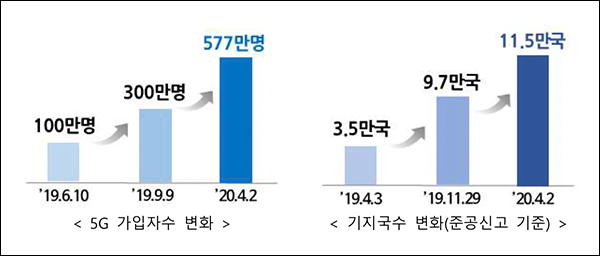
Going forward, telecommunications companies have decided to increase their network investment in the first half of the year by approximately 50%, from 2.7 trillion won to 4 trillion won, to overcome the economic crisis caused by COVID-19, and to provide approximately 420 billion won in support to small businesses and merchants.
To improve service quality, telecommunications companies are expanding coverage by installing 5G indoor base stations in over 2,000 facilities, including subways, airports, department stores, and small and medium-sized buildings.
Additionally, the company plans to commercialize 5G standalone (SA) and build a 28 GHz band network within this year.
Terminal manufacturers plan to release mid- to low-priced 5G terminals.
5G+ Strategy Implementation Status and Future Plans
In order to fully foster the 5G+ strategic industry, the government will invest approximately 650 billion won in the budget and develop convergence services. To accelerate the discovery and expansion of new businesses, we plan to establish a continuous inspection system along with regulatory innovation and the discovery of new businesses to accelerate the creation of results.
First, the government announced its 2020 goals and key plans for each of the 15 major 5G+ strategic industries.
▲ Fields with technology such as network equipment, next-generation smartphones, wearable devices, information security, realistic content and VR/AR devices, and smart factories aim to expand their global market share.
△Future drones △5G V2X △autonomous vehicles △smart cities △digital healthcare, etc. Fields with established foundations are targeted for commercialization. In particular, 5G V2X is planned to be commercialized in 2024, and autonomous vehicles (level 4 or higher) are planned to be commercialized in 2027.
▲Intelligent CCTV ▲Connected robots ▲Edge computing, and other areas requiring technological development will establish a verification base and move toward technological advancement.
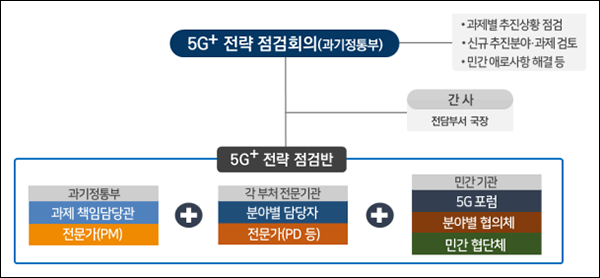
In order to continuously promote the 5G+ strategy, the existing task execution system centered on the Ministry of Science and ICT will be reorganized, and an inspection team will be formed and operated with the participation of specialized agencies from each ministry and public and private organizations.
The inspection team, which will be operated under the chairmanship of the Director of the Information and Communication Policy Bureau of the Ministry of Science and ICT, is planned to be formed within the first half of the year with the Ministry of Science and ICT's responsible officer, officials from specialized agencies of each ministry, experts, and private organizations.
Finally, to achieve and expand the results of the 5G+ strategy, we plan to pursue new projects in 2021, including the development, verification, distribution, and expansion of 5G terminals and services, through inter-ministerial cooperation.
Currently, projects underway include the development of 'Doctor Answer 2.0', which can quickly diagnose and analyze major infectious disease symptoms and diseases such as high blood pressure, diabetes, fever, and abdominal pain, as well as the development of core technologies for fully autonomous driving, such as autonomous driving data collection and processing, vehicle communication, and security.
The projects currently being planned will be finalized after going through the Ministry of Strategy and Finance's budget review process within the year.
Several private members who participated in the discussion said that there are difficulties in the field, such as decreased sales and difficulties in procuring parts due to COVID-19.However, in the post-COVID era, where remote work, telecommuting, and non-face-to-face medical treatment will become the norm, the company said it expects new growth opportunities through aggressive expansion of 5G infrastructure and discovery of various non-face-to-face services.
The government plans to supplement and concretize the "Implementation Plan for Fostering 5G+ Strategic Industries," including an analysis of the impact of COVID-19 on the 5G industry, based on the results of the discussion and the operation of the 5G+ Strategy Inspection Team.
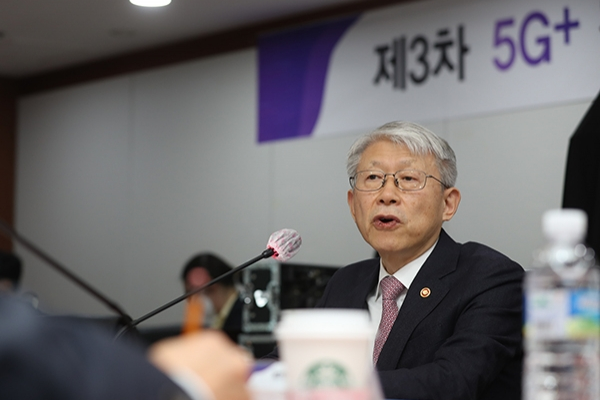
Minister Choi Ki-young of the Ministry of Science and ICT, who is the chairman of the committee, said, “It has already been a year since we commercialized 5G for the first time in the world, but there are still many shortcomings for the public to feel the change,” and added, “We will create concrete results early and overcome the current economic crisis caused by COVID-19 with the 5G+ strategy.”
Comments 1
1 Comments:
Related news

Ministry of Science and ICT and KISA Promote Security Enhancement Project for 5G+ Core Services
Cybersecurity threats are extending into traditional industries, making preemptive prevention necessary. The Ministry of Science and ICT and KISA announced that they will be implementing the 5G+ Core Service Security Enhancement Project. Through this initiative, security improvement measures for each 5G+ core service will be established, and security models containing implementation methods for convergence security technologies applicable to each service will be developed.
2020.03.19by 이수민 기자

How to determine and detect the effects of 5G waves on the human body?
The radio wave characteristics of 5G are significantly different from those of previous generation networks. Organizations such as ITU and IEC are continuously presenting methods for evaluating the impact of electromagnetic fields generated by 5G equipment on the human body. Developers must be familiar with these methods in order to rapidly bring 5G-related products to market in the future.
2020.03.31by 이수민 기자

[1st Anniversary of 5G Commercial Service] What Path Has Been Taken and What Path Will Be Next?
April 3, 2020 marks exactly one year since the world's first commercial 5G service was launched in our country. We comprehensively review the path our country has taken over the past several years to foster the 5G ecosystem and reflect on the future ahead.
2020.04.03by 이수민 기자
ESP32 Development Environment Selection and GPS Application Implementation
The ESP32 is a microcontroller that integrates Wi-Fi, Bluetooth, 12-bit ADC, capacitive touch, PWM, DAC, and UART in a single SoC. However, the abundance of features does not by itself solve the designer's problems. The real challenges lie in selecting the appropriate development environment, determining which pins can be used and which must be avoided, and converting raw data from modules into usable information. This document addresses ESP32 peripheral constraints (ADC2 and Wi-Fi coexistence limitation, UART1 occupancy, ADC non-linear regions), the trade-offs between Arduino IDE and ESP-IDF, and the process from connecting NEO-6M/NEO-M8N GPS modules to UART2, parsing NMEA sentences, and visualizing routes in Google Earth, all organized based on documented references.
2026.10.12by 편집부

[e4ds Tech Day 2026 ⑨] Sim Sang-gyu, Autocrypt CTO: "In the Physical AI Era, Automotive Security Must Extend Beyond the Vehicle"
At e4ds Tech Day 2026, Sim Sang-gyu, CTO of Autocrypt, explained automotive cybersecurity strategies in the era of Physical AI and SDV (Software-Defined Vehicle). Automobiles are evolving as part of an ecosystem connected to AI, cloud, chargers, IoT, and robots, and he emphasized that the scope of security must expand beyond the vehicle interior to the entire connected environment. In particular, AI model tampering, adversarial attacks, OTA updates, and EV charger hacking were identified as major threats. He explained that response measures require zero trust, AI model integrity protection, intrusion detection, Security by Design and Default, and full lifecycle security management, and that proactive security system establishment beyond regulatory compliance is critical for securing future mobility competitiveness.
2026.10.12by 배종인 기자












안녕하세요.