


Domestic ICT Market Growth Rate Downward Adjusted Due to COVID-19
 Published2020.04.19 08:41
Concerns over negative growth if COVID-19 persists until the third quarter
The spread of contactless culture will contribute to growth recovery in the second half of the year
IDC Korea announced on the 14th that it has lowered its forecast for the domestic ICT market growth rate to 2.4% compared to the previous year, publishing the 'Korea ICT 2020 Market Outlook Report' in response to the impact of COVID-19.
As the economic slowdown caused by COVID-19 spreads, ICT spending is also expected to be adjusted downward due to corporate emergency management systems and short-term cost-cutting measures.
The report presented two scenarios expected based on the impact of COVID-19.
The most likely scenario is that the spread of COVID-19 subsides during the second quarter. In this case, the domestic ICT market is expected to grow by only 2.4% year-on-year. This is a downward revision from the previous forecast of 3.1%.
If the COVID-19 situation persists until the third quarter and the aftermath of the economic recession is prolonged, the growth rate is expected to fall further to 0.5% year-on-year.
Looking at the IT market alone, this year's growth forecast has been lowered from 4.0% to 2.5%, and in the worst-case scenario, it is predicted to contract by as much as -1.2%.
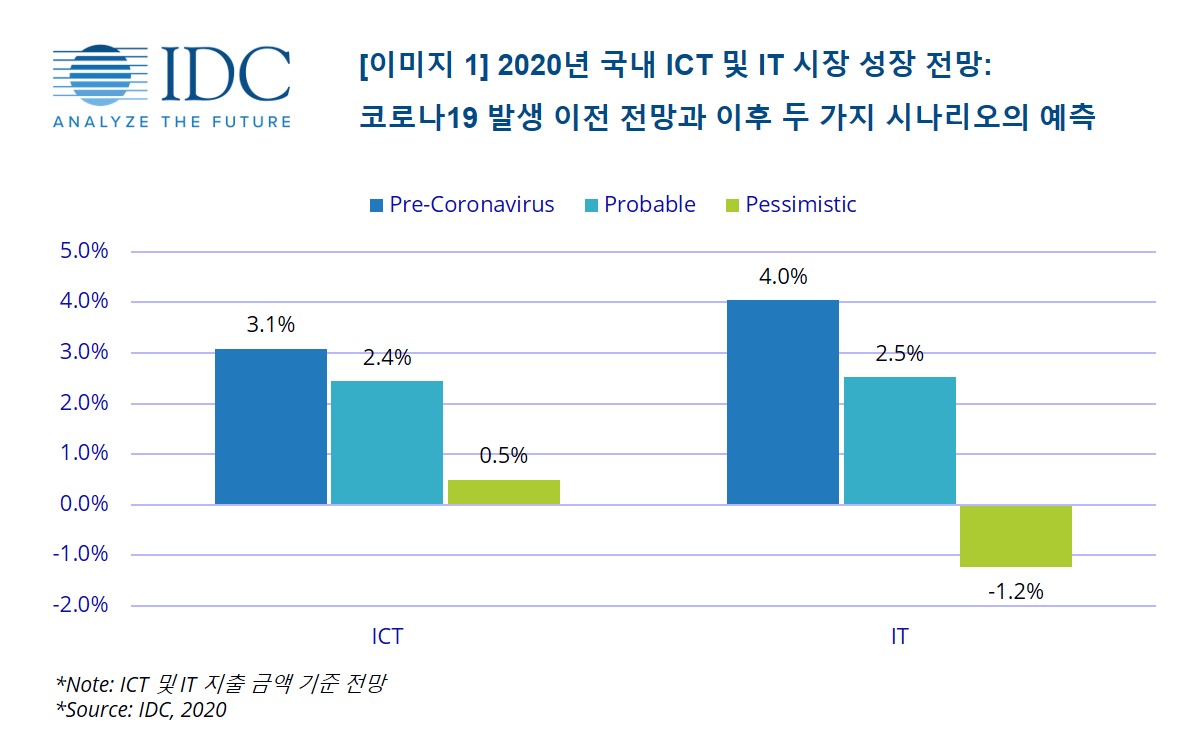
[Graph = IDC Korea]
According to the most likely scenario, when examining IT market segments based on ICT spending, the device sector, including PCs and smartphones, appears likely to face direct downward pressure.
Adjustments in the data center hardware sector are also expected due to investment delays. On the other hand, pressure for a slowdown in growth in the IT services and software sectors is expected to be relatively mild, even as the COVID-19 situation is reflected.
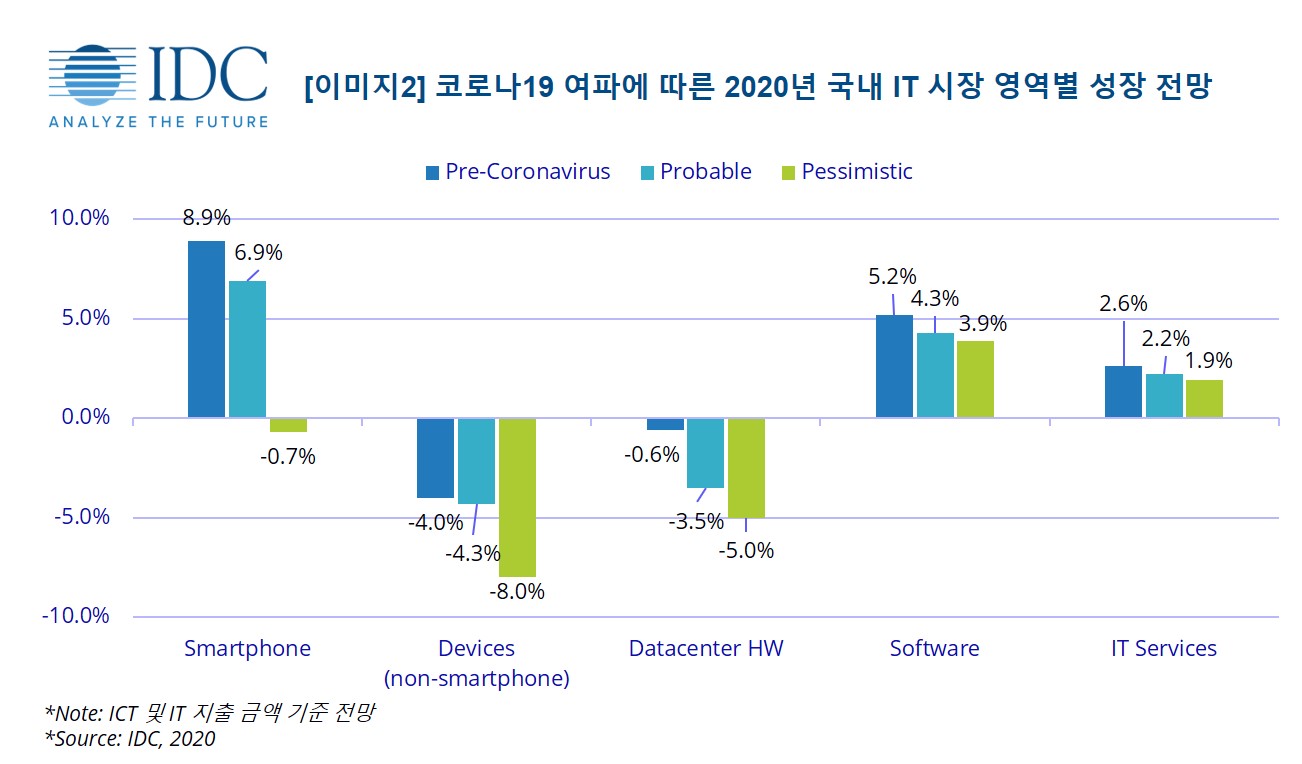
Growth forecast by sector [Graph = IDC Korea]
The device sector excluding smartphones is expected to decline by 4.3% year-on-year. While the market slowed in the first quarter due to the combined effects of the end of Windows 10 migration and the COVID-19 situation, centered on the PC market, the situation is expected to improve in the second half of the year as online channels become more active and the transition to laptops accelerates.
Although the smartphone sector is expected to show relative growth compared to other device sectors, despite a slight slowdown in operators' aggressive moves to secure a leading position in the 5G market in 2020. However, based on shipment volume, the smartphone sector is also expected to shift to a market downturn, declining by 5.9% year-on-year.
While the enterprise computing hardware sector, such as servers, storage, and network equipment, was basically affected by the COVID-19 situation on the supply side, overall enterprise computing hardware is estimated to decline by 3.5% in 2020 compared to the previous year.
On the other hand, the software sector is expected to show relative growth even amidst a downward revision to 4.3% compared to the previous year. This is because while new demand is decreasing, the demand for collaboration solutions such as video conferencing and enterprise messengers is increasing, and the adoption of cloud-based applications is expanding.
The IT services market is expected to be affected by the trend of delayed new investments in the first half of the year, but with demand for operations and support services remaining, the overall market is projected to show a limited downward adjustment of 2.2% compared to the previous year.
Han Eun-sun, Managing Director at IDC Korea, stated, “The impact of COVID-19 across industries will result in a downward adjustment of IT spending in major sectors, including manufacturing, as the combination of reduced consumer demand, the postponement of corporate technology investments, and supply chain risks.”
At the same time, stating that growth opportunities exist even in a crisis situation, they said, “The trend of spreading ‘Untact’ culture is leading to increased investment in non-face-to-face channels and work environments, and coupled with new demand in next-generation technology areas such as big data analysis, AI, IoT, and edge computing, it will contribute to the recovery of growth in the second half of the year.”
Comments
Related news
Increased demand for video conferencing due to COVID-19… Cisco Webex usage doubles compared to pre-pandemic levels
Cisco Systems announced that usage of Cisco Webex, its video conferencing solution, is increasing due to the COVID-19 pandemic, and enterprise adoption of cybersecurity solutions is also surging. Webex has recorded growth of 3.5 times in Asia-Pacific, 2.5 times in the Americas, and 4 times in Europe, as demand has risen with the recent spread of COVID-19.
2020.04.09by 이수민 기자

South Korean smartphone market continues to decline due to COVID-19 pandemic
The domestic smartphone market is expected to continue its downward trend. IDC announced that total smartphone shipments in the domestic market in 2019 reached approximately 17.06 million units, declining 5.9% year-over-year. Additionally, IDC forecasted continued market contraction in the first half of 2020 due to the impact of COVID-19.
2020.04.13by 이수민 기자

Global PC shipments decline due to COVID-19 pandemic.
Global PC shipments in the first quarter of 2020 totaled 56.1 million units, representing a 12.3% decrease compared to the same period last year. The global PC market, which had shown three consecutive quarters of growth, recorded its sharpest decline since 2013 due to the outbreak of COVID-19.
2020.04.14by 이수민 기자

ESP32 Development Environment Selection and GPS Application Implementation
The ESP32 is a microcontroller that integrates Wi-Fi, Bluetooth, 12-bit ADC, capacitive touch, PWM, DAC, and UART in a single SoC. However, the abundance of features does not by itself solve the designer's problems. The real challenges lie in selecting the appropriate development environment, determining which pins can be used and which must be avoided, and converting raw data from modules into usable information. This document addresses ESP32 peripheral constraints (ADC2 and Wi-Fi coexistence limitation, UART1 occupancy, ADC non-linear regions), the trade-offs between Arduino IDE and ESP-IDF, and the process from connecting NEO-6M/NEO-M8N GPS modules to UART2, parsing NMEA sentences, and visualizing routes in Google Earth, all organized based on documented references.
2026.10.12by 편집부

MIPI CSI-2, DSI-2, C-PHY, D-PHY Test Solution Technical White Paper
The MIPI interface adopts a burst mode that transitions between low-power (LP) and high-speed (HS) states for low-power consumption, and in return, strict timing rules are imposed on state transitions. Additionally, the high-speed section operates as a packet-based protocol with headers, ECC, and CRC, so verification engineers must handle waveforms and protocols simultaneously. Traditional configurations combining general-purpose oscilloscopes and AWGs reveal limitations in setup complexity, measurement uncertainty, and lack of reproducibility when faced with these requirements. This white paper, based on webinar materials, organizes the structure of this problem and describes how the SV5C-DPTXCPTX generator for receiver testing and SV5C-DPRXCPRX analyzer for transmitter testing integrate state transition testing, stressed eye testing, and protocol analysis into a single bench, along with their application boundaries.
2026.10.12by 편집부











