



Start of supply of MEMS-based inertial measurement device 'ADIS16507'
 Published2020.04.21 16:45
Uses a 3-axis gyroscope and a 3-axis accelerometer
Mouser Electronics announced today that it is now stocking the ADIS16507 precision inertial measurement unit (IMU) from Analog Devices (ADI).
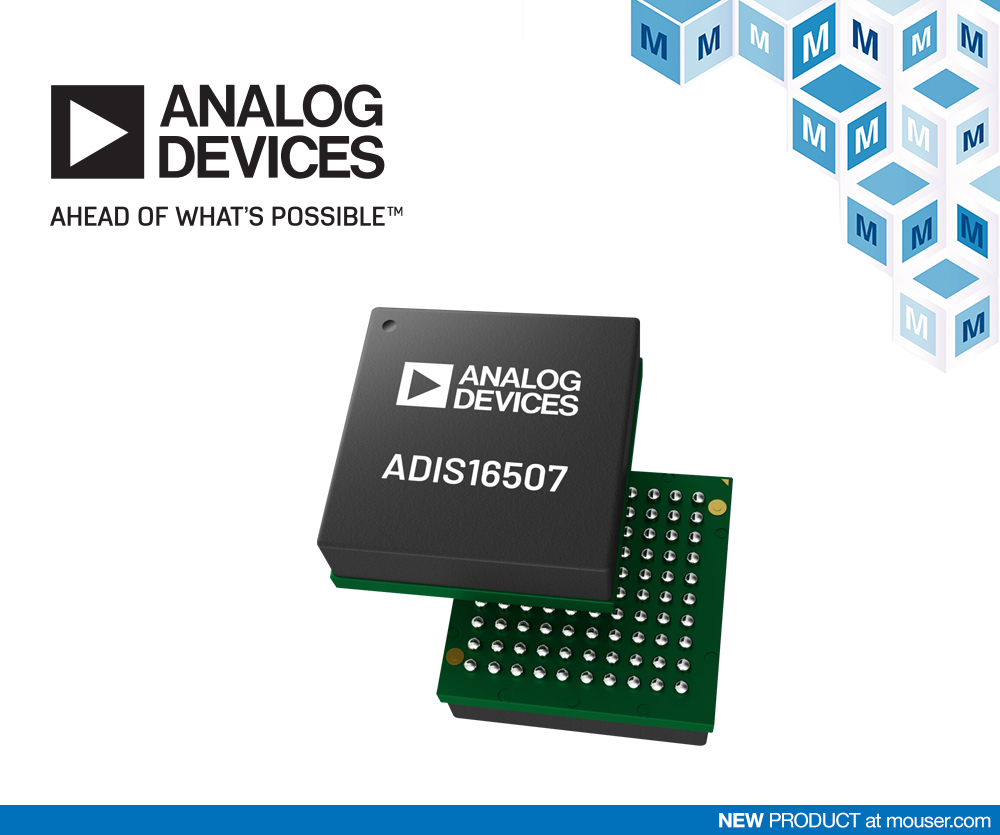
The ADIS16507, part of the ADI MEMS (Micro-Electro-Mechanical System) IMU line, features multi-axis inertial sensing capabilities and is suitable for industrial systems, IoT applications, unmanned aerial vehicles (UAVs), smart farms, autonomous vehicles, AR, and VR.
The ADIS16507 IMU implements 6 Degrees of Freedom (DoF) sensing using a MEMS-based 3-axis gyroscope and a 3-axis accelerometer, enabling the device to accurately detect movement across a wide range of conditions.
The size is 15mm × 15mm × 5mm, and the dynamic range model is ±125, ±500, ±2000 degrees per second. It simplifies inertial frame alignment in navigation systems with strict orthogonal alignment, and the Serial Peripheral Interface (SPI) and register structure provide a simple interface for data acquisition and configuration control.
Each sensor is factory tested and calibrated for bias, alignment, sensitivity, and linear acceleration to ensure accurate measurements through dynamic compensation formulas.
Comments
Related news
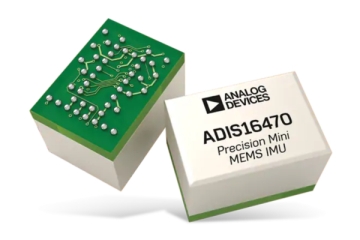
Mouser to Supply ADI Industrial Mini IMUs to Enhance Navigation Performance in IoT Applications
Mouser Electronics supplies Analog Devices' ADIS1647x precision industrial inertial measurement unit. The ADIS1647x IMU, newly added to ADI's MEMS IMU product family, improves navigation performance and stability in IIoT and IoT applications, unmanned aerial vehicles, smart agriculture, and autonomous vehicles. The device can also be used in devices being developed in the growing VR and AR markets.
2019.01.25by 이수민 기자
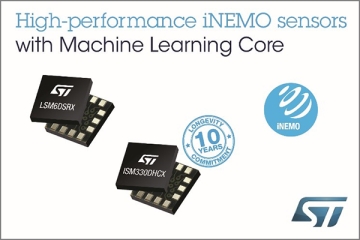
ST Launches 6-Axis Inertial Measurement Unit with 'Machine Learning Core'
ST has launched the industrial ISM330DHCX and consumer LSM6DSRX 6-axis iNEMO inertial measurement units (IMUs). ST stated that it is extending the benefits of machine learning core (MLC) technology for motion detection to both industrial and consumer applications. The MLC performs simple AI preprocessing of motion data using approximately 1/1000 of the power that a typical MCU would consume to handle the same task.
2020.03.17by 이수민 기자
.jpg)
KT measures rooftop 5G base station information using AR.
KT announced that it has developed a base station twin solution that measures remote 5G base station construction information using AR technology. Base station twin is a technology that analyzes AR screen data from a 5G base station and IMU sensor values embedded in a smartphone through a pose estimation server to derive the inclination angle, directional angle, and installation height values of the base station installed on-site.
2020.03.20by 이수민 기자

Intel Unveils Next-Generation 'Core Ultra Series 3' and vPro Platform for Enterprise PCs
Intel has officially unveiled the "Intel Core Ultra Series 3" for next-generation enterprise PCs and the latest vPro platform, addressing a wide range of demands from enterprise notebooks to high-performance workstations.
2026.03.26by 배종인 기자

ROHM Launches ESD Protection Diode Compatible with High-Speed Interfaces of 10Gbps or Higher
Semiconductor specialist ROHM has developed the 'RESDxVx series' of ESD (electrostatic discharge) protection diodes capable of responding to next-generation high-speed data communication environments exceeding 10Gbps, simultaneously enhancing both signal quality maintenance required in high-speed interfaces and IC protection performance.
2026.03.26by 배종인 기자











