



ST launches two CMF grades meeting ISO10605 and AEC-Q101
 Published2020.04.29 11:22
Integrated low clamping voltage and transient-suppression diodes
Capable of preventing interference with wireless communication equipment
ST Microelectronics launched the ECMF04-4HSM10Y and ECMF04-4HSWM10Y, automotive-grade common-mode filters (CMF) for high-speed serial buses, on the 29th.
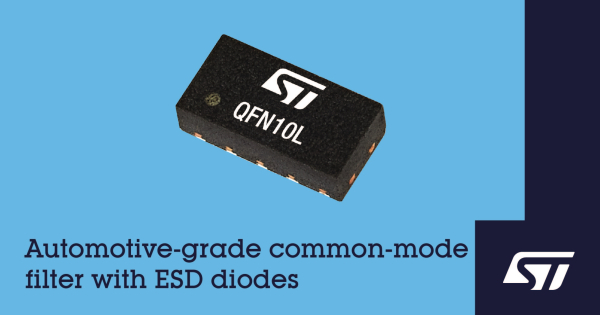
[Photo=ST Microelectronics]
The new products integrate low clamping voltage and transient-suppression diodes to protect interface ICs.
Both devices are CMF with automotive-grade certification and automotive surge standard compliance. They have undergone certification and production in accordance with AEC-Q101 requirements, and design and testing have been completed to match automotive surge specifications such as ISO10605.
They can replace discrete common-mode chokes or LTCC (Low-Temperature Cofired Ceramic) devices that are larger in size and do not offer ESD protection capability.
Installed on high-speed data lines for cameras, radar, displays, and multimedia applications, they can prevent interference with wireless communication equipment.
With a footprint of 3.5mm² and height of 0.75mm, they reduce board space, simplify design, and reduce bill-of-materials (BoM) costs.
The ECMF04-4HSM10Y employs 2.2GHz differential bandwidth to suppress common-mode noise in HDMI 1.4 and MIPI connections. It provides deep attenuation of -25dB at 900MHz and -14dB at 1.5GHz, ensuring that radiated noise does not reduce the reception sensitivity of mobile and GPS antennas.
The ECMF04-4HSWM10Y features 3.5MHz bandwidth, extending application scope to LVDS, DisplayPort™, USB 3.1, and HDMI 2.0 buses. It provides attenuation of -30dB at 2.4GHz and -16dB at 5.0GHz, protecting Bluetooth® equipment and V2X (Vehicle-to-Everything) WiFi antennas as well as cellular and GPS systems.
The ECMF04-4HSM10Y and ECMF04-4HSWM10Y are currently in mass production and are supplied in a 2.6mm × 1.35mm QFN10L package. Pricing starts at $0.2 for orders of 1,000 units.
Comments
Related news
How to implement a vehicle gateway for next-generation cars?
Automotive architecture is now pursuing fully autonomous vehicles. High-speed processors and networks for automotive electronics enable capabilities that vehicles previously could not achieve. Therefore, automotive manufacturers need to reassess vehicle gateway and TCU systems.
2020.03.31by 이수민 기자
Automotive cameras require ASIL-rated power protection
Automotive cameras play a critical role in vehicle safety, making it essential to ensure power supply and operational reliability. Therefore, compliance with automotive safety integrity level, or ASIL, must be considered.
2020.04.06by 이수민 기자
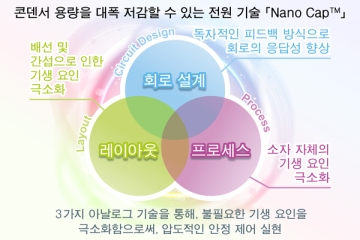
ROHM Establishes 'Nano Cap' Technology to Drastically Reduce Capacitance
Rohm has established 'nano cap' technology that enables stable control even when external capacitor capacity in various power circuits for automobiles and industrial equipment is extremely small, measured in nF. Linear regulators with nano cap stabilization control technology applied do not require output-side capacitors and can stabilize operation with only a 100nF capacitor, thereby reducing circuit design burden.
2020.04.20by 이수민 기자
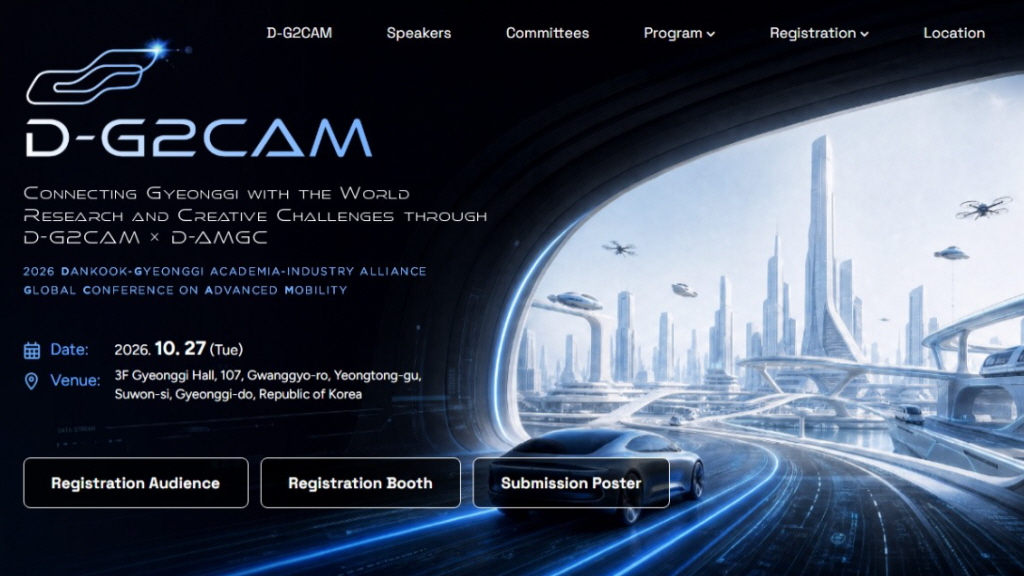
GAIA-Festa 2026, Autonomous Driving, AI, and Aerospace Experts Gather…Discussing Global Cooperation in the 'Silicon Intelligence Era'
GAIA-Festa 2026, which will be held in Suwon on October 27, is an industry-academia-research exchange event that explores the present and future of future mobility and AI technology through the global conference D-G2CAM 2026 and the international contest D-AMGC 2026. Domestic and international experts will share the latest research in autonomous driving, 5G/6G mobility, space technology, and data protection fields, while university students will showcase robots and physical AI prototypes that they have independently developed. Additionally, through poster presentations, corporate exhibitions, international cooperation meetings, and signing ceremonies, a platform will be established to connect the research capabilities and industrial needs of the Gyeonggi region with a global cooperation network.
2026.10.13by 배종인 기자
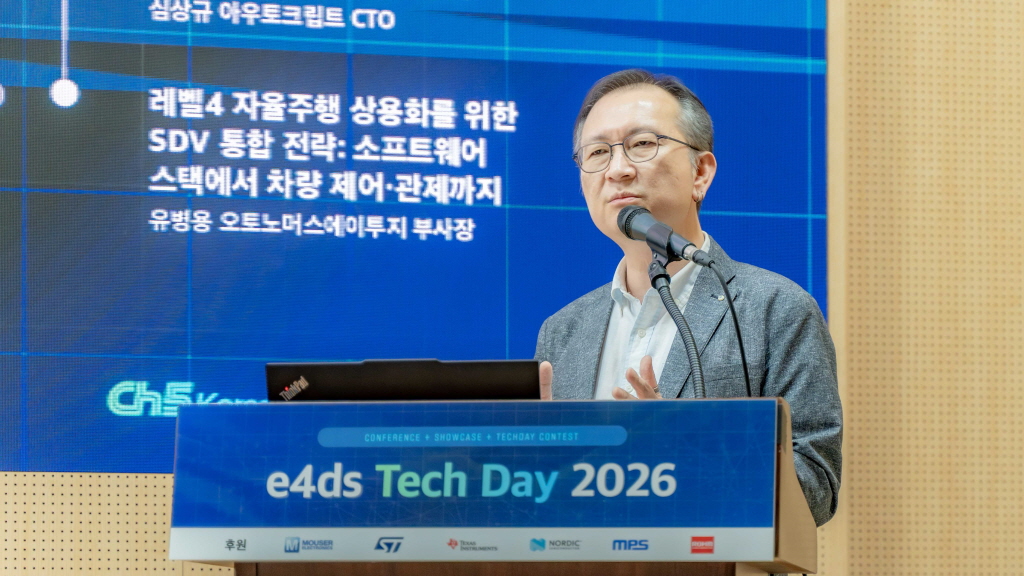
[e4ds Tech Day 2026 ⑨] Sim Sang-gyu, Autocrypt CTO: "In the Physical AI Era, Automotive Security Must Extend Beyond the Vehicle"
At e4ds Tech Day 2026, Sim Sang-gyu, CTO of Autocrypt, explained automotive cybersecurity strategies in the era of Physical AI and SDV (Software-Defined Vehicle). Automobiles are evolving as part of an ecosystem connected to AI, cloud, chargers, IoT, and robots, and he emphasized that the scope of security must expand beyond the vehicle interior to the entire connected environment. In particular, AI model tampering, adversarial attacks, OTA updates, and EV charger hacking were identified as major threats. He explained that response measures require zero trust, AI model integrity protection, intrusion detection, Security by Design and Default, and full lifecycle security management, and that proactive security system establishment beyond regulatory compliance is critical for securing future mobility competitiveness.
2026.10.12by 배종인 기자











