



South Korea’s Smart City Market Faces Challenges and Opportunities Amid COVID-19 Pandemic
 Published2020.05.15 15:52
Mitigating Information Silos That Hinder Smart City Development
Technical improvements are needed due to privacy concerns, etc.
On the 13th, Korea IDC presented the current status of the domestic smart city industry and the market development direction and challenges in response to the COVID-19 pandemic through the 'Domestic Smart City Market Trend Report'.
The report recently described three characteristics of domestic smart cities.
First, the focus of the business has changed from development led by ICT infrastructure suppliers to development of citizen-oriented services. Rather than a top-down approach led by the city government, a bottom-up approach is becoming more common, strengthening the experience of smart citizens and developing cities through consensus across the city.
Second, as the digital transformation movement spreads, the impact of smart cities is growing in that various digital technologies can be integrated and applied to cities that serve as a collection of industries.
Third is the expansion of smart city services into various fields. Starting with U-City, domestic smart cities first developed the most basic infrastructure for urban life, starting with land development, and in the past, they focused on building ICT resources, administration, transportation, and security services.
Recently, along with the advancement of existing services, smart city services are expanding into various areas such as education, culture, administration, citizen participation, smart water, and public health.
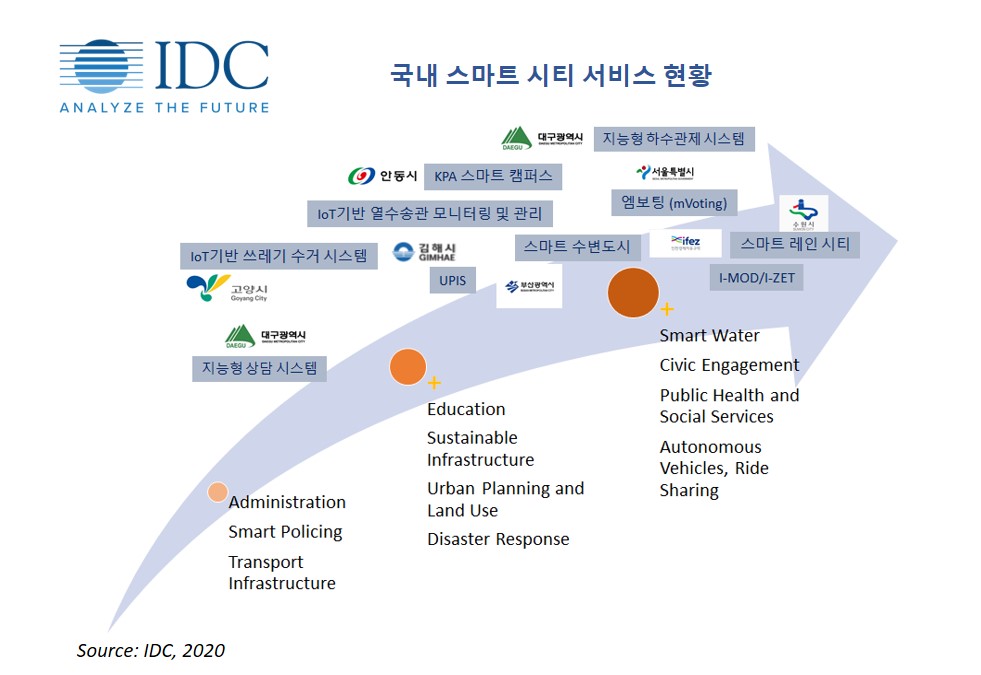
Recently, as each country's response to COVID-19 has become a hot topic, not only establishing a quarantine system, but also establishing a post-COVID-19 plan that responds to changes in the living environment and lifestyle of the entire society is emerging as a new challenge for the smart city industry.
In response to the COVID-19 situation, the Ministry of Land, Infrastructure and Transport in Korea created a COVID-19 epidemiological investigation support system in collaboration with the Ministry of Health and Welfare based on the smart city data hub. The Ministry of Land, Infrastructure and Transport and the Korea Centers for Disease Control and Prevention cooperated in this project, and a cooperative system was established among various stakeholders in the public and private sectors, including the National Police Agency, telecommunications companies, credit finance associations, and credit card companies.
It can be said that this is a good example of building a flexible cooperation system that suits the situation while alleviating the information and inter-organizational silos that have been one of the factors hindering the development of smart cities.
The central government-led information collection and sharing guarantees the protection of personal information, such as the invasion of citizens' privacy, so efforts to secure technological improvements and socio-cultural agreements for information protection by the government, local governments, and related organizations should continue.
Movements responding to changes in urban lifestyles due to COVID-19 are also becoming visible. The contactless trend across society is expected to bring about changes in smart city administration, operation, and overall citizen services.
In addition to the current COVID-19 response efforts in progress in Korea, such as drive-through treatment, robot AI treatment, and AI counselors at public health centers, changes are also becoming visible in general city administration and operations and in the lives of citizens.
The city of Seoul is reviewing external business contest projects through non-face-to-face video business briefings, implementing online education for elementary, middle, and high schools, and increasing the use of micromobility instead of public transportation.
Kim Kyung-min, a senior researcher at IDC Korea, said, “COVID-19 is becoming an opportunity to evaluate the maturity of domestic smart cities,” and added, “While sharing data between organizations to prevent the spread of COVID-19 is creating more advanced smart city services while alleviating silos, it is also highlighting the social issue of privacy invasion.”
He advised, “In addition to preparing for the non-contact trend in the post-corona era, the frequency of infectious diseases caused by unexpected viruses is expected to increase due to climate change and environmental pollution,” and “We should consider building future urban infrastructure and services based on urban resilience.”
Comments
Related news
A 3D National Land Management System will be established by the end of this year
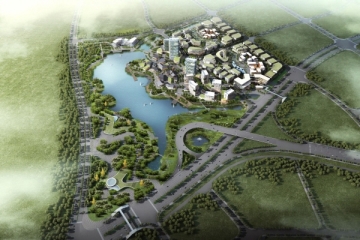
A total of 403.5 billion won will be invested in 3D spatial information construction projects, which are core to emerging growth industries such as smart cities, autonomous vehicles, and data economy. The Ministry of Land, Infrastructure and Transport, along with the Ministry of Economy and Finance, Ministry of Science and ICT, Ministry of Trade, Industry and Energy, and local governments, will finalize the 2020 National Spatial Information Implementation Plan on March 6 and promote nationwide 3D map pilot projects, operation of dedicated national satellites, and expansion of digital cadastral resurvey.
2020.03.06by 최인영 기자

The key to urban mobility is the harmony of four ICT technologies.
Major cities worldwide are collaborating with the private sector to develop intelligent transportation infrastructure, bringing about changes in urban mobility management. Frost & Sullivan anticipates that the performance of smart city mobility systems in the future will be differentiated based on how well they integrate city-wide communication networks, cloud-based data storage, intelligent command centers, and cybersecurity measures.
2020.03.06by 최인영 기자
Smart City Technology-Based COVID-19 Epidemiological Investigation System Launched
With the surge in confirmed COVID-19 cases, epidemiological investigation workload has also increased dramatically, raising the need for computational support systems to rapidly analyze large-scale data. The Korea Disease Control and Prevention Agency, the Ministry of Science and ICT, and the Ministry of Land, Infrastructure and Transport announced that they have developed a COVID-19 epidemiological investigation support system based on the Smart City Data Hub platform and will operate it on a temporary basis starting from the 16th.
2020.03.12by 이수민 기자
Korea Instrument, KOLAS Accredited Calibration Agency First to Simultaneously Acquire ISO/IEC 27,001·27,701
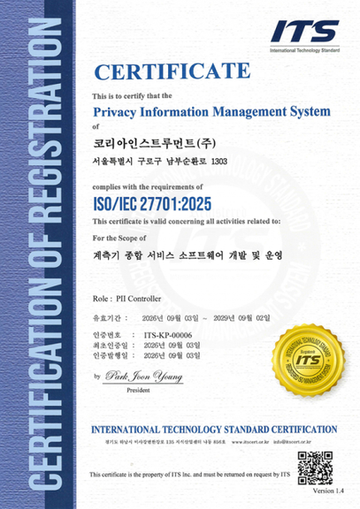
Korea Instrument has become the first among KOLAS accredited calibration agencies to simultaneously acquire ISO/IEC 27,001 and ISO/IEC 27,701 certifications. Through its proprietary platforms CWIZ Enterprise and CWIZ Partners, the company has embedded information security and personal data protection requirements across all business processes including customer information, equipment data, and calibration reports, with plans to continuously advance its management system through regular audits and security inspections.
2026.10.12by 배종인 기자
TeamViewer One, IT Incident Automation Workflow and Resolution Center Enhanced
TeamViewer has added IT incident automation capabilities and an advanced Resolution Center to its integrated digital workplace management platform 'TeamViewer ONE'. Recurrent service disruptions, configuration errors, and capacity shortages are automatically handled according to preset policies, and device status verification through script deployment can be managed in a unified interface, significantly reducing repetitive tasks for IT teams.
2026.10.12by 배종인 기자











