


Sensor technology capable of detecting humidity within approximately 1cm has been developed.
 Published2020.05.18 09:46
660 times more sensitive and 12 times faster than existing sensors
Suitable for COVID-19 prevention, such as elevator buttons
Domestic researchers have developed sensor technology capable of detecting humidity within 1 cm without touching.
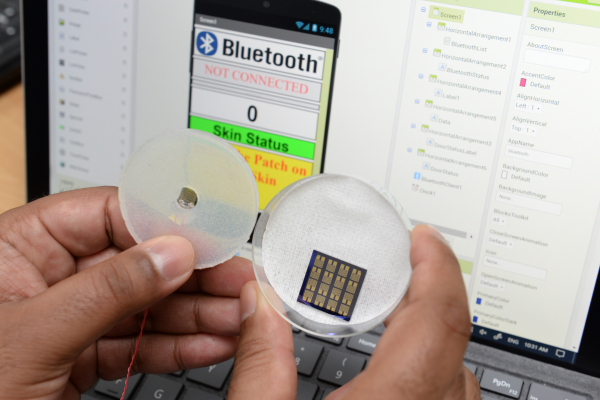
The Electronics and Telecommunications Research Institute (ETRI) announced on the 13th that it has developed high-sensitivity humidity sensor technology using molybdenum disulfide (MoS).
The humidity sensor developed by ETRI has a sensitivity of over 66,000%, which is more than 660 times more sensitive than existing sensors, and a detection time of 0.5 seconds, which is up to 12 times faster than existing commercial sensors.
The research team enhanced sensitivity by coating molybdenum disulfide into nano-sized holes drilled in an anodized aluminum substrate and then dissolving only the anodized aluminum substrate to create a sensor with a honeycomb structure.
When the sensor's constituent material forms a honeycomb structure, the specific surface area capable of detecting moisture increases, thereby enhancing sensitivity. If the sensitivity of the humidity sensor is high, it is also possible to develop a non-contact sensor capable of responding without contact.
The developed device has a size of 5 x 5 mm and can be developed as a patch-type sensor by joining multiple sensors together, and can be utilized in both rigid silicon and flexible devices.
It can be utilized not only in home appliances and industrial electronic devices but also as a radiation sensor for nuclear power plant systems, and is expected to see many applications as a technology related to disease prevention in daily life due to the recent spread of COVID-19.
Dr. Choi Chun-ki of the New Materials Research Lab at ETRI’s ICT Creative Research Institute stated, “We are currently in the process of filing a patent for this technology,” adding, “Since technology transfer is possible immediately, commercialization is possible within two years.”
Comments 1
1 Comments:
Related news
Teledyne Unveils LWIR Camera for Non-Contact Fever Diagnosis
Teledyne DALSA has announced the Caliber GXM, a new long-wavelength infrared (LWIR) camera series. The Caliber GXM series is equipped with a microbolometer sensor featuring a 17μm pixel pitch manufactured at Teledyne DALSA's own foundry, providing high sensitivity in the long-wavelength infrared range.
2020.04.21by 이수민 기자

Smart IoT sensors that “predict and judge” are the key to advanced manufacturing
Smart factories can identify correlations between phenomena and issues occurring at production sites using smart sensors and resolve equipment failures and quality defects. If various sensors and devices are wirelessly integrated to autonomously gather information, and the production system evolves into an AI-based system that analyzes and leverages the collected information, enterprises can establish flexible production systems capable of responding in real time to changes in market conditions and customer demands.
2020.04.21by 이수민 기자

How can we achieve domestic production of smart sensors for the air industry?
The environmental sensor market accounts for approximately 15% of the overall sensor market. In particular, the gas sensor market for air pollutant measurement is estimated to exceed 30 billion dollars by 2027. For domestic companies to establish a strong position in this market, development direction should be oriented toward addressing the limitations of existing air industry sensors.
2020.04.27by 이수민 기자

Intel Unveils Next-Generation 'Core Ultra Series 3' and vPro Platform for Enterprise PCs
Intel has officially unveiled the "Intel Core Ultra Series 3" for next-generation enterprise PCs and the latest vPro platform, addressing a wide range of demands from enterprise notebooks to high-performance workstations.
2026.03.26by 배종인 기자
ROHM Launches ESD Protection Diode Compatible with High-Speed Interfaces of 10Gbps or Higher
Semiconductor specialist ROHM has developed the 'RESDxVx series' of ESD (electrostatic discharge) protection diodes capable of responding to next-generation high-speed data communication environments exceeding 10Gbps, simultaneously enhancing both signal quality maintenance required in high-speed interfaces and IC protection performance.
2026.03.26by 배종인 기자












Untact 동작하는 패널형 디스플레이가 시급할 것 같습니다.