



"Even quantum computers can't solve this problem." LG U+ becomes the first company to apply domestically developed quantum-resistant cryptography technology to its customer network equipment.
 Published2020.06.10 10:15
Quantum cryptography and quantum-resistant cryptography are on the rise.
U+ Becomes First to Apply Quantum-Resistant Cryptography to Customer-Only Network Equipment
In the age of quantum computing, existing cryptographic systems may be vulnerable, necessitating new security technologies. Representative examples include quantum cryptography and the emerging quantum-resistant cryptography technology.
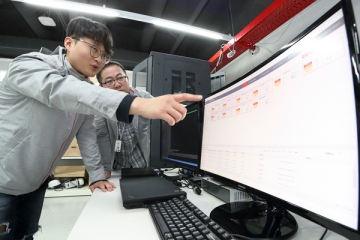
LG Uplus announced on the 10th that it has developed post-quantum cryptography (PQC) technology with Seoul National University's Industrial Mathematics Center and Crypto Lab and applied it to customer-only network optical communication transmission equipment.
.jpg)
Holding the module [Photo = LG U+]
Quantum-resistant cryptography technology enables the provision of security services such as cryptographic key exchange, data encryption/decryption, and integrity verification by utilizing mathematical algorithms that would take billions of years to solve even for quantum computers. It can be implemented using only software without any separate equipment, so it can be applied to everything from mobile phones to small IoT devices.
Last December, U+ signed a business agreement on wired and wireless quantum-resistant encryption with Seoul National University's Industrial Mathematics Center and Crypto Lab, and has been cooperating to develop encryption technology that cannot be broken even by quantum computers.
LG Uplus, the world's first company to apply quantum-resistant cryptography to its customer-only network equipment, plans to apply quantum-resistant cryptography technology to its 5G services and wired and wireless subscriber services to achieve end-to-end security.
Currently, the U.S. National Institute of Standards and Technology (NIST) is conducting standardization work with IBM, Amazon, Google, Microsoft, and others, and research is also being conducted in the OQS (Open Quantum Safe) project, which is a joint project of several IT companies and security research institutes.
The quantum-resistant cryptography technology applied this time is a purely domestic technology developed by Seoul National University and Crypto Lab, and is expected to contribute to the domestic production of next-generation standard cryptography.
Cheon Jeong-hee, director of the Seoul National University Industrial Mathematics Center, said, "Through follow-up research, we will continue to cooperate with the industry to replace electronic encryption, authentication, and signatures with quantum-resistant encryption that is safe for quantum computers, and to commercialize it."
Comments
Related news

Quantum computing at high temperatures possible
Intel and QuTech have published a research paper in Nature demonstrating that qubits, the fundamental units of quantum computing, can be controlled at temperatures above 1 Kelvin. The research also verified that controlling two qubits through a single electron control device can be achieved while maintaining maximum fidelity of 99.3% for each qubit respectively.
2020.04.17by 이수민 기자
Successful 5G data transmission using domestically developed quantum cryptography technology
KT has successfully demonstrated encrypting and transmitting 5G data using quantum cryptography communication technology developed domestically. KT applied its proprietary quantum key distribution system and encryption equipment developed by a domestic small and medium-sized enterprise to the 5G network actually being used by customers in some regions of Gyeonggi Province, in accordance with open hierarchical international standards.
2020.05.11by 이수민 기자
'Galaxy A Quantum' Unveiled, First to Equip Quantum Random Number Generation Chipset
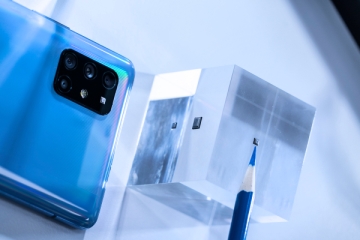
SK Telecom and Samsung Electronics unveiled the 5G smartphone "Galaxy A Quantum" equipped with a quantum random number generation chipset. Inside the quantum random number generation chipset, a CMOS image sensor detects light emitted by an LED light source and extracts random numbers by utilizing quantum randomness. The extracted random numbers are used as encryption keys for T ID dual login, SK Pay biometric authentication protection, and the blockchain mobile electronic certificate service "Initial".
2020.05.15by 이수민 기자
.png)
Databricks Unveils Open AI Security Monitoring 'Lakewatch'
Databricks entered the security market on March 24 by unveiling LakeWatch, an open-source agentic SIEM. The core functionality of this product is to integrate and analyze security, IT, and business data in a single environment to support AI-based threat detection and investigation. The company explained that it reduces the limitations of existing security operations centers, which have had to forgo some data due to high cost structures, and enables large-scale data analysis and automation based on open formats and ecosystems. LakeWatch is currently offered as a private preview, with Adobe and Dropbox mentioned as early customers. Databricks also announced an expanded partnership with Anthropic as well as the acquisition of Antimatter and SiftD.ai.
2026.03.26by 배종인 기자

Kaspersky Unveils Revamped 'NEXT' Combining SOC Integrated Management and AI Analytics
As enterprises increase demand for integrated management and automation in the construction and operation of Security Operations Centers (SOC), Kaspersky has disclosed updates to its B2B security product suite 'Kaspersky Next'. This update expands EPP, EDR, XDR, and SIEM integration through a single console based on OSMP, incorporates AI capabilities such as DLL hijacking detection and suspicious account takeover behavior identification, and includes integration with generative AI assistant tool KIRA. The company stated that in large-scale deployment environments, EDR Expert can reduce resource requirements by up to 30%, and XDR Expert by up to 60%.
2026.03.25by 배종인 기자











