



GitLab Holds First Korea Forum to Unify DevOps Solutions
 Published2020.07.01 16:12
Enterprise customers don't need to pay extra for code security.
Supporting Korean customers with Korean partners such as MegaZone Cloud
On the 1st, GitLab held its first press conference since entering the Korean market last year and announced its plans and ambitions for the Korean market.
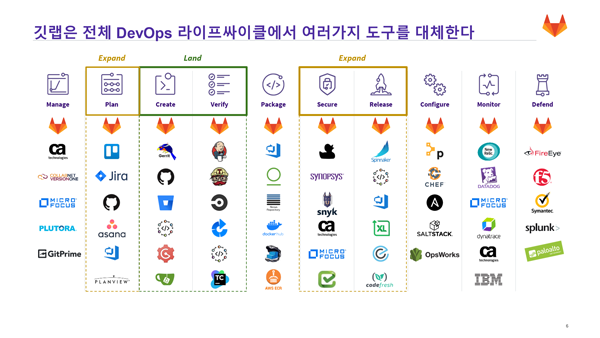
GitLab has implemented the entire DevSecOps lifecycle into a single application. Currently, corporate customers in various fields such as IT, finance, insurance, and oil refining are using GitLab's products for software development, deployment, and real-time monitoring.
Additionally, it provides code static analysis, dynamic analysis, and open source license management functions to enable the practical implementation of the Shift Left concept of checking security from the early stages of development, so corporate customers do not need to spend separately on separate code security tools.
“GitLab has delivered a single DevOps platform that enables customers to successfully deploy across all stages of the DevOps lifecycle,” said Sid Sijbrandij, CEO of GitLab.
“Today’s software DevOps toolchain is complex,” said CEO Seabrandi. “GitLab replaces multiple vendor solutions across the entire lifecycle by converging people, processes, and tools to enable adaptive IT and business agility.”
“It works seamlessly with other solutions such as JIRA and Bitbucket, and can work regardless of team size, composition, or project type,” he continued. “It accelerates digital innovation by shortening software delivery cycles and improves collaboration and productivity by streamlining workflows.”
He added, “It’s also worth noting that we always provide actionable feedback, which allows us to continuously improve the application.”
GitLab directly and indirectly supports four elements necessary for building a cloud-native environment: containers, microservice architecture, continuous integration and deployment (CI/CD), and DevOps. CI/CD and DevOps are areas that GitLab directly supports.
“GitLab is trying to reach more domestic users through direct technical support, domestic technical support partners, and provision of Korean language materials,” said Woo-Sang Lee, director of GitLab Korea’s Korean corporate sales division. “We are working with various domestic partners, including Megazone Cloud, Two Seed, Hanul IT, Slexon, Korea Business Service, Project Research, Softworks, Good Morning I-Tech, and GS ITM.”
Comments
Related news

6 Security Rules to Protect Corporate Assets in the Cloud Era
As the prolonged COVID-19 pandemic drives a sharp increase in cloud adoption and utilization among enterprises, IBM X-Force Security Research has released a cloud security report introducing various forms of cloud security threats. The report cautions that when enterprises adopt cloud services without adequate prior security preparation, responsibility for cloud security can become unclear and risk response becomes difficult to manage.
2020.06.15by 이수민 기자

Ministry of Science and ICT Announces Strategy to Revitalize Domestic Cloud Industry: "Prioritize Adoption of Domestic Cloud Services in Public Sector"
Cloud is drawing attention as a core foundation for data utilization in the AI era and economic revitalization following COVID-19. The Ministry of Science and ICT announced that it has deliberated on and finalized a cloud industry development strategy in preparation for the data economy and AI era. The government has decided to establish and implement a development strategy for revitalizing the domestic cloud industry, with national cloud transformation and strengthening of the cloud industry ecosystem as key objectives.
2020.06.25by 이수민 기자
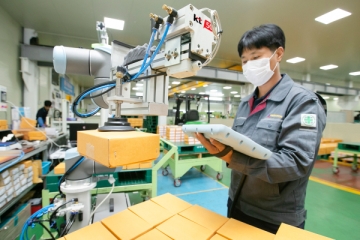
KT Begins Supplying 5G Smart Factory Cobots to Domestic SMEs
KT has established a dedicated 5G network and smart factory cobots at Parkwon, a manufacturer of ultra-precision steel balls used in automotive components. The system enables real-time monitoring of data generated during work processes through a cloud-based Factory Makers platform. The deployed cobots and platform have respectively reduced worker fatigue and enabled real-time production monitoring, thereby enhancing factory productivity.
2020.06.30by 이수민 기자
.jpg)
SalePoint Signs Multi-Year Partnership Agreement with AWS… Promoting Identity Security that Integrates Even AI Agents
Sailpoint has entered into a multi-year strategic partnership agreement with AWS and is moving forward with establishing an integrated governance system that manages both human and non-human identities together. The plan is to consistently manage access permissions in an environment where AI agents are increasing as work execution entities, while applying the principle of least privilege and automated policy enforcement. The two companies plan to jointly expand capabilities to manage the identities of various entities, including AI agents, within a single layer in the AWS environment. This collaboration is interpreted as a move to design security and governance together in corporate environments where AI adoption is expanding.
2026.03.26by 배종인 기자
.png)
Databricks Unveils Open AI Security Monitoring 'Lakewatch'
Databricks entered the security market on March 24 by unveiling LakeWatch, an open-source agentic SIEM. The core functionality of this product is to integrate and analyze security, IT, and business data in a single environment to support AI-based threat detection and investigation. The company explained that it reduces the limitations of existing security operations centers, which have had to forgo some data due to high cost structures, and enables large-scale data analysis and automation based on open formats and ecosystems. LakeWatch is currently offered as a private preview, with Adobe and Dropbox mentioned as early customers. Databricks also announced an expanded partnership with Anthropic as well as the acquisition of Antimatter and SiftD.ai.
2026.03.26by 배종인 기자











