



Seoul National University of Engineering develops tungsten oxide nanofilm display device
 Published2020.07.16 16:27
Development of display devices using nano thin films
No voltage is needed to maintain the color.
Seoul National University College of Engineering announced on the 16th that a joint research team consisting of Professor Lee Byung-ho of the Department of Electrical and Information Engineering, Professor Jung Taek-dong of the Department of Chemistry, and Professor Sun Ho-jeong of Kunsan National University Department of Materials Science and Engineering has developed a display device using tungsten oxide ( WO3 ) nanofilms, an electrochromic material.
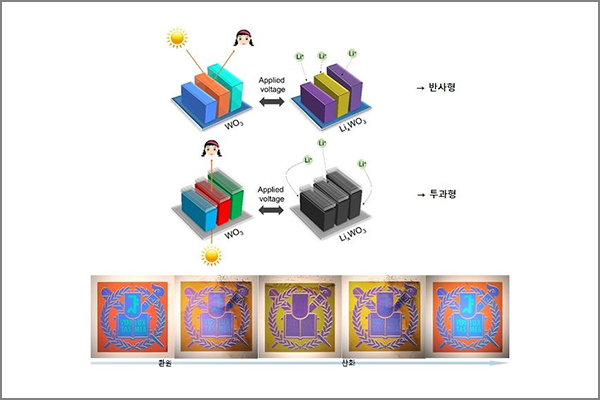
[Image = Seoul National University College of Engineering]
Electrochromism is a phenomenon in which the color of a substance changes due to an electrochemical reaction in response to voltage, and each electrochromic material is known to possess a unique color resulting from oxidation and reduction.
In the case of tungsten oxide, a representative electrochromic material, it changes to a deep blue color when lithium ions are injected into the material through a reduction voltage while it is in a transparent state, and it can return to a transparent state by extracting the lithium ions again through an oxidation voltage.
Although much research has been conducted to utilize this phenomenon, which allows color change with low voltage, in displays, there have been difficulties in expressing various colors and controlling their intensity due to the limitation that the color cannot change to colors other than blue.
To solve these problems, Professor Lee Byung-ho's joint research team developed an optical device capable of various color reproduction and color change by combining nanometer-thick tungsten oxide thin films with semiconductors and metals.
complicationBy creating a tungsten oxide structure stacked layer upon layer on a silicon reflector without using a single structure, various colors of reflected light were reproduced according to the thickness, and an optical information encryption device was fabricated based on the principle that the color of the reflected light changes to a different color through oxidation-reduction voltage, confirming the possibility of its application as a display device.
In addition, by combining a tungsten oxide thin film with a nanometer-thick metal, we succeeded in reproducing a transmissive RGB pixel capable of expressing about 94% of the color gamut used in conventional displays and controlling its intensity with voltage.
The fabricated optical device has a simple stacked structure with a thickness of less than 200 nm and does not require voltage to maintain color, so it is expected to help in the development of low-cost, ultra-thin, and low-power displays.
Dr. Lee Yo-han, who led the experiment, explained, “Through this research, we have taken another step closer to developing full-color display devices using electrochromic materials,” adding that “securing improved device driving reversibility and response speed is key to practical application.”
Meanwhile, this study was published as an online paper on July 6 in 'Nano Letters,' an international academic journal published by the American Chemical Society (ACS).
Comments
Related news
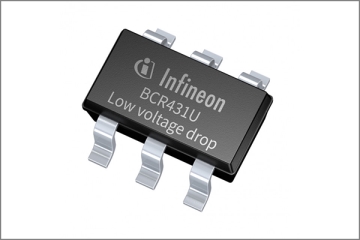
Infineon Unveils BCR431U Constant Current Linear LED Driver IC
Infineon has launched the BCR431U, a constant current linear LED driver IC. The BCR431U provides low voltage drop performance for LED current regulation and is suitable for low-current designs operating at a maximum of 37mA. Target applications include LED strips, channel signs, architectural LED lighting, LED displays, emergency lighting, retail lighting, and residential lighting.
2020.06.10by 강정규 기자
Microchip Announces Two Automotive Ultra-Small Touch Controllers
Microchip announced the MXT288UD-AM and MXT144UD-AM touch controllers. The two devices provide low-power mode, weather-resistant operation, and gloved touch detection capabilities for multifunctional displays, touch pads, and smart surfaces used in various mobility applications.
2020.06.30by 명세환 기자
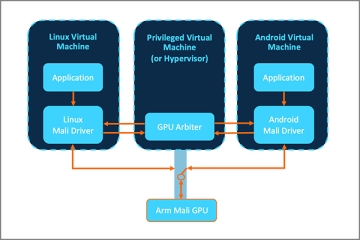
Arm Unveils Mali DDK to Expand In-Vehicle Display Capabilities
Arm has unveiled a new version of Arm Mali DDK to enhance the in-vehicle driver experience. Arm added new virtualization support capabilities to enable GPU resources to be shared among multiple applications running various virtual machines. Mali DDK virtualization is designed to be completely transparent to applications, with all operations executed internally within the driver and system software, so developers do not need to separately modify applications to support it.
2020.07.06by 명세환 기자

Intel Unveils Next-Generation 'Core Ultra Series 3' and vPro Platform for Enterprise PCs
Intel has officially unveiled the "Intel Core Ultra Series 3" for next-generation enterprise PCs and the latest vPro platform, addressing a wide range of demands from enterprise notebooks to high-performance workstations.
2026.03.26by 배종인 기자

ROHM Launches ESD Protection Diode Compatible with High-Speed Interfaces of 10Gbps or Higher
Semiconductor specialist ROHM has developed the 'RESDxVx series' of ESD (electrostatic discharge) protection diodes capable of responding to next-generation high-speed data communication environments exceeding 10Gbps, simultaneously enhancing both signal quality maintenance required in high-speed interfaces and IC protection performance.
2026.03.26by 배종인 기자











