



ETRI develops wearable walking assistance system to improve walking disability
 Published2020.07.23 10:05
Muscle control based on user movements
All physical activities can be assisted
A technology that controls muscles and joints electrically as the wearer desires to assist with daily activities and muscle development has been developed by domestic researchers.
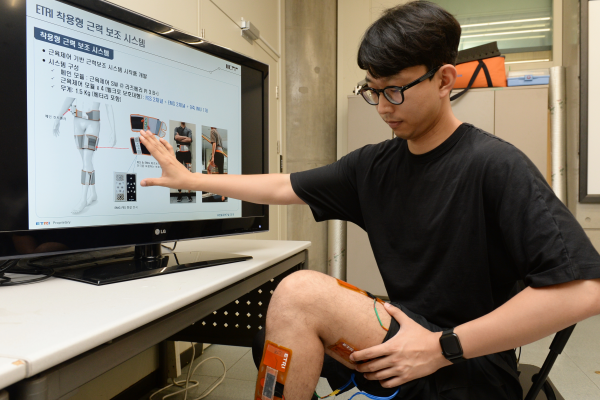
Wearing and inspecting [Photo = ETRI]
The Electronics and Telecommunications Research Institute (ETRI) announced on the 23rd that it has developed a walking assistance system that allows the wearer to move joints as desired by electrically stimulating muscle activity signals generated from the muscles.
By attaching a patch to the desired muscle location and engaging in activity, the system identifies the user's intended movement and naturally controls it, enabling a high degree of freedom and comfort. Applicable to all physical activities, it is expected to be helpful in managing sarcopenia in the elderly, improving mobility in rehabilitation patients, and improving gait disturbances.
Since the muscles in our body contract even with a small amount of electric current, we can induce artificial muscle contraction through electricity.
Low-frequency stimulators, EMS equipment, and physical therapy devices utilize this principle, but their operating times and patterns are pre-programmed. This limits their effectiveness, as they often fail to understand user intent or only allow repetitive movements.
The research team developed a technology that can assist movement by identifying the user's intention in real time from muscle signals and providing microscopic electrical signals (5-35 mA) appropriate for each user to the muscles. This is a method of controlling muscle contraction through electrical stimulation while identifying joint direction and movement intensity from signals generated from muscles when the user moves.
To determine the effectiveness of assisting physical activity, the research team attached the system to eight lower extremity muscles in elderly people and conducted a two-year exploratory clinical trial to improve walking function through a commissioned study with Samyuk University.
The results of the experiment showed improvements in physical function assessment scores when walking and climbing stairs, as well as a decrease in muscle use and energy requirements. The improvements included a 13% increase in walking speed, increased muscle mass, and a marked improvement in ground reaction force, leading to a more normalized gait.
The research team explained that they were able to achieve this result by developing an algorithm that improves the accuracy of detecting spontaneous muscle activation signals among various complex muscle activation signals to 98%.
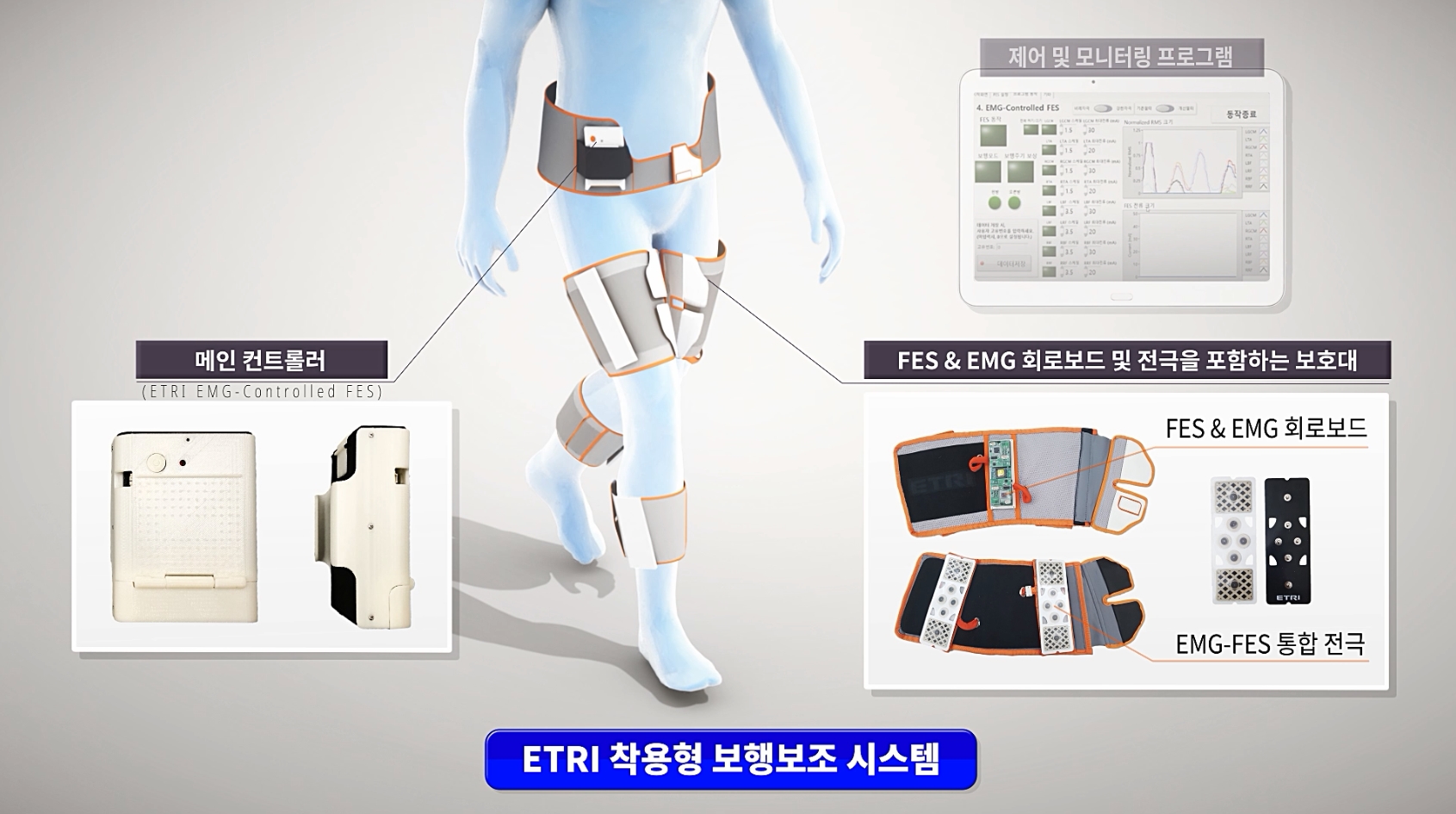
The walking assistance system developed this time is composed of a 17 × 6 cm sized patch that acquires data and instructs calculations and electrical signals, a sensor that senses muscle signals, an electrical stimulation module, and a controller.
It weighs approximately 950g including the battery, making it comfortable to wear. Currently, the electrodes are connected by wires so that they can be attached to the desired location, but in the future, when commercialized, they will also be wireless.
ETRI's Shin Hyeong-cheol, head of the Human Augmentation Research Lab, said, "We plan to research ways to make the developed module lighter and utilize it with artificial muscles for future commercialization."
Meanwhile, the research team plans to collect clinical trial data on exercise conditions and muscles, further refine the results, and pursue technology transfer to relevant companies. They are also conducting research that combines the use of other strength-enhancing and assistive methods, such as wire drive.
Comments
Related news

STMicroelectronics and Fingerprint to Jointly Develop BSoC Solutions
ST Microelectronics and Fingerprint Cards announced that they will collaborate to develop a BSoC solution based on fingerprint recognition technology. Through this partnership, the two companies plan to integrate ST's secure payment technology based on the ST31/STPay chipset and STM32 general-purpose MCU with Fingerprint Cards' T-shaped sensor module to provide a safe, battery-free turnkey BSoC solution to the financial market.
2020.07.13by 이수민 기자
ETRI publishes "Report on Medical AI Technology and Standards for Infectious Disease Response."
ETRI has published a report on "Technical Standardization Trends for Medical AI in Response to Infectious Disease Disasters." The report analyzes AI utilization cases across the entire lifecycle of infectious disease disasters and describes response measures available in the event of future outbreaks. Based on this report, ETRI's Standards Research Division plans to develop international standards for AI technologies necessary for more concrete infectious disease disaster response.
2020.07.15by 강정규 기자

Maxim Unveils Dual-Core MCU to Extend Battery Life of IoT Devices
Maxim Integrated Korea announced on the 22nd the launch of the MAX32666 MCU, which features dual Arm Cortex-M4 processors. The MAX32666 integrates an application processing-dedicated processor with FPU, a separate processor operating as a sensor hub, a standalone BLE 5.2 MCU, and a PMIC. The product is offered in a 3.8mm × 4.2mm WLP package, also reducing the board footprint.
2020.07.22by 강정규 기자

Intel Unveils Next-Generation 'Core Ultra Series 3' and vPro Platform for Enterprise PCs
Intel has officially unveiled the "Intel Core Ultra Series 3" for next-generation enterprise PCs and the latest vPro platform, addressing a wide range of demands from enterprise notebooks to high-performance workstations.
2026.03.26by 배종인 기자

ROHM Launches ESD Protection Diode Compatible with High-Speed Interfaces of 10Gbps or Higher
Semiconductor specialist ROHM has developed the 'RESDxVx series' of ESD (electrostatic discharge) protection diodes capable of responding to next-generation high-speed data communication environments exceeding 10Gbps, simultaneously enhancing both signal quality maintenance required in high-speed interfaces and IC protection performance.
2026.03.26by 배종인 기자











