



Magnetic smart material with redesignable magnetization shape developed
 Published2020.08.03 12:08
Development of magnetic smart materials with redesignable magnetization patterns
Prospects for application in biomedical engineering, flexible devices, soft robots, etc.
It has become possible to create more diverse shapes of magnetic smart materials that move on their own in response to a magnetic field.
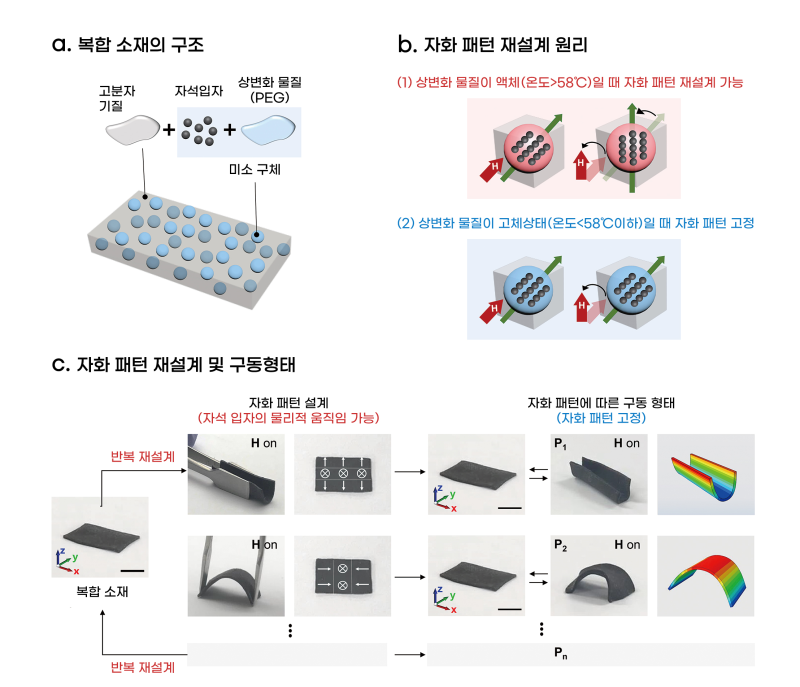
Structure and Principle [Figure = UNIST]
On the 3rd, Professor Jiyoon Kim's research team from the Department of Materials Science and Engineering at UNIST announced that they had developed a magnetic smart material that can change its magnetization pattern in collaboration with Professor Minsang Kwon's research team from the Department of Materials Science and Engineering at Seoul National University.
Magnetic smart materials move through the interaction between the magnetization pattern pre-input inside and the external magnetic field. It utilizes the attractive or repulsive force that occurs when another magnet (magnetic field) is placed on a magnet. The magnetization pattern is a blueprint that determines the strength of the magnetic force and the direction of the N/S pole. Depending on the magnetization pattern, the magnetic smart material bends or folds in a specific direction.
However, once the magnetization pattern is fixed during the material production process, it is not easy to change. This is the reason why magnetic smart materials are not widely used despite their advantages of being able to remotely control movement and responding quickly to external stimuli. The joint research team solved this problem by using a material that changes state depending on temperature.
The developed material has a structure in which micrometer (10 -6 m)-sized granules (magnetic microspheres) containing a mixture of magnetic particles (magnetic material) and a phase change material (polyethylene glycol; PEG) are embedded in a polymer matrix. Because PEG is a phase change material that changes from solid to liquid, it is possible to repeatedly change the magnetization pattern.
Just as a bead in ice is firmly fixed but moves freely in water, the magnetic particles can use an external magnetic field to input a new magnetization pattern because of the phase change material that has become liquid. On the other hand, when the temperature drops to room temperature, the magnetic particles cannot physically move because of the phase change material that has become solid, so the magnetization pattern is fixed.
“The solid-liquid phase change of PEG is a reversible reaction, so the magnetization pattern of soft composite materials can be easily redesigned as much as desired simply by repeating the above process,” explained Song Hyeon-seo, the first author and a researcher in the combined master’s and doctoral program in the School of Materials Science and Engineering at UNIST.
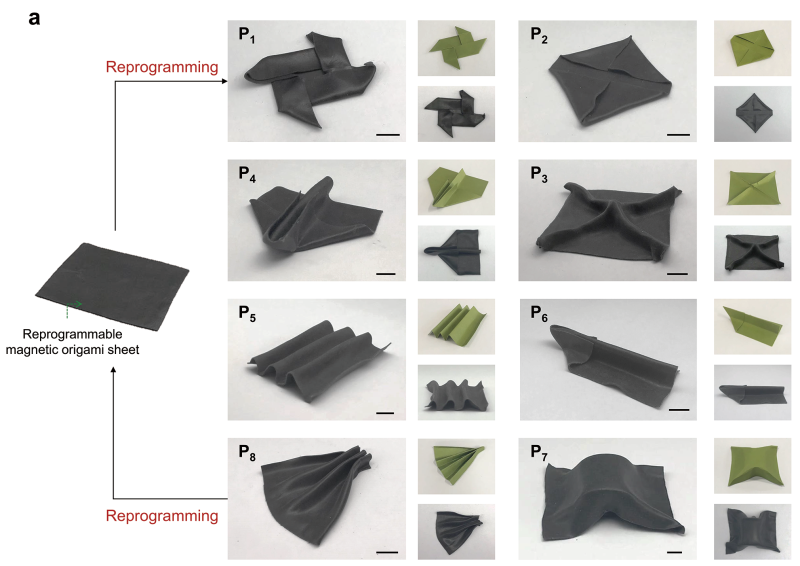
Soft Origami Actuator [Image = UNIST]
The research team also developed a magnetic soft actuator capable of self-folding paper using the developed composite material. The magnetization shape of the actuator was redesigned in situ in an actual operating environment, and various complex three-dimensional shapes were realized by exposing it to a magnetic field. Since it utilizes a reversible reaction, it has the advantage of maintaining the material's performance even if a new magnetization form is repeatedly input to the same actuator.
Professor Kim Ji-yoon explained, “Unlike previous studies, the significance of this study lies in the fact that we have developed a material whose magnetization form can be easily redesigned without changing the inherent characteristics of the magnetic particles or polymer substrate.” He continued, “The material developed this time is also flexible, and will play a role in various fields that require variable-structure smart materials, such as biomedical engineering, flexible electrical devices, and soft robots.”
Meanwhile, this study (Reprogrammable Ferromagnetic Domains for Reconfigurable Soft Magnetic Actuators) was published on July 8 in the prestigious journal in the nano field, Nano Letters. The research was conducted with the support of the National Research Foundation of Korea and the Korea Institute of Industrial Technology Evaluation and Planning.
Comments
Related news
Seoul National University of Engineering develops tungsten oxide nanofilm display device
A joint research team consisting of Professor Lee Byung-ho and Professor Jeong Taek-dong from Seoul National University's College of Engineering, and Professor Seon Ho-jeong from Gunsan National University's Department of Advanced Materials Engineering has developed a display device utilizing electrochromic tungsten oxide nanoscale thin films. The fabricated optical device features a simple stacked structure with a thickness of 200nm or less and does not require voltage to maintain color.
2020.07.16by 이수민 기자

Ceramic nanomaterials with maximized electromagnetic shielding performance have been developed.
With the high performance and high integration of electronic devices, the need for developing lightweight shielding and absorption materials that effectively absorb electromagnetic waves is increasing. A research team led by Gu Jong-min, Center Director at KIST, Kim Myung-ki, Professor at Korea University, and Yuri Gogotsi, Professor at Drexel University in the United States, has successfully developed a titanium-carbon-nitrogen compound MXene electromagnetic wave absorption material that addresses existing electromagnetic interference issues.
2020.07.24by 이수민 기자

Semiconductor packaging materials market projected to grow at an average annual rate of 3.4%.
SEMI cited the latest global semiconductor packaging materials outlook report from TechSearch, a specialized research institute for the electronics industry, and announced that the semiconductor packaging materials market size is projected to grow from $17.6 billion in 2019 to $20.8 billion in 2024, with a compound annual growth rate of 3.4%.
2020.07.29by 강정규 기자

Intel Unveils Next-Generation 'Core Ultra Series 3' and vPro Platform for Enterprise PCs
Intel has officially unveiled the "Intel Core Ultra Series 3" for next-generation enterprise PCs and the latest vPro platform, addressing a wide range of demands from enterprise notebooks to high-performance workstations.
2026.03.26by 배종인 기자

ROHM Launches ESD Protection Diode Compatible with High-Speed Interfaces of 10Gbps or Higher
Semiconductor specialist ROHM has developed the 'RESDxVx series' of ESD (electrostatic discharge) protection diodes capable of responding to next-generation high-speed data communication environments exceeding 10Gbps, simultaneously enhancing both signal quality maintenance required in high-speed interfaces and IC protection performance.
2026.03.26by 배종인 기자











