



NVMe controllers for next-generation memory development released free of charge
 Published2020.08.05 14:30
Freely modifiable NVMe controller IP
Accelerating the development of next-generation memory with the release of OpenExpress.
NVMe controller technology, which significantly improves performance to make it suitable for next-generation memory development, has been developed by domestic researchers and released free of charge.

Professor Myung-Soo Jeong's research team from the Department of Electrical and Electronic Engineering at KAIST announced on the 4th that they have developed 'OpenExpress', a next-generation NVMe controller that implements data parallel input/output processing of SSDs in pure hardware.
NVMe is a non-volatile memory interface standard that is six times faster than SATA. It was developed to replace the SATA standard, which was designed for HDDs, as it did not perform well on SSDs.
Major ICT companies around the world are investing heavily in proprietary development to secure the hardware NVMe controller IP required to use NVMe. However, this IP is not publicly available, making it difficult for universities and research institutes to use it for research purposes.
A small number of venture companies in Silicon Valley in the United States provide some of their own IP, but they charge a monthly fee of about 40 million won. Additionally, to receive single-use source code for IP modification, you must pay approximately 100 million won per copy.
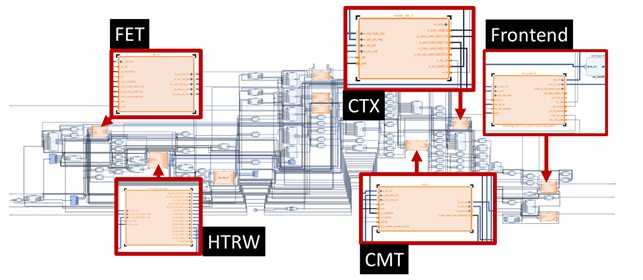
To solve these problems, Professor Jeong Myeong-su's research team developed OpenExpress, a freely modifiable hardware NVMe controller IP, and released it free of charge. This public controller consists of dozens of hardware basic IPs and several core NVMe IP cores.
Professor Jeong's team prototyped an NVMe hardware controller using OpenExpress for actual performance evaluation, and designed all logic provided by OpenExpress to operate at high frequencies.
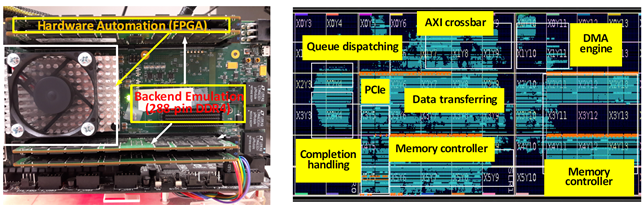
The FPGA storage card prototype developed using OpenExpress supports a bandwidth of up to 7 GB/s, making it suitable for research on ultra-high-speed next-generation memory.
Tests comparing various storage server workloads also demonstrated 76% higher bandwidth and 68% lower input/output latency than Intel's Optane SSD. Professor Yeon's team predicted that synthesizing silicon devices according to user needs could yield even higher performance.
The controller developed by Professor Jeong's team can be freely used and modified by non-profit universities and research institutes under the OpenExpress open source license. Therefore, it is ideal for research on NVMe controllers and software stacks that accommodate next-generation memory.
Meanwhile, this research was conducted with the support of MemRay, a next-generation memory developer and supplier.
Comments
Related news
Memory semiconductor integration will increase 1,000 times compared to now
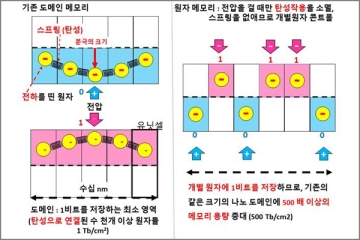
Professor Lee Jun-hee's research team at UNIST has presented a principle that can increase the integration density of memory semiconductors by more than 1,000 times. Conventional memory uses domains of tens of nanometers in size to store 1 bit through inter-atomic elastic interactions, but by utilizing the phenomenon presented by the research team, inter-atomic elastic interactions disappear when voltage is applied, making it possible to store data in individual atoms.
2020.07.03by 이수민 기자

Samsung Electronics' Q2 earnings: DRAM is a bright spot, NAND is a slogan, thanks to COVID-19.
Samsung Electronics announced its second quarter 2020 results on the 30th, with consolidated revenue of 52.97 trillion won and operating profit of 8.15 trillion won. While memory revenue increased due to growing demand centered on data centers and PCs, overall revenue declined 4.3% quarter-over-quarter and 5.6% year-over-year as set product sales such as smartphones decreased. Operating profit reached 8.15 trillion won, up 1.7 trillion won from the previous quarter, driven by improved memory profitability, one-time gains in display, and peak season effects in consumer appliances.
2020.07.30by 이수민 기자

Mouser now offers 287 new products, including Intel Optane memory.
Mouser Electronics announced that it will supply an additional 287 new products, including Intel Optane DC Persistent Memory, Dialog DA14531 SmartBond TINY Module Development Kit, OSRAM SYNIOS S 2222 mid-power LED, and Kemet KC-LINK capacitors.
2020.08.03by 이수민 기자

Intel Unveils Next-Generation 'Core Ultra Series 3' and vPro Platform for Enterprise PCs
Intel has officially unveiled the "Intel Core Ultra Series 3" for next-generation enterprise PCs and the latest vPro platform, addressing a wide range of demands from enterprise notebooks to high-performance workstations.
2026.03.26by 배종인 기자

ROHM Launches ESD Protection Diode Compatible with High-Speed Interfaces of 10Gbps or Higher
Semiconductor specialist ROHM has developed the 'RESDxVx series' of ESD (electrostatic discharge) protection diodes capable of responding to next-generation high-speed data communication environments exceeding 10Gbps, simultaneously enhancing both signal quality maintenance required in high-speed interfaces and IC protection performance.
2026.03.26by 배종인 기자











