



ETRI Unveils Three Infrastructure Technologies to Boost Solar Energy Utilization
 Published2020.08.12 16:08
Solar power management, small-scale power brokerage, and ESS integration technology
Expectations for the deployment of renewable energy and expansion of platform services
Infrastructure-based technology capable of efficiently managing and utilizing solar energy in the right places, as well as commercialization platform technology to support new industries, have been developed by domestic researchers.
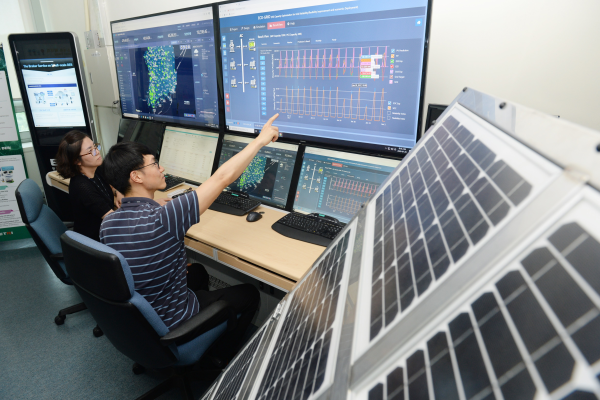
Demonstrating [Photo = ETRI]
The Electronics and Telecommunications Research Institute (ETRI) announced on the 11th that it has developed three types of technologies: a monitoring platform technology for the full lifecycle management and maintenance of solar power plants, a platform technology for small-scale distributed energy power brokers, and an Energy Storage System (ESS) linkage technology.
Foundation technology for integrated solar resource control system established
Monitoring platform technology for the management and maintenance of solar power plants is an intelligent platform technology based on big data that enables optimal operational management across all stages, from power generation forecasting to automatic recovery and decommissioning diagnosis.
The research team conducted a demonstration of the developed monitoring technology on approximately 3,000 solar power plants nationwide. The demonstration results confirmed that the research team's technology enables the performance of big data-based analysis for management and maintenance through the real-time collection and monitoring of the operational status of each power plant.
This technology, which proactively identifies anomalies, automatically repairs problems, and helps power plants achieve maximum performance until the end of their lifespan, has been transferred to solar maintenance operators. It is currently operating as a system capable of integrated control of large-scale solar resources.
Small-scale solar power exchange operation becomes possible
Small-scale power brokerage platform technology is a new business operating system technology that supports power brokers in aggregating distributed energy resources and trading them in the power market.
The research team developed an operating system that enables brokers to aggregate small-scale power and trade it as a collective resource. In particular, they introduced solar power generation forecasting technology to facilitate stable bidding in the electricity market. Through this, they are supporting operators in conducting more flexible operations while reducing uncertainty.
The local company that received the technology plans to launch full-scale services in the first half of next year. In addition, the basic research on the renewable energy forecast improvement settlement system conducted by the research team and the Korea Power Exchange has been incorporated into the forecast improvement settlement system and is scheduled to be implemented in April 2021 following the amendment of related rules and procedures for system implementation.
Technology for stable solar-ESS integrated operation developed
The optimal linkage technology between solar power generation and ESS for grid stabilization is a technology that enables the optimal operation of solar power generation by linking it with ESS.
When a solar power generator exists as a single unit, stable operation is difficult due to fluctuating power generation. Although ESS needs to store residual power and supply it when needed, there was a disadvantage in that it was difficult to build due to the high unit cost of the device and the wide variety of types.
The research team developed relevant indicators, operational plan design structures, and evaluation tools to optimize power generation and stabilize output. It is a technology designed to calculate the appropriate ESS capacity based on solar power capacity and to evaluate the stability of how much the output energy affects the power grid during operation.
In particular, the distributed resource grid stabilization index has been established as a national standard for the first time and is expected to be widely utilized in the operation of renewable energy complexes.
The research team plans to develop digital energy infrastructure and application technologies, such as AI energy convergence appropriate technology, energy digital twin technology, and energy data dams, as well as energy convergence platform technology used in factories and smart cities.
Comments
Related news
Infineon Announces Industry-Standard 62mm Package SiC MOSFETs
Infineon has added a 62mm industry-standard package to its CoolSiC MOSFET 1200V module product family. Unlike conventional 62mm IGBT modules manufactured from silicon, the CoolSiC 62mm modules made from silicon carbide can be used in applications such as photovoltaic, server, energy storage, EV charging, traction, commercial induction cooking, and power conversion systems.
2020.07.16by 명세환 기자

ON Semiconductor Develops SiC Power Modules for Solar Inverters
ON Semiconductor unveiled the NXH40B120MNQ, a full silicon carbide (SiC) power module product family for photovoltaic inverter applications, on the 21st. The NXH40B120MNQ full SiC power module product family, consisting of 2-channel and 3-channel models, integrates 1200V, 40mΩ SiC MOSFETs and 1200V, 40A SiC boost diodes with a dual boost stage.
2020.07.21by 이수민 기자
Can renewable energy become a stable power source?
The Ministry of Industry is implementing a pilot operation for the power supply and demand utilization of solar-connected energy storage systems from the 4th of this month through the 12th of next month, in order to explore ways to utilize solar-connected ESS as a power supply and demand resource. This pilot operation is being conducted jointly by the Ministry of Industry and relevant power authorities to test the feasibility of power supply and demand utilization through adjustment of charging and discharging times of solar-connected ESS, as well as fire safety and other aspects.
2020.08.04by 이수민 기자
Korea Instrument, KOLAS Accredited Calibration Agency First to Simultaneously Acquire ISO/IEC 27,001·27,701
Korea Instrument has become the first among KOLAS accredited calibration agencies to simultaneously acquire ISO/IEC 27,001 and ISO/IEC 27,701 certifications. Through its proprietary platforms CWIZ Enterprise and CWIZ Partners, the company has embedded information security and personal data protection requirements across all business processes including customer information, equipment data, and calibration reports, with plans to continuously advance its management system through regular audits and security inspections.
2026.10.12by 배종인 기자
TeamViewer One, IT Incident Automation Workflow and Resolution Center Enhanced
TeamViewer has added IT incident automation capabilities and an advanced Resolution Center to its integrated digital workplace management platform 'TeamViewer ONE'. Recurrent service disruptions, configuration errors, and capacity shortages are automatically handled according to preset policies, and device status verification through script deployment can be managed in a unified interface, significantly reducing repetitive tasks for IT teams.
2026.10.12by 배종인 기자











