



ETRI Sets Out to Develop 5G Edge Network and MEC Security Technologies
 Published2020.08.20 16:06
ETRI Consortium Develops 5G Edge Security Technology
Demonstration of 5G B2B services applied to smart factories
LTE provides internet services through a centralized core network, so the scope of security management is relatively limited. However, 5G involves the large-scale connection of various devices such as IoT, the network becoming software-driven, and the significant role of the edge, resulting in many attack points outside the core network.
The Electronics and Telecommunications Research Institute (ETRI) announced on the 19th that it is developing technology capable of detecting and responding to potential security threats in 5G 'Edge Networks' and 'Multi-access edge computing (MEC)'.
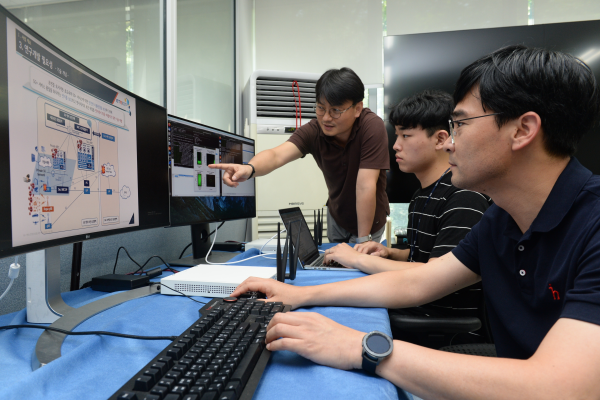
Inspecting the testbed for verification [Photo = ETRI]
An edge network refers to the initial access segment in a 5G network extending from a base station physically close to a terminal to a local area or wide-area central office. MEC is a technology that reduces latency by providing computing services using the cloud in the edge network.
MEC requires greater attention to security, particularly as an open system where applications from external service developers can run, which poses a relatively high risk of intrusion and causes significant ripple effects if an attack occurs. However, the relevant technology is still insufficient.
ETRI is moving away from responding to security threats centered on the core network boundary and is pursuing developments that guarantee the stability of 5G convergence services. The technologies being developed by the research team include 5G edge network security technology, MEC and container security technology, and AI-based security threat analysis and monitoring technology.
5G edge network security technology analyzes abnormal data captured in the Radio Access Network (RAN) and detects intrusion attempts through fake base stations. The research team also plans to develop a hardware platform for real-time intrusion threat detection and blocking to protect mobile carriers and private MECs.
MEC and container security technology is a technology that detects anomalies in virtualization platforms and running containers to control unauthorized access, prevent information leakage, and verify the integrity of application software.
Intelligent security threat analysis and monitoring technology is a technology that detects security threats using AI technology based on big data regarding security situations collected from edge networks and MEC, and guarantees infrastructure security across the entire 5G network by sharing threat information with the core network.
The research team plans to apply the developed technologies to smart factories and verify the effectiveness of the technology through security demonstrations of 5G MEC-based B2B convergence services.
Meanwhile, this technology development was conducted as part of the information security core source technology development project supported by the Ministry of Science and ICT and the Institute of Information and Communication Technology Planning and Evaluation (IITP). It will be carried out for four years starting in April of this year, with ETRI serving as the lead organization and an industry-academia-research consortium consisting of Sungkyunkwan University, SGA Solutions, SK Telecom, Somansa, Soongsil University, Sysmate, LGU+, and Wins participating in the research and development.
Comments
Related news
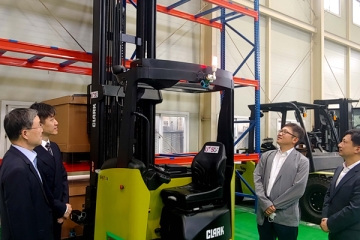
5G will allow a single person to control 50 unmanned forklifts simultaneously.
LG Uplus, Clark Material Handling Asia, Mughini, and KEN have signed an MOU regarding the joint implementation of a 5G-based autonomous forklift project. The 5G autonomous forklift is a solution that enables remote, unmanned operation of forklifts used across various industrial sectors including manufacturing plants, logistics centers, and ports.
2020.08.10by 명세환 기자
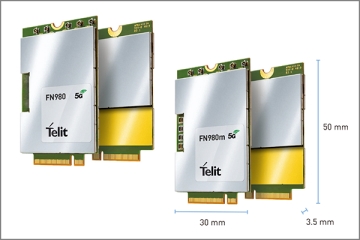
Telit's Industrial 5G Data Card Achieves Multiple Global Certifications
Telit announced that its industrial LTE-A/5G data card series, FN980, has passed FCC, PTCRB, RED, GCF, JRL, JTBL, and KC certifications. With the acquisition of multiple global certifications, it has been demonstrated that devices from OEMs, system integrators, and end users utilizing the FN980 series can operate as expected across major mobile networks worldwide.
2020.08.12by 이수민 기자

Keysight Unveils New Software to Integrate 5G Product Development Process
Keysight Technologies announced the launch of Pathwave Design 2021, an expanded and predictable open 5G and millimeter-wave software solution. Design and verification engineers can use this solution to accelerate chip, board, and system product launches by adding enhanced performance and accuracy to device, circuit, and system design.
2020.08.20by 강정규 기자
.png)
Databricks Unveils Open AI Security Monitoring 'Lakewatch'
Databricks entered the security market on March 24 by unveiling LakeWatch, an open-source agentic SIEM. The core functionality of this product is to integrate and analyze security, IT, and business data in a single environment to support AI-based threat detection and investigation. The company explained that it reduces the limitations of existing security operations centers, which have had to forgo some data due to high cost structures, and enables large-scale data analysis and automation based on open formats and ecosystems. LakeWatch is currently offered as a private preview, with Adobe and Dropbox mentioned as early customers. Databricks also announced an expanded partnership with Anthropic as well as the acquisition of Antimatter and SiftD.ai.
2026.03.26by 배종인 기자

Kaspersky Unveils Revamped 'NEXT' Combining SOC Integrated Management and AI Analytics
As enterprises increase demand for integrated management and automation in the construction and operation of Security Operations Centers (SOC), Kaspersky has disclosed updates to its B2B security product suite 'Kaspersky Next'. This update expands EPP, EDR, XDR, and SIEM integration through a single console based on OSMP, incorporates AI capabilities such as DLL hijacking detection and suspicious account takeover behavior identification, and includes integration with generative AI assistant tool KIRA. The company stated that in large-scale deployment environments, EDR Expert can reduce resource requirements by up to 30%, and XDR Expert by up to 60%.
2026.03.25by 배종인 기자











