


UNIST succeeds in synthesizing flexible semiconductor material "exene" for the first time.
 Published2020.08.26 12:01
High flexibility and easy processing, making it suitable as a flexible component material
An organic semiconductor material whose existence was discovered 79 years ago has been synthesized for the first time by domestic researchers.
A joint research team led by Professors Park Young-seok, Lee Geun-sik, and Shin Hyeong-jun at Ulsan National Institute of Science and Technology (UNIST) announced on the 26th that they had successfully synthesized ixene, a polycyclic aromatic hydrocarbon (PAH) molecule, for the first time. Furthermore, they synthesized ixene with added nitrogen and boron, exploring its potential as an organic semiconductor material.
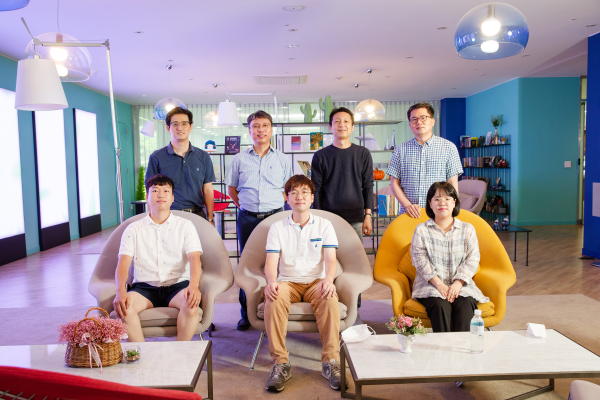
Professor Park Young-seok and Professor Choi Won-young [Photo = UNIST]
Carbon-based organic semiconductors, unlike silicon semiconductors, are flexible and highly processable, making them suitable for use in flexible devices. Representative organic semiconductor materials include PAHs, which consist of carbon atoms arranged in hexagonal rings.
Semiconductor materials require electrons that can move freely, but PAHs have delocalized electrons that can move freely within the molecule.
This is one type of PAH synthesized by the research team. The structure of this molecule was proposed in 1941, along with the name Ixene, but it was never actually produced because it was difficult to synthesize using methods known at the time.
The research team succeeded in synthesizing ixene using a cyclization reaction of diacetylene molecules and a carbon-hydrogen arylation reaction using a palladium catalyst.
In addition, using the same two-step synthetic method, nitrogen and boron were added (doped) to specific positions of the ixene molecule, and 'B2N2-ixene', which has a narrower energy gap than ixene, was synthesized.
Just as commercial semiconductor materials are synthesized by doping silicon with nitrogen and boron, the energy gap is reduced by adding nitrogen and boron to specific positions of the ixene molecule.
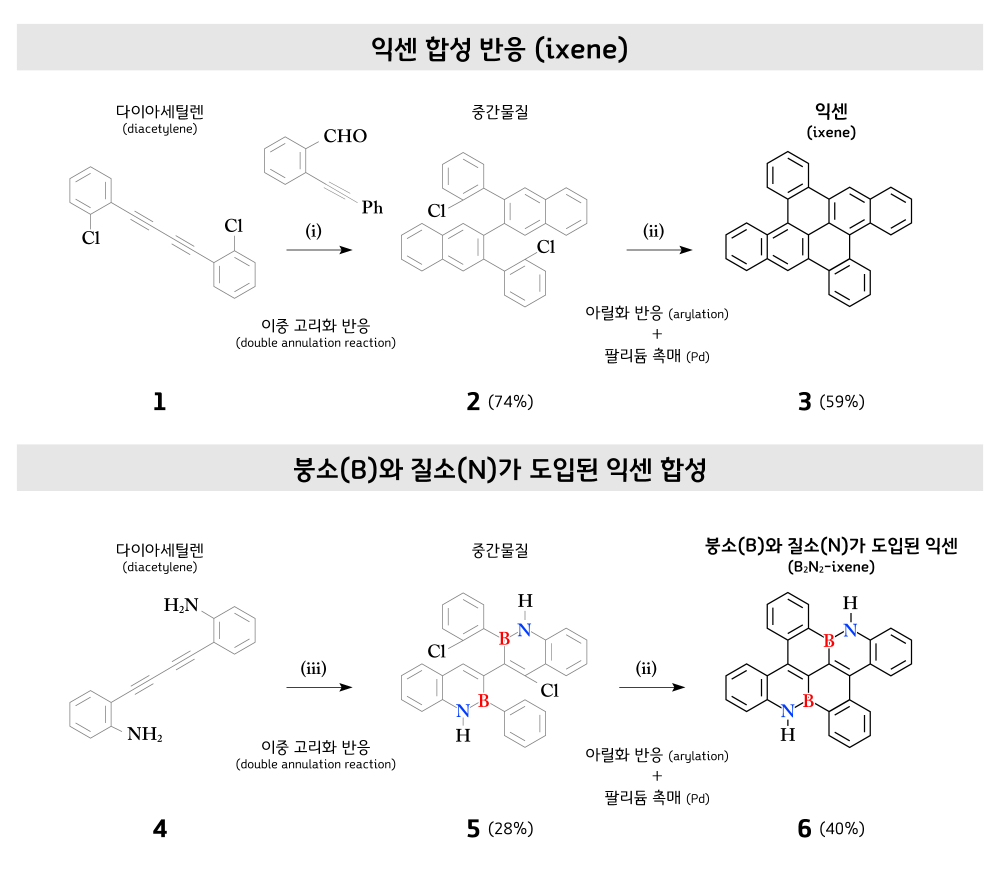
To use a material as a semiconductor, it is important to control the width of the energy gap, which acts as a threshold for moving electrons. The synthetic method used in this study can accurately and easily reduce the energy gap.
Professor Park Young-seok explained, “By doping boron and nitrogen simultaneously, we synthesized a B2N2-ixene molecule that has an isoelectronic structure like a carbon-carbon (C-C) bond, but with a narrower energy gap.”
Professor Shin Hyeong-jun and Professor Lee Geun-sik's research team proved through actual experiments and theoretical calculations that the B2N2-ixene molecule has a narrower energy gap compared to ixene.
In particular, using UV-visible spectroscopy, it was observed that B2N2-ixene absorbs light at longer wavelengths (λabs) than ixene, indicating that the energy gap of the B2N2-ixene molecule is narrower.
Professor Park Young-seok explained, “This research is significant not only because it synthesized a new substance called ixene using modern organic chemistry, but also because it proposed a method to control physical properties by precisely adding a desired substance to a specific position in a molecule.”
He also expressed his expectation that “the palladium catalyst and carbon-hydrogen arylation reaction used in this study can also be applied to the synthesis of PAHs with larger molecular sizes.”
Meanwhile, the research results of Professor Won-Young Choi's team in the Department of Natural Sciences at UNIST and Professor Seok-Joo Kang's team in the Department of Energy and Chemical Engineering at UNIST were published on August 24th in the prestigious chemistry journal Angewandte Chemie International Edition under the title 'Unveiling 79-Year-Old Ixene and Its BN-Doped Derivative.'
This research was supported by the Basic Research and Basic Laboratory Program of the National Research Foundation of Korea (NRF).
Comments
Related news
Will the 12-inch wafer-based micro-parts testbed yield results?
Minister Choi Ki-young of the Ministry of Science and ICT visited the on-site location of the 12-inch semiconductor materials, components, and equipment localization support testbed being established at the Nano Comprehensive Technology Institute, inspected the progress, and held a discussion meeting to activate the testbed. A total of 45 billion won will be invested in the Nano Comprehensive Technology Institute's construction of the 12-inch wafer-based semiconductor testbed from 2019 to 2022.
2020.08.13by 이수민 기자

Next-generation wearable devices made with graphene
Graphene is a material composed of a single layer of carbon atoms bonded in a hexagonal honeycomb structure on a two-dimensional plane. It has a thin thickness, high transparency, flexibility, stretchability, and high electrical and thermal conductivity. If materials and components utilizing these characteristics of graphene are commercialized, the wearability of wearable devices will be significantly improved compared to current standards.
2020.08.13by 이수민 기자
31 R&D Projects Selected to Support Commercialization of Materials, Parts, and Equipment Technologies for SMEs
The Ministry of SMEs and Startups has selected 31 projects in the first round for the Tech Bridge Commercialization Technology Development Project, which provides follow-up commercialization technology development funding to SMEs that have acquired core technologies in the materials, components, and equipment sectors from universities and research institutes.
2020.08.24by 명세환 기자

Intel Unveils Next-Generation 'Core Ultra Series 3' and vPro Platform for Enterprise PCs
Intel has officially unveiled the "Intel Core Ultra Series 3" for next-generation enterprise PCs and the latest vPro platform, addressing a wide range of demands from enterprise notebooks to high-performance workstations.
2026.03.26by 배종인 기자

ROHM Launches ESD Protection Diode Compatible with High-Speed Interfaces of 10Gbps or Higher
Semiconductor specialist ROHM has developed the 'RESDxVx series' of ESD (electrostatic discharge) protection diodes capable of responding to next-generation high-speed data communication environments exceeding 10Gbps, simultaneously enhancing both signal quality maintenance required in high-speed interfaces and IC protection performance.
2026.03.26by 배종인 기자











