



Rohm Develops VCSEL Module Technology Integrating Light Source and Driving Elements
 Published2020.09.02 13:31
System accuracy↑ due to less impact on the light receiving sensor
Recently, vertical cavity surface emitting lasers (VCSELs) are being used as laser light sources in facial authentication systems for smartphones and spatial recognition systems for tablets.
As demand for VCSELs continues to grow in industrial inspection systems, etc., ROHM announced on the 1st that it has developed high-output VCSEL module technology that improves the precision of space recognition and distance measurement systems.
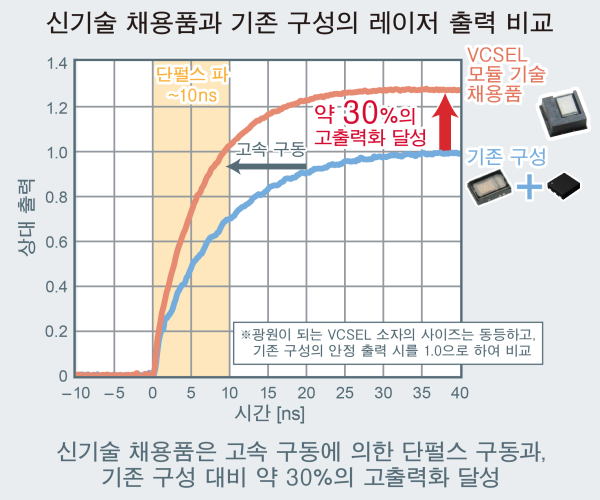
Laser Output Comparison [Image = Rohm]
In the case of laser light sources using existing VCSELs, the VCSEL element that serves as the light source and the MOSFET element that drives the light source had to be individually mounted on the substrate. At this time, even if unintentionally, the wiring length between products affected the driving time and output of the light source, making it difficult to realize a single pulse and high-output light source required for high-precision sensing.
ROHM has developed a technology to modularize VCSEL elements and MOSFET elements by integrating them into a single package. Rohm explained that with this technology, it has simultaneously achieved the following: △improved performance of each element, △operation of a single pulse light source of less than 10 ns that excludes the influence of external noise such as sunlight, and △increased output by approximately 30% compared to conventional configurations.
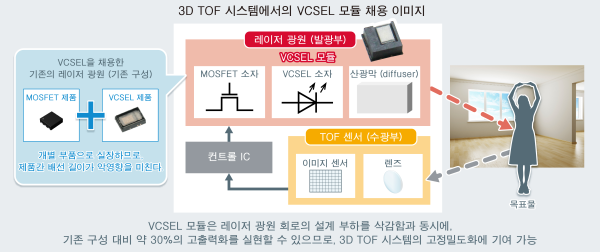
In addition, the VCSEL module (laser light source) manufactured with the technology reduces the reflected light impact on the ToF sensor (light-receiving sensor) installed in the space recognition and distance measurement system by 30% compared to existing products, which helps to improve the precision of the system, it added.
ROHM is promoting the commercialization of VCSEL modules that use this technology by March 2021 for facial authentication systems in mobile devices and industrial unmanned transport robots. In addition, it plans to promote the development of high-output laser technology to support vehicle lidar, etc.
Comments
Related news
Rohm Develops 'Zero Cross Detection IC' Excluding Photocoupler
Rohm has developed the BM1ZxxxFJ series, a zero-cross detection IC for white goods appliances that enables zero-cross detection without a photocoupler. The new product line achieves zero-cross detection without a photocoupler and reduces the standby power of the zero-cross detection circuit to 0.01W during continuous power supply. Even during application operation, the delay time error generated according to AC voltage has been reduced to ±50μs or less.
2020.07.15by 이수민 기자
Electronic signal errors can be measured in the order of one quadrillionth of a second?
A research team led by Professor Kim Jung-won from the Department of Mechanical Engineering at Korea Advanced Institute of Science and Technology (KAIST) has developed technology to measure and control timing errors of electronic signals to below 1 quadrillionth of a second using ultrafast pulse lasers. Utilizing this research result, timing errors of electronic clock signals can be controlled to the level of 100 attoseconds, which is below femtoseconds.
2020.07.27by 이수민 기자
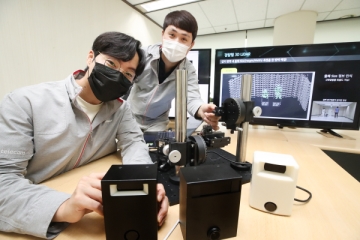
KT Develops Short-Range 3D LiDAR Prototype with High Price Competitiveness
KT announced the development of an indoor short-range 3D LiDAR. The manufacturing cost is approximately one-tenth that of existing products, and a single laser is controlled via software to generate up to 24 detection lines for identifying approaching hazards. Additionally, the detected space can be rendered in three dimensions, and AI analysis functionality distinguishes whether an approaching obstacle is a person or an object.
2020.08.31by 이수민 기자
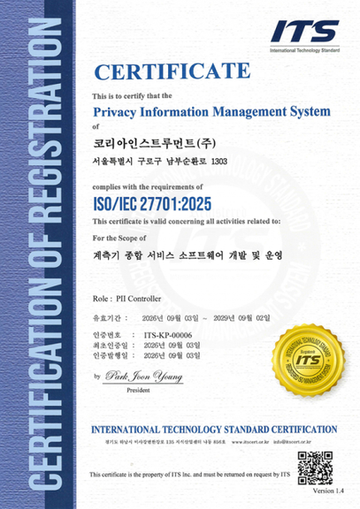
Korea Instrument, KOLAS Accredited Calibration Agency First to Simultaneously Acquire ISO/IEC 27,001·27,701
Korea Instrument has become the first among KOLAS accredited calibration agencies to simultaneously acquire ISO/IEC 27,001 and ISO/IEC 27,701 certifications. Through its proprietary platforms CWIZ Enterprise and CWIZ Partners, the company has embedded information security and personal data protection requirements across all business processes including customer information, equipment data, and calibration reports, with plans to continuously advance its management system through regular audits and security inspections.
2026.10.12by 배종인 기자

TeamViewer One, IT Incident Automation Workflow and Resolution Center Enhanced
TeamViewer has added IT incident automation capabilities and an advanced Resolution Center to its integrated digital workplace management platform 'TeamViewer ONE'. Recurrent service disruptions, configuration errors, and capacity shortages are automatically handled according to preset policies, and device status verification through script deployment can be managed in a unified interface, significantly reducing repetitive tasks for IT teams.
2026.10.12by 배종인 기자











