



"Processing from storage" Arm announces Cortex-R82
 Published2020.09.09 12:00
Empowering storage controllers with processing power
The number of connected devices in the world today is uncountable, and the amount of data produced is incomparable to that of the past. These numbers and volumes are continuously increasing, and it is impossible to process them all in the cloud.
On the 9th, Arm held an online press conference and announced the Cortex-R82 processor, which provides processing power to storage devices.
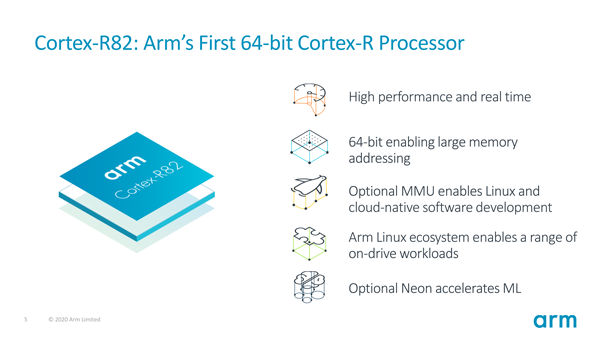
The closer data processing is to the data, the higher the efficiency. The 64-bit Cortex-R82 supporting Linux is optimized for computational storage architecture to accelerate the development of next-generation storage devices.
Computational storage is a structure that processes data in a storage device, reducing the amount of data that must be moved between the storage device and the processor.
Traditional storage controllers perform data storage and access tasks in bare-metal and RTOS environments. In contrast, the Cortex-R82 allows various OSs to run directly on the storage controller through its memory management unit (MMU) option.
The Cortex-R82 delivers up to twice the performance of its predecessor, the Cortex-R8, depending on the task, and can access up to 1TB of DRAM.
Processing data on storage devices enables parallel computing on the storage device, improves scalability, eliminates the need to move large files, reduces latency, and enhances security.
Neil Werdmuller, Arm's director of storage solutions, explained in the conference that these benefits would be useful in areas such as transportation where storage devices are in motion, or video editing that requires processing large amounts of data.
The Cortex-R82 can be tailored to the needs of storage devices, is supported by the Arm cloud native software ecosystem, and is also highly secure with Arm TrustZone technology.
Comments
Related news
VMware Ranks #1 in IT Automation and Configuration Management Software for Three Consecutive Years
Today, enterprises need solutions that can reduce human error and respond with agility to business requirements through operational simplification and infrastructure automation. VMware is expanding R&D investments in vRealize Suite and vCloud Suite to enable enterprises to lower TCO across its portfolio of data center, desktop, network, security, communication, and storage products.
2020.08.03by 강정규 기자
Launch of an 8-channel PCIe Gen 4 NVMe SSD controller for enterprise use.
As the role of data centers grows, many enterprises are adopting NVMe SSDs that support PCIe Gen 4, which delivers high storage density. Microchip's 8-channel FlashTek NVMe 3108 SSD controller is equipped with key security features to provide end-to-end enterprise-grade data integrity.
2020.08.06by 이수민 기자
Intel Unveils Next-Generation 'Core Ultra Series 3' and vPro Platform for Enterprise PCs
Intel has officially unveiled the "Intel Core Ultra Series 3" for next-generation enterprise PCs and the latest vPro platform, addressing a wide range of demands from enterprise notebooks to high-performance workstations.
2026.03.26by 배종인 기자
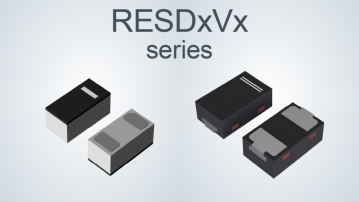
ROHM Launches ESD Protection Diode Compatible with High-Speed Interfaces of 10Gbps or Higher
Semiconductor specialist ROHM has developed the 'RESDxVx series' of ESD (electrostatic discharge) protection diodes capable of responding to next-generation high-speed data communication environments exceeding 10Gbps, simultaneously enhancing both signal quality maintenance required in high-speed interfaces and IC protection performance.
2026.03.26by 배종인 기자
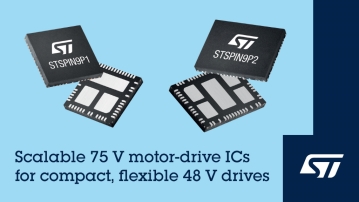
ST Launches 75V Drive IC Targeting 48V Industrial Motor Driving
ST Microelectronics has unveiled the 'STSPIN9P' series of 75V motor drive ICs tailored for 48V-class industrial drive system design. The new product family is characterized by half-bridge and full-bridge configurations that enable design scalability according to motor type and output conditions. Power supply circuits, protection functions, and current sensing circuits are integrated on-chip to simplify system configuration, and the devices are designed to support applications up to 500W maximum. The company plans to provide reference designs and demo boards to support development and evaluation in industrial automation, robotics, pumps, fans, lighting, and textile machinery.
2026.03.26by 배종인 기자











