



The commercialization of fabric-based wearable devices is now possible.
 Published2020.09.11 15:13
Combination of conductive fabric and piezoelectric polymer film
Development of a method for manufacturing a wearable energy harvester
Today, wearable devices are used in a wide range of applications, from sensors and motors to displays and energy harvesting. Furthermore, they are rapidly evolving from miniaturization to embedded form factors. Accordingly, wearable devices based on comfortable and durable fabrics that can be embedded in existing clothing are attracting attention.
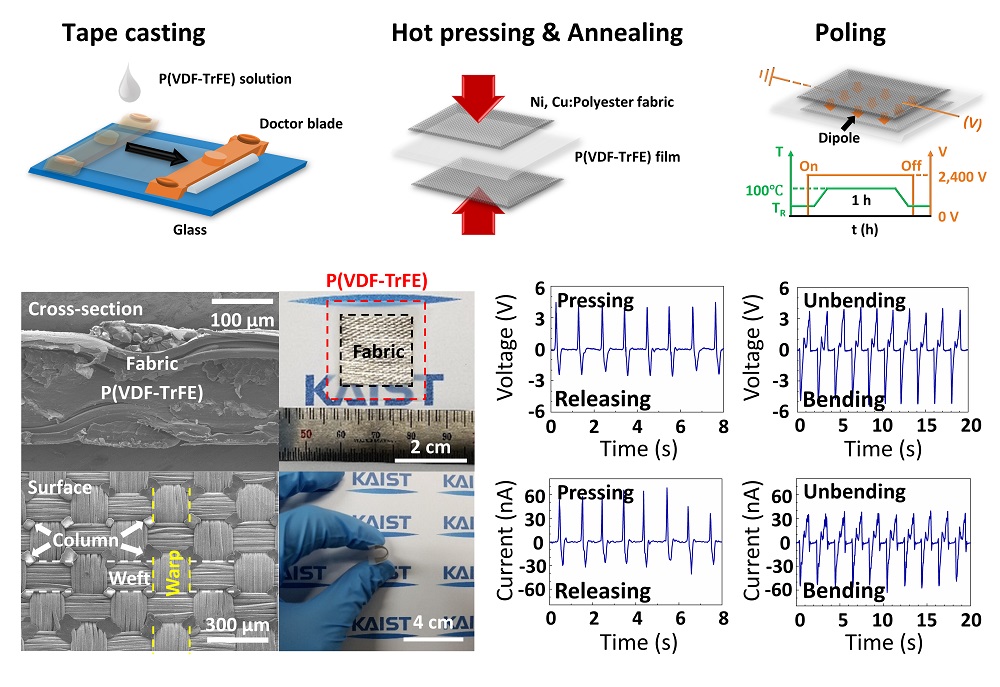
Piezoelectric energy harvesting of manufacturing methods, structures, and devices
Characteristic Analysis Results [Figure = KAIST]
The Korea Advanced Institute of Science and Technology (KAIST) announced on the 9th that a research team led by Professor Seung-Beom Hong of the Department of Materials Science and Engineering has successfully developed a method for manufacturing a fabric-based wearable piezoelectric energy harvester that is cost-competitive and highly durable using a hot pressing method.
Hot pressing is a method of firmly bonding two objects by applying temperature and pressure, and piezoelectric energy harvesting is a technology that converts energy such as pressure and vibration into usable electrical energy using piezoelectric materials.
Existing fabric-based wearable devices have yet to reach the practical stage due to limitations in terms of process and cost, stemming from complex manufacturing methods and equipment requirements. Furthermore, the lack of bonding and efficiency testing between the fabric within the device and the actual operating components raises questions about the device's durability.
To address these issues, active research is being conducted on simple, inexpensive processes and materials, as well as new mechanical property analysis technologies. The research team developed a method for manufacturing a fabric-based wearable piezoelectric energy harvester by combining a conductive polyester fabric and a piezoelectric polymer film (P(VDF-TrFE)) using hot pressing.
Hot pressing is a method primarily used in the production of batteries and fuel cell cells. It is a fast and simple process that can be completed in 2 to 3 minutes while also achieving high adhesive strength.
When a polymer film is bonded to a fabric at a temperature near or below the crystallization temperature, the polymer film surface becomes amorphous, densely bonding to the rough fabric surface with a wide contact area, and leaks between the warp and weft yarns to form nails, allowing for high interfacial bonding.
Wearable devices developed using the hot pressing method are expected to have the potential to be applied to existing clothing, thereby reducing the process cost.
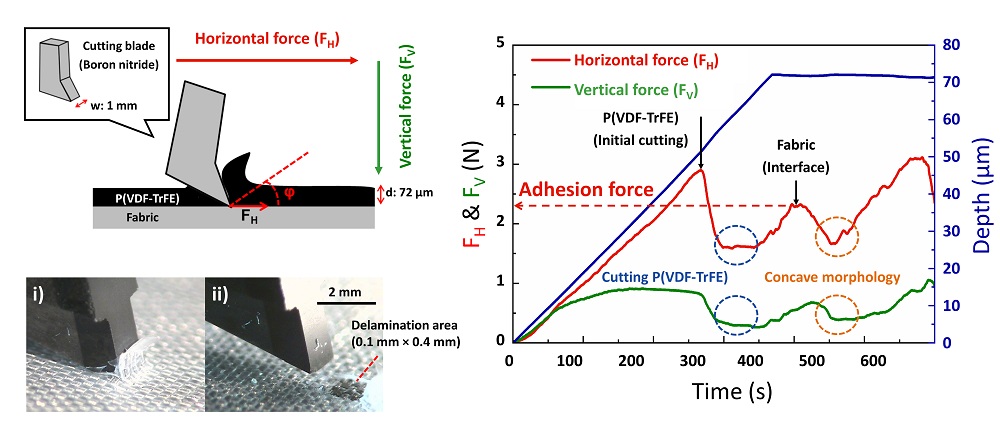
Horizontal and vertical force and depth of blade according to method and time
Graph showing [Image = KAIST]
In addition, the mechanical durability of the wearable device was proven by measuring the interfacial adhesion between the fabric and the polymer film using the newly introduced 'Surface and Interfacial Cutting Analysis System (SAICAS)' in addition to the existing durability test method, the bending test.
Interfacial bonding using SAICASAdhesion analysis is a method that quantitatively and qualitatively measures force at the microscale using a blade. It is more accurate than existing methods for measuring interfacial adhesion, such as peel tests, tape tests, and microstretch tests. The research team stated, "Interfacial adhesion analysis using SAICAS could be used as a new method for testing the durability of wearable devices using polymers in the future."
Professor Hong Seung-beom commented, “The fabric-based wearable piezoelectric energy harvester manufacturing technology developed this time has increased the possibility of commercializing fabric-based devices,” and “Through analysis of interfacial adhesion, it has suggested a design direction for high-durability wearable devices.”
Meanwhile, this research was patented domestically on December 23rd of last year, and was published in the September 2020 issue of the international academic journal 'Nano Energy', and was published online on May 22nd. The research was participated by the research team of Professor Noh Kwang-soo of the Department of Materials Science and Engineering at the same university, Professor Yoo Seung-hwa of the Department of Mechanical Engineering, and Professor Lee Yong-min of the Department of Energy Engineering at DGIST.
Comments
Related news
Seoul National University of Engineering develops tungsten oxide nanofilm display device
A joint research team consisting of Professor Lee Byung-ho and Professor Jeong Taek-dong from Seoul National University's College of Engineering, and Professor Seon Ho-jeong from Gunsan National University's Department of Advanced Materials Engineering has developed a display device utilizing electrochromic tungsten oxide nanoscale thin films. The fabricated optical device features a simple stacked structure with a thickness of 200nm or less and does not require voltage to maintain color.
2020.07.16by 이수민 기자
Magnetic smart material with redesignable magnetization shape developed
Professor Kim Ji-yoon's team from the School of Advanced Materials Engineering at UNIST and Professor Kwon Min-sang's team from the Department of Materials Science and Engineering at Seoul National University have developed a magnetic smart material capable of changing magnetization patterns. The developed material also possesses flexibility, and is expected to be applied in various fields requiring reconfigurable structure-type smart materials, such as biomedical engineering, flexible electronic devices, and soft robotics.
2020.08.03by 이수민 기자
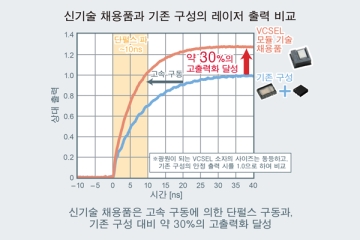
Rohm Develops VCSEL Module Technology Integrating Light Source and Driving Elements
Rohm has developed high-power VCSEL module technology that enhances the precision of spatial recognition and distance measurement systems. VCSEL modules adopting this technology are suitable for facial authentication systems in mobile devices and industrial autonomous transport robots, with the first product scheduled to launch in March 2021.
2020.09.02by 이수민 기자

Intel Unveils Next-Generation 'Core Ultra Series 3' and vPro Platform for Enterprise PCs
Intel has officially unveiled the "Intel Core Ultra Series 3" for next-generation enterprise PCs and the latest vPro platform, addressing a wide range of demands from enterprise notebooks to high-performance workstations.
2026.03.26by 배종인 기자
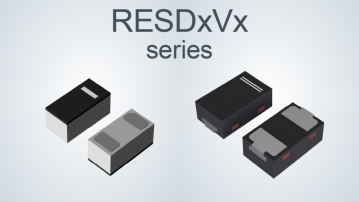
ROHM Launches ESD Protection Diode Compatible with High-Speed Interfaces of 10Gbps or Higher
Semiconductor specialist ROHM has developed the 'RESDxVx series' of ESD (electrostatic discharge) protection diodes capable of responding to next-generation high-speed data communication environments exceeding 10Gbps, simultaneously enhancing both signal quality maintenance required in high-speed interfaces and IC protection performance.
2026.03.26by 배종인 기자











