



KAIST Develops Chip-Scale Ultra-Low-Noise Pulse Signal Generation Technology
 Published2020.09.18 15:06
22 GHz repetition rate, 2.6 femtosecond timing jitter
Simultaneous generation of optical pulse trains is possible
A joint research team led by Professor Lee Han-seok of the Department of Physics and Professor Kim Jeong-won of the Department of Mechanical Engineering at the Korea Advanced Institute of Science and Technology (KAIST) announced on the 17th that they have developed a technology to periodically generate pulse signals with very low noise using a silica microresonator.
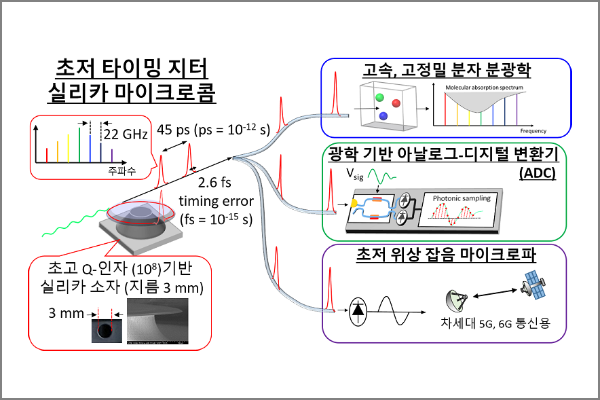
22 GHz optical pulse train with ultra-low pulse-to-pulse timing error
Creation process and application areas [Figure = KAIST]
This technology can generate optical pulse trains with a high repetition rate of 22 GHz and a low timing jitter of 2.6 femtoseconds (385 trillionths of a second) from a 3 mm diameter chip. Therefore, it is expected to be utilized in the development of sampling clocks for ultra-high-speed, wideband analog-to-digital converters (ADCs) or ultra-low-noise microwave signal sources for 5G and 6G communications.
Mode-locked lasers, which generate optical pulses with pulse widths on the femtosecond (quadrillionths of a second) scale, are used as important light sources in basic science. Recently, research is being conducted on microcomb technology, which generates femtosecond pulses using chip-scale microresonator devices rather than laser equipment. While conventional mode-locked lasers have repetition rates of around 100 MHz, microcombs have repetition rates of over tens of GHz, more than 100 times higher.
Microcombs are theoretically expected to achieve extremely low timing errors, on the order of 1 femtosecond. Previously, measurement limitations prevented accurate measurement of this performance, nor did they allow for optimization of noise performance.
This research was possible by combining the on-chip microresonator fabrication technology with a very high Q factor (quality factor) of over 100 million, owned by Professor Lee Han-seok's team, with the pulse-to-pulse timing measurement technology with a resolution of 100 attoseconds (one quadrillionth of a second) owned by Professor Kim Jeong-won's team.
The joint research team was able to measure the time error between pulses using timing measurement technology that is more than 100 times more precise than existing technology, and by using the results to find the optimal operating conditions for the microresonator, they were able to improve the noise performance of the microcomb.
Professor Lee Han-seok stated, "We are currently researching new optical device configuration techniques to further improve pulse generation efficiency and noise performance." Professor Kim Jeong-won also stated, "We are conducting follow-up research to utilize the developed technology as a K-band microwave signal source with extremely low phase noise and as a sampling clock for ultra-high-speed ADCs."
Comments
Related news

"Continuous-time Delta-Sigma ADC architecture" that reduces high-speed circuit power and implements high-resolution performance
Today's communication systems primarily employ Nyquist ADC circuit architectures such as flash, pipeline, and SAR ADCs to convert high-speed analog signals into digital form. Continuous-time delta-sigma ADC architecture has strengths in low-power aspects, and through this approach, chip size reduction and manufacturing cost savings are achievable via DWA elimination.
2020.06.08by 이수민 기자
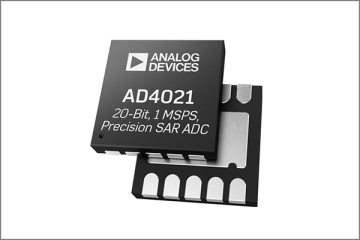
Mouser Supplies Two Types of SAR ADCs That Do Not Require ADC Drivers
Mouser supplies ADI's AD4021/AD4022 SAR ADC. Users can accurately capture high-frequency signals with the AD4021/AD4022, which are pin-compatible with the AD4020, and implement oversampling techniques to mitigate issues related to anti-aliasing filter design.
2020.07.08by 강정규 기자

Why is 6G commercialization being promoted when 5G has not yet taken hold?
Perspectives on 5G are not favorable. This is because its ultra-high-speed, ultra-low-latency, and ultra-connectivity characteristics have failed to deliver their intended performance even after more than a year since commercialization. 6G is a next-generation mobile communication technology that complements 5G with characteristics of ultra-performance, ultra-broadband, ultra-precision, ultra-spatial, ultra-intelligence, and ultra-reliability. With the Ministry of Science and ICT announcing plans to advance 6G R&D projects, we examined the differences between 5G and 6G.
2020.08.11by 이수민 기자

Intel Unveils Next-Generation 'Core Ultra Series 3' and vPro Platform for Enterprise PCs
Intel has officially unveiled the "Intel Core Ultra Series 3" for next-generation enterprise PCs and the latest vPro platform, addressing a wide range of demands from enterprise notebooks to high-performance workstations.
2026.03.26by 배종인 기자

ROHM Launches ESD Protection Diode Compatible with High-Speed Interfaces of 10Gbps or Higher
Semiconductor specialist ROHM has developed the 'RESDxVx series' of ESD (electrostatic discharge) protection diodes capable of responding to next-generation high-speed data communication environments exceeding 10Gbps, simultaneously enhancing both signal quality maintenance required in high-speed interfaces and IC protection performance.
2026.03.26by 배종인 기자











