



"3D scanners are the fastest way to digitize reality."
 Published2020.09.22 10:25
The 3D scanner market is growing at a rate of 15-20% annually.
Increasing utilization in non-destructive testing, medical, and gaming
Blueprints are the foundation of all manufacturing. Products not manufactured according to blueprints are difficult to trace if problems arise, limiting potential fixes. Even if a perfect product is created, it's extremely difficult to replicate it with the same structure.
In the past, design drawings were 2D drawings drawn with pencil and mechanical pencil. This involved first creating prototypes, verifying them, and then revising the design based on those prototypes. Manufacturing commercial products was an inevitably time-consuming and labor-intensive process.
Since Ivan Sutherland proposed the 'Sketchpad' system in his doctoral thesis at MIT in 1963, computer-aided design (CAD) tools have emerged, transforming design drawings from 2D drawings to 3D models.
The freedom to modify and verify blueprints using computers has laid the foundation for producing more sophisticated products. For various reasons, the digitalization of existing objects is also on the rise. However, this task involves a lot of difficulty and skill.
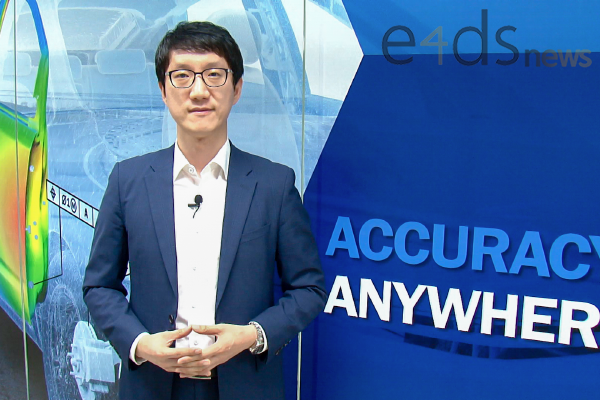
We met with Kim Geon-ah, the head of Creaform, which has been introducing various types of 3D scanners since it first released a handheld 3D scanner in 2005, and asked her about the importance and necessity of 3D scanners used when creating digital reality.
Q. Please briefly introduce yourself and your company.
A. Hello. I'm Kim Geon-ah, Manager of Creaform Korea. Creaform provides non-contact precision measurement scanner solutions and is a business unit within AMETEK's Ultra Precision Technologies division.
Q. What are the recent trends in the 3D measuring equipment market?
A. For the past four to five years, the 3D measuring equipment market has been shifting from coordinate-measuring machines (CMMs) to 3D scanners. 3D scanners are faster than CMMs, which require significant time and effort, and they ensure precise measurements, improving the quality of mass-produced products.
The global 3D scanner market has been growing at an annual rate of 15-20% over the past decade, and the Korean market is also growing accordingly. This growth trend appears likely to continue for some time.
Q. 3D scanners are most widely used in manufacturing. How are they utilized?
A. In manufacturing, 3D scanners are used to determine how well a finished product compares to the CAD design and, if any issues are found, to identify areas for improvement. They are also used to analyze competitor products or for reverse engineering, modifying the design of a product whose blueprints have been lost.
Reverse engineering involves digitally converting a product into CAD using various measuring instruments. In the past, this required repeated revisions based on the experience of experienced designers. 3D scanners significantly speed up and accurately perform this repetitive work, as well as the basic sketching.
Q. What are the unique advantages of Creaform 3D scanners compared to competitors?
A. Creaform is the first company to develop a non-contact handheld scanner. Creaform's 3D scanners offer high portability, fast scanning speeds, and the flexibility to scan a wide variety of products in a variety of environments.
The recently launched next-generation BLACK product line features a blue laser (which has a shorter wavelength than red lasers, allowing for greater data capture) for greater precision and scanning of a wider range of materials than previous models. Creaform also offers software optimized for inspection (VXinspect™) and reverse engineering (VXmodel™).
Q. Creaform has a variety of 3D scanner products. Please briefly describe each specialized use.
A. Creaform has three product lines of 3D scanners.
The first is the "Go!SCAN SPARK" line. This entry-level white-light scanner requires minimal pre-processing and can even scan textures. It's ideal for applications such as reverse engineering, artifact and human body scanning, and AR/VR, rather than precision engineering.
The second product is the "HandySCAN BLACK" line. These portable, handy scanners are high-performance laser scanners that deliver accuracy of up to 25㎛ with a single scanner frame. They are ideal for use in situations where design components are small or measurement space is limited. Despite being a handy scanner, they offer the same performance as premium scanners.
The third product is the "MetraSCAN BLACK" line. Among Creaform's scanners, this is the fastest, most precise, and most accurate. It can scan any size object and is ideal for automated installations. Its ability to scan multiple areas repeatedly with a single setup makes it a highly preferred choice among designers.
Q. Could you please explain the features and intended use of the MetraSCAN BLACK product you introduced? And what is the function of the circular device attached to each vertex?
A. MetraSCAN BLACK is suitable for product developers and mass-produced quality managers in automotive, heavy equipment, ships, military (tanks, fighter jets), etc. High precision and industry-leading speed expand traditional sampling measurements to a wider range of volumes, significantly contributing to improved product performance.
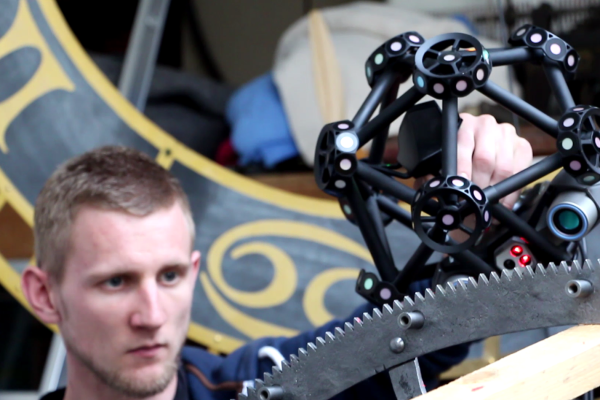
We call the circular device surrounding the scanner head and measuring device a "target." The target serves as a reference point for the external tracker (C-Track) to map real-world spatial coordinates to digital space. In other words, it serves as a reference point for aligning the scanner's real-world location with its position in the digital virtual space.
Q. Could you share some examples of businesses utilizing Creaform's 3D scanner products in industries other than manufacturing?
A. While manufacturing accounts for approximately 80% of the 3D scanner market, they are also widely used in other fields. They have long been used for the preservation and management of artifacts and artwork, as well as for non-destructive testing. Recently, their use in the medical and gaming sectors has been increasing.
In particular, the augmented reality (AR) and virtual reality (VR) gaming sectors are emerging markets, just like CAD reverse engineering. While digital graphics in the past were conceptual diagrams of human imagination and reality, recent trends are shifting towards scanning real-world images with 3D scanners and then reproducing them digitally to maximize realism.
Q. What are Creaform's goals and plans for the future 3D scanner market?
A. As a leader in 3D scanners in the measurement field, Creaform aims to position itself as a partner that contributes to the advancement of the industry and the growth of our customers.
Our goal is to move beyond the limited solutions of the past, enabling our customers to develop accurate and predictive models, and then use these models to develop next-generation mass production and digital restoration technologies. We aim to grow together with them.
Comments
Related news
Creaform Introduces Two Improved Portable 3D Scanners Optimized for Reverse Engineering and Quality Control
Creaform has introduced two new industrial portable 3D scanners to the domestic market. The HandySCAN Black features improved optics and blue laser technology with an ergonomic design, ensuring portability and rapid measurement processes. It enables fast measurement of various types of components regardless of size, material, or complex geometry from any location. The GoSCAN Spark is an industrial 3rd generation GoSCAN 3D portable scanner that can acquire 3D data of measurement objects without location constraints. Equipped with four inline cameras for fast 3D scanning and color acquisition, the GoSCAN Spark enables quick setup and rapid scanning of any measurement object, producing high-resolution scan data including color information through white light technology.
2019.06.27by 이수민 기자
Creaform Launches 3D Scanner for Non-Destructive Pipeline Inspection
Creaform has added Go!SCAN 3D to its NDT pipeline inspection product line for the oil and gas industry. Additionally, it has launched Pipecheck 6.0, an NDT software. Pipecheck 6.0 includes an additional module for wrinkle analysis within pipes.
2020.07.10by 이수민 기자
Collaborative solution for sharing 3D designs via the cloud unveiled.
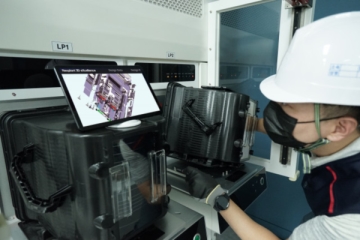
Samsung SDS recently announced the launch of 'Nexplant 3D Excellence Solution,' which supports on-site sharing of 3D design data and non-face-to-face collaboration. By utilizing this solution, 3D design data can be shared via cloud, enabling collaboration between clients, construction sites, and partners.
2020.09.04by 이수민 기자
Korea Instrument, KOLAS Accredited Calibration Agency First to Simultaneously Acquire ISO/IEC 27,001·27,701
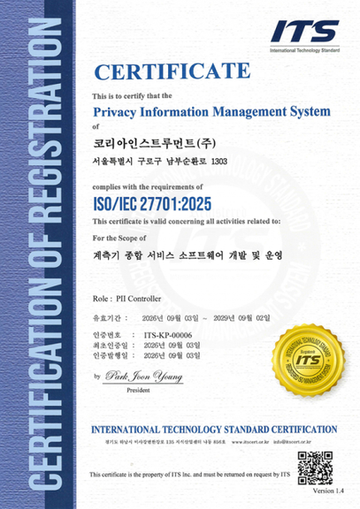
Korea Instrument has become the first among KOLAS accredited calibration agencies to simultaneously acquire ISO/IEC 27,001 and ISO/IEC 27,701 certifications. Through its proprietary platforms CWIZ Enterprise and CWIZ Partners, the company has embedded information security and personal data protection requirements across all business processes including customer information, equipment data, and calibration reports, with plans to continuously advance its management system through regular audits and security inspections.
2026.10.12by 배종인 기자
TeamViewer One, IT Incident Automation Workflow and Resolution Center Enhanced
TeamViewer has added IT incident automation capabilities and an advanced Resolution Center to its integrated digital workplace management platform 'TeamViewer ONE'. Recurrent service disruptions, configuration errors, and capacity shortages are automatically handled according to preset policies, and device status verification through script deployment can be managed in a unified interface, significantly reducing repetitive tasks for IT teams.
2026.10.12by 배종인 기자











