



Perovskite solar cell moisture vulnerability problem solved.
 Published2020.09.25 12:10
A joint research team from UNIST and KIER has developed a hydrogen-based hole transport layer.
Addressing Perovskite Battery Vulnerabilities by Switching to Fluorine
A material has been developed that overcomes the moisture vulnerability issue that has hindered the commercialization of perovskite solar cells, the next-generation type of solar cell. Cells using this material achieved the highest efficiency (24.82%) among perovskite solar cells reported to date.
On the 25th, a joint research team from Ulsan National Institute of Science and Technology (UNIST) and the Korea Institute of Energy Research (KIER) developed an 'organic hole transport layer material' that prevents the photoactive layer of a perovskite solar cell from being exposed to moisture while increasing cell efficiency.
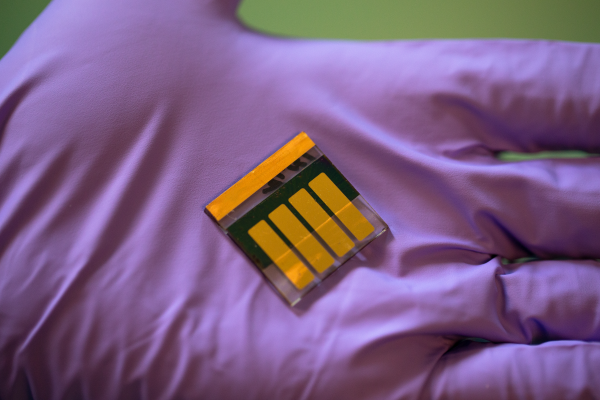
A perovskite solar cell is a solar cell that produces electric current from sunlight by using a perovskite material with an ABO 3 structure in which two cations (A, B) and one anion (O) are combined as a photoactive layer.
The photoactive layer is a material in a solar cell that receives sunlight and generates electrons and holes. These electrons and holes are then transported to the electrodes through the electron transport layer and hole transport layer, respectively. The greater the number of electrons and holes transported to the electrodes, the greater the power generation.
However, if the hole transport layer absorbs moisture from the air, its performance deteriorates. Furthermore, moisture can degrade the photoactive layer, which is made of perovskite material. When decomposition occurs, the efficiency of the battery decreases.
The joint research team developed a hole-transport material with high performance but no moisture absorption by replacing hydrogen in the hole-transport layer with fluorine, which has a spiro-OMeTAD structure. It has strong hydrophobic properties, meaning it does not mix with water like oil, and thus does not absorb moisture.
Using the developed material as a hole-transport layer in a solar cell, the research team achieved a high-efficiency perovskite solar cell with a 24.82% efficiency (24.64% according to official certification). Furthermore, moisture stability was improved, maintaining an efficiency of over 87% for 500 hours even in a high-humidity environment. Using conventional materials as hole-transport layers would result in an efficiency drop of over 40% after 500 hours.
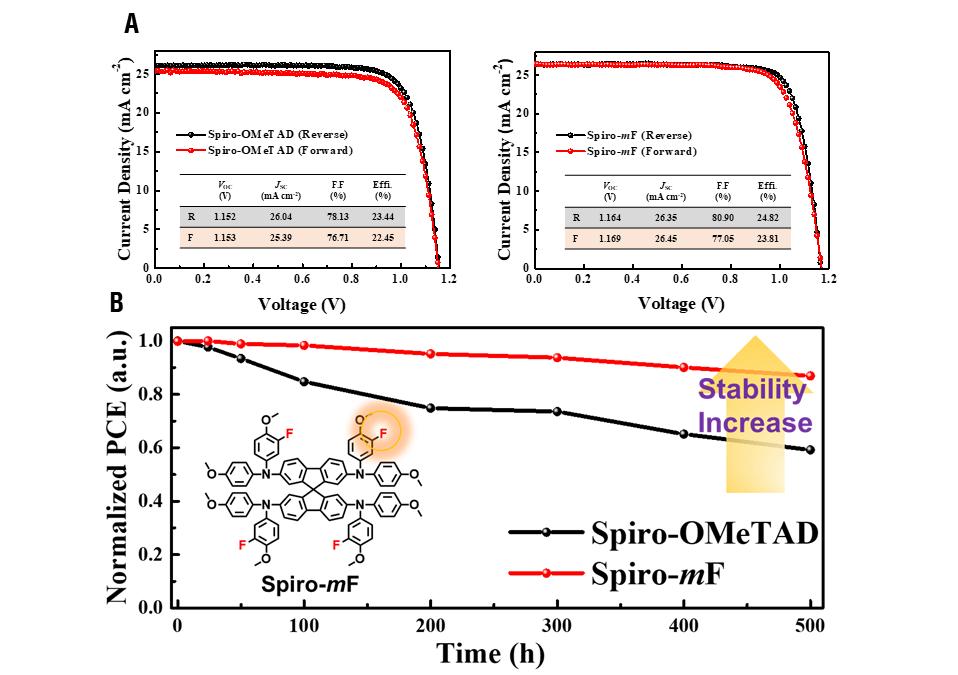
For the officially certified battery, a high open circuit voltage of 1.18 V was observed, which is the closest value to the voltage theoretically generated by a perovskite battery.
Dr. Dong-Seok Kim of KIER, who was in charge of manufacturing the battery, explained, “We obtained an open circuit voltage close to the theoretical value with a voltage loss of 0.3 V (based on perovskite solar cells), which is the lowest voltage loss reported to date.” He added, “Even if the battery is manufactured on a large area (1 cm 2 ), the decrease in efficiency (22.31%) is small, so the possibility of commercialization is bright.”
The results of this study were published online in the journal Science on September 25.
Comments
Related news

Technology developed to reduce electric vehicle battery size by half
Samsung Electronics Advanced Institute of Technology has developed groundbreaking technology to resolve the dendrite problem in all-solid-state batteries, which is garnering attention as a next-generation battery, and the research has been published in Nature Energy. All-solid-state batteries can increase energy density by reducing the thickness of the battery anode, making it possible to reduce the size to approximately half that of lithium-ion batteries.
2020.03.11by 이수민 기자
Infineon Launches 1200V SiC Power Module for EVs
Infineon Technologies has launched the EasyPACK module 'FF08MR12W1MA1_B11A' adopting CoolSiC automotive MOSFET technology. The new module is a 1200V half-bridge module with 8mΩ/150A current rating, suitable for high-speed switching auxiliary drives such as HV/HV DC-DC step-up converters, multi-phase inverters, and fuel cell compressors.
2020.07.07by 강정규 기자
Separator technology developed to increase silicon solar cell efficiency using water
A research team led by Professor Choi Kyung-jin from the Department of Materials Science and Engineering at UNIST has developed a silicon solar cell technology utilizing water. The technology involves adding water to a separation membrane located on the rear side of the solar cell, thereby improving performance and simplifying the manufacturing process. The separation membrane is a material that determines the efficiency of solar cells. The research team enhanced performance and reduced manufacturing steps by adding water to an organic-based separation membrane.
2020.09.17by 명세환 기자

Intel Unveils Next-Generation 'Core Ultra Series 3' and vPro Platform for Enterprise PCs
Intel has officially unveiled the "Intel Core Ultra Series 3" for next-generation enterprise PCs and the latest vPro platform, addressing a wide range of demands from enterprise notebooks to high-performance workstations.
2026.03.26by 배종인 기자

ROHM Launches ESD Protection Diode Compatible with High-Speed Interfaces of 10Gbps or Higher
Semiconductor specialist ROHM has developed the 'RESDxVx series' of ESD (electrostatic discharge) protection diodes capable of responding to next-generation high-speed data communication environments exceeding 10Gbps, simultaneously enhancing both signal quality maintenance required in high-speed interfaces and IC protection performance.
2026.03.26by 배종인 기자











