


Material and structural innovation, development of ultra-high sensitivity microwave detectors
 Published2020.10.05 10:42
Rapid measurement of electrical resistance using 'Josephson junction structure'
Expected to be utilized in next-generation quantum information technology
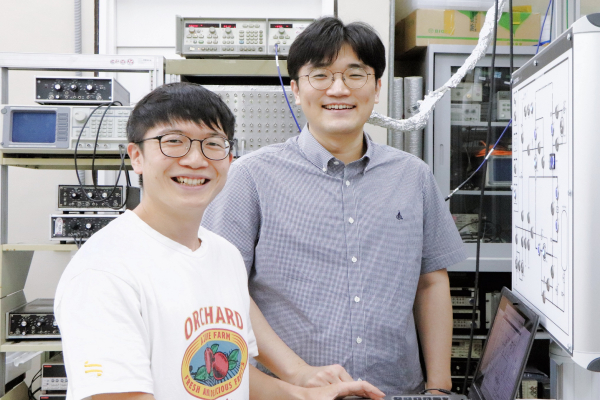
Developed an ultra-sensitive detector. (From left) Researcher Jung Woo-chan, Professor Lee Gil-ho [Photo by Samsung Electronics]
A team led by Professor Lee Gil-ho of the Department of Physics at POSTECH, in collaboration with Harvard University, the Massachusetts Institute of Technology, and Raytheon BBN, measured microwave intensity at the theoretical limit of 1 attowatt (aW) per second. It was announced on the 4th that an ultra-high sensitivity detector capable of detecting at the level of 1 aW (100 quadrillionths of a W) has been developed.
Recently, as it has become known that microwaves can be utilized in quantum information technologies such as quantum computing and quantum information communication, research aimed at detecting them with ultra-high sensitivity is actively underway.
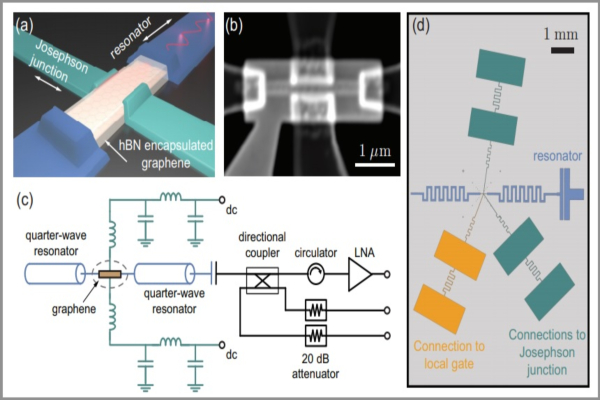
Bolometers currently used as microwave detectors consist of a microwave-absorbing material, a material that converts absorbed microwaves into heat, and a material that converts the generated heat into electrical resistance, and they calculate the intensity of the absorbed microwaves using changes in electrical resistance.
However, because bolometers use semiconductor devices such as silicon or gallium arsenide as microwave absorption materials, precise intensity measurement was impossible, with the detection limit remaining at the level of 1 nanowatt (nW, 1 nm is 1/1,000,000,000 W) per second of measurement.
Professor Lee's team increased microwave absorption rates by using graphene instead of commercially available semiconductors. Furthermore, by introducing a 'Josephson junction structure' that sandwiches graphene between two superconductors, they reduced the change in electrical resistance generated by graphene to 10 picoseconds (ps. 1 ps made it possible to detect within 1/100 billionth of a second.
As a result, the microwave detection was able to be increased to the theoretical limit of 1 attowatt (aW) per second.
"It is significant that we have established foundational technology for the actual implementation of next-generation quantum devices," said Professor Lee. "By utilizing this technology, we can maximize the measurement efficiency of quantum computing and enable the development of large-scale quantum computers."
Comments
Related news
Brain health maintenance mechanisms, artificial intelligence, etc. selected for Samsung Future Technology Development Project
Samsung Electronics has selected 40 research projects for the first half of 2017 under its Future Technology Development Program, which is supported by research funding from Samsung Electronics. A total of 18 projects are being supported in the basic science field through the Samsung Future Technology Foundation, and 22 projects are being operated in the materials technology and ICT fields through Samsung Electronics' Future Technology Development Center. The Samsung Future Technology Development Program, which commenced in 2013, is a program that supports the cultivation of national future technologies by contributing a total of 1.5 trillion won over 10 years across three research areas: basic science, materials technology, and ICT.
2017.04.07by 신윤오 기자

Samsung Electronics Selects Projects for Future Technology Development Support, Including Research on Treatments for Dementia and Intractable Cancer
Samsung Electronics has selected 31 projects to be supported through the Future Technology Development Project in the first half of 2018, funded by Samsung's research contributions. The 'Samsung Future Technology Development Project' began in 2013 and is a program that selects supported projects three times annually across three research fields—basic science, materials technology, and ICT—contributing a total of 1.5 trillion won over 10 years to support the development of national future technologies. The fields selected this time consist of 10 projects in basic science, 10 in materials technology, and 11 in ICT, with 50.1 billion won in research funding to be provided over the next five years.
2018.04.05by 김지혜 기자

Next-generation wearable devices made with graphene
Graphene is a material composed of a single layer of carbon atoms bonded in a hexagonal honeycomb structure on a two-dimensional plane. It has a thin thickness, high transparency, flexibility, stretchability, and high electrical and thermal conductivity. If materials and components utilizing these characteristics of graphene are commercialized, the wearability of wearable devices will be significantly improved compared to current standards.
2020.08.13by 이수민 기자
Quantum sensors surpassing classical sensors, a precursor to the advancement of quantum technology
Quantum sensing is a sensing and imaging technology that precisely measures minute signals that cannot be detected by classical systems by utilizing the unique characteristics of quantum systems. Precise measurement of quantum states such as qubits forms the foundation of all quantum technologies, and advances in quantum sensing can serve as a catalyst for realizing major long-term technologies such as quantum computing and quantum communication.
2020.09.01by 이수민 기자
KAIST Develops Chip-Scale Ultra-Low-Noise Pulse Signal Generation Technology
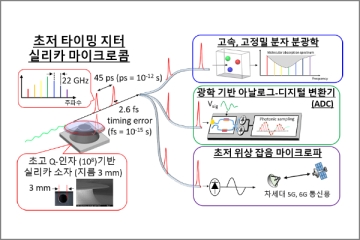
A joint research team led by Professor Lee Han-seok from the Department of Physics at KAIST and Professor Kim Jung-won from the Department of Mechanical Engineering has developed a technology for periodically generating pulse signals with very low noise using silica microresonators. The technology is expected to be utilized as a sampling clock for ultra-high-speed wideband ADCs or as an ultra-low-noise microwave signal source for 5G and 6G communications.
2020.09.18by 이수민 기자











