



KAIST Develops Long-Lasting and Highly Safe Aqueous Battery
 Published2020.10.06 09:58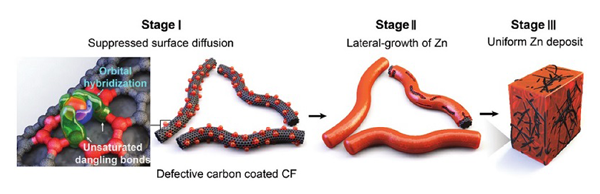
▲ Overview of technology to inhibit zinc dendrite formation through high-density carbon defect interfaces [Photo=KAIST]
A research team led by Professor Heetak Kim of the Department of Biological and Chemical Engineering at KAIST announced on the 5th that they have succeeded in developing the longest-lasting aqueous zinc-bromine redox flow battery.
Recently, energy storage system (ESS) technology, which can increase energy efficiency, is gaining attention.
Currently, most ESS systems adopt the inexpensive 'lithium-ion battery' technology, but it has been pointed out that it is unsuitable for ESS due to inherent fire risks. In fact, there were 33 ESS fire accidents caused by lithium-ion batteries in Korea over the two years from 2017 to 2019. This accounts for 35% of the total, and the total loss, including damages incurred from shutdowns, is estimated to exceed 700 billion won.
Therefore, redox flow batteries using water-based electrolytes that can fundamentally prevent battery overheating are receiving great attention. In particular, zinc-bromine redox flow batteries using ultra-low-cost zinc bromide (ZnBr2) as an active material have been developed for ESS since the 1970s because they have the advantage of being able to increase energy density along with high operating voltage compared to other aqueous redox flow batteries, and are inexpensive.
The problem is that commercialization is being delayed due to the short lifespan of zinc anodes. In particular, the formation of uneven, protruding dendrites on zinc metal during the charging and discharging process is pointed out as a major cause of shortened lifespan by inducing internal short circuits in the battery.
Professor Heetak Kim's research team focused on the fact that "self-agglomeration" through "surface diffusion" of zinc nuclei occurs at carbon electrode interfaces with low surface energy. Through quantum mechanics-based computer simulations and transmission electron microscopy analysis, they succeeded in identifying self-agglomeration as the primary cause of zinc dendrite formation. In addition, the team discovered that dendrites did not form in specific carbon defect structures because the surface diffusion of zinc nuclei was suppressed.
"Professor Kim Hee-tak stated, 'The achievement of this research is the presentation of a new technology to overcome the lifespan limitations of next-generation aqueous batteries.' He added, 'Not only is it cheaper than existing lithium-ion batteries, but it can also operate for over 5,000 cycles at an energy efficiency of over 80%, which will contribute to the expansion of renewable energy and the revitalization of the ESS market.'"
Comments
Related news
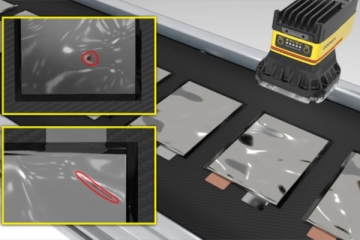
Quality control of electric vehicle battery production requires deep learning solutions
Electric vehicle batteries must be built with durability that can withstand harsh conditions. A single defectively manufactured battery cell can have a negative impact on the overall battery pack performance. Therefore, if quality control is not conducted in a timely manner, numerous defective products can be produced. In response, Cognex has proposed a deep learning-based machine vision solution that can be applied to manufacturing process automation for ensuring the quality and extending the lifespan of electric vehicle batteries.
2020.09.10by 명세환 기자
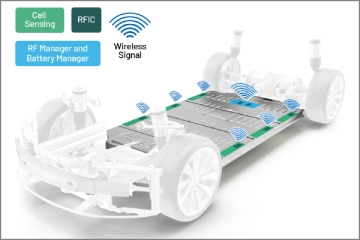
ADI's wireless battery management system will be used in GM electric vehicles.
ADI has launched the industry's first wireless battery management system (wBMS). The wBMS eliminates harnesses, reducing wiring by up to 90% and battery pack volume by up to 15%, while improving design flexibility and manufacturing ease without compromising range and accuracy throughout the battery lifecycle.
2020.09.14by 명세환 기자
.jpg)
Toshiba CMOS operational amplifiers suitable for battery-powered devices
Operational amplifiers are used to amplify weak sensor signals. To extend the operating time of battery-powered devices, operational amplifiers with low current consumption are required. Toshiba has released the TC75S102F, a CMOS operational amplifier with low current consumption, and has begun shipments.
2020.09.30by 강정규 기자
LS Electric Unveils BTS, ESS Fire Prevention Technology
LS Electric has developed BTS (Battery Temperature Sensing), an ESS fire blocking technology. BTS is a technology that utilizes optical technology to measure battery temperature in real-time down to the cell level and stops ESS operation when overheating occurs.
2020.10.05by 김동우 기자

ESP32 Development Environment Selection and GPS Application Implementation
The ESP32 is a microcontroller that integrates Wi-Fi, Bluetooth, 12-bit ADC, capacitive touch, PWM, DAC, and UART in a single SoC. However, the abundance of features does not by itself solve the designer's problems. The real challenges lie in selecting the appropriate development environment, determining which pins can be used and which must be avoided, and converting raw data from modules into usable information. This document addresses ESP32 peripheral constraints (ADC2 and Wi-Fi coexistence limitation, UART1 occupancy, ADC non-linear regions), the trade-offs between Arduino IDE and ESP-IDF, and the process from connecting NEO-6M/NEO-M8N GPS modules to UART2, parsing NMEA sentences, and visualizing routes in Google Earth, all organized based on documented references.
2026.10.12by 편집부











