


The semiconductor M&A storm reached its second-largest volume ever, reaching $63.1 billion.
 Published2020.10.06 14:05
Semiconductor M&A deal second largest ever
Mergers and acquisitions (M&A) in semiconductor companies, which had been slowed by the escalating US-China trade dispute, governments around the world strengthening their protectionist stances for their domestic semiconductor industries, and the spread of COVID-19, have seen a rare boost in activity in the third quarter.
Semiconductor market research firm IC Insights predicted on the 29th that 2020 would be the second-largest year in terms of semiconductor M&A transactions ever, following two large-scale deals in July and September.
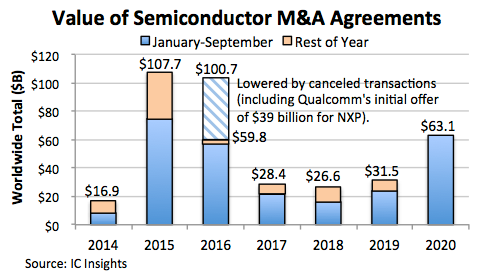
It will be recorded as the second largest year ever [Graph = IC Insights]
Last July, Analog Devices (ADI), the second-largest analog semiconductor company, acquired and merged with Maxim Integrated, the seventh-largest company, for $21 billion (approximately KRW 24.3978 trillion).
Related article: ADI, the second-largest analog semiconductor company, acquires and merges with Maxim, the seventh-largest.
> In September, Nvidia, an American GPU specialist company, acquired and merged with Arm, a British IP specialist company, from Japan's Softbank for $40 billion (approximately 46.448 trillion won).
Related article: Arm finally joins Nvidia... Existing business maintained
Before the two M&As were concluded, the total M&A transaction volume among semiconductor companies in the first quarter of 2020 was only $1.8 billion (approximately KRW 2.09 trillion), and in the second quarter, it was only $170 million (KRW 197.4 billion).
If the relevant authorities approve the two M&As concluded in the third quarter, the total M&A transaction volume in semiconductor companies in 2020 is expected to reach $63.1 billion (KRW 73.3158 trillion), surpassing 2016 and following the record-breaking year of 2015.
Comments
Related news
ST Strengthens Wireless Connectivity Solutions with Acquisition of French Spoon and GaRiot
STMicroelectronics announced that it has signed two M&A agreements regarding the acquisition of the entire share capital of Visium, a French UWB specialist fabless company, and Riot Micro, a Canadian company with cellular IoT connectivity technology. The transaction terms were not disclosed. Upon completion of the transactions, ST plans to enhance and add wireless connectivity capabilities to its STM32 MCU and secure MCU portfolio.
2020.07.29by 명세환 기자
ADI Strengthens "2.1" Capabilities with Acquisition of Invecas HDMI Business Unit
Analog Devices has acquired InveCas' HDMI business division. The transaction terms related to the acquisition were not disclosed. Through this acquisition, ADI has strengthened its AV technology capabilities while expanding its position within the HDMI standards organization.
2020.07.30by 이수민 기자

Keysight Strengthens SW Testing Capabilities with Acquisition of Eggplant
Keysight has acquired Eggplant, a company specializing in digital intelligent automation. Through this acquisition, Keysight will be able to build innovation across both the physical and protocol layers as well as the application layer of the automated software testing market. The bidirectional utilization of measurement technology between the two companies is expected to enhance solution differentiation through a broader scope of support.
2020.07.31by 이수민 기자

Intel Unveils Next-Generation 'Core Ultra Series 3' and vPro Platform for Enterprise PCs
Intel has officially unveiled the "Intel Core Ultra Series 3" for next-generation enterprise PCs and the latest vPro platform, addressing a wide range of demands from enterprise notebooks to high-performance workstations.
2026.03.26by 배종인 기자

ROHM Launches ESD Protection Diode Compatible with High-Speed Interfaces of 10Gbps or Higher
Semiconductor specialist ROHM has developed the 'RESDxVx series' of ESD (electrostatic discharge) protection diodes capable of responding to next-generation high-speed data communication environments exceeding 10Gbps, simultaneously enhancing both signal quality maintenance required in high-speed interfaces and IC protection performance.
2026.03.26by 배종인 기자











