



Successful Development of 'PeLED', Addressing Blue Light Issues and Economics
 Published2020.10.13 12:01
Development of blue-emitting perovskite LEDs
Triple the luminous efficacy by replacing the material within the device.
A research team led by Professors Myung-Hoon Song and Sang-Kyu Kwak of UNIST and Professor Han-Young Woo of Korea University announced on the 13th that they have jointly developed a 'perovskite light-emitting device (PeLED)' that emits blue light. The perovskite light-emitting device developed by the research team is three times more efficient at producing blue light than existing devices and has high color purity, enabling the implementation of a vivid blue color.
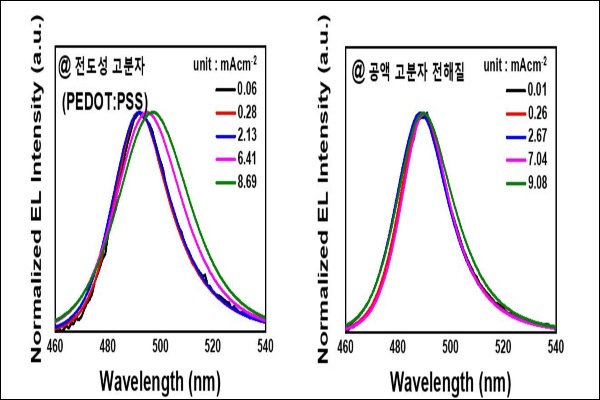
▲Comparison of color purity (luminescence spectrum stability) of light-emitting devices [Photo = UNIST]
However, existing blue PeLEDs only achieved a 10% efficiency in converting electrical energy into light, resulting in power consumption less than half that of red or green. Furthermore, the ions added to create blue PeLEDs caused color purity to deteriorate over time, posing a problem.
So, the research team simplified the process by changing the 'hole transport layer' material adjacent to the perovskite in the light-emitting device. By using a newly synthesized organic material as a hole transport layer, the efficiency was improved by 3 to 4 times compared to existing light-emitting devices, and the 'electroluminescence spectrum' was also greatly stabilized, achieving both problem solving and economic feasibility.
Professor Song Myung-hoon said, “PeLED achieved efficiency levels comparable to OLED (Organic LED) in a short period of six years, but its blue light efficiency was only around 10%.” He added, “This research is expected to simultaneously improve device efficiency and color purity, which will help accelerate commercialization.”
Meanwhile, the results of this study were published on September 10 in ACS Nano, a world-renowned journal in the field of nanotechnology.
Comments
Related news
LG Electronics Launches Two 65-Inch 8K NanoCell TVs in Korea
LG Electronics has launched a new nanocell TV product in the domestic market that implements 8K resolution on a 65-inch display. Nanocell is a technology that precisely adjusts light wavelengths using particles approximately one nanometer in size to express colors in a more refined and accurate manner. LG Electronics applied nanocell technology at the panel stage, which is closest to the viewer's eyes.
2020.05.27by 강정규 기자
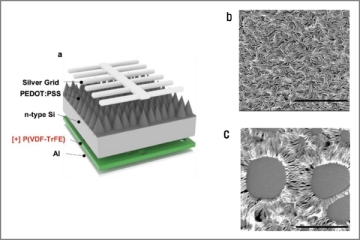
Separator technology developed to increase silicon solar cell efficiency using water
A research team led by Professor Choi Kyung-jin from the Department of Materials Science and Engineering at UNIST has developed a silicon solar cell technology utilizing water. The technology involves adding water to a separation membrane located on the rear side of the solar cell, thereby improving performance and simplifying the manufacturing process. The separation membrane is a material that determines the efficiency of solar cells. The research team enhanced performance and reduced manufacturing steps by adding water to an organic-based separation membrane.
2020.09.17by 명세환 기자
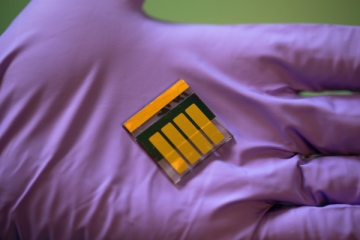
Perovskite solar cell moisture vulnerability problem solved.
A material has been developed that solves the moisture vulnerability problem, which was a bottleneck in the commercialization of perovskite solar cells, the next-generation solar cell technology. A joint research team from UNIST and KIER developed a hole transport layer material with superior performance that does not absorb moisture by replacing hydrogen with fluorine in the spiro-structured hole transport layer. It exhibits strong hydrophobicity, a property similar to oil that prevents mixing with water, thereby not absorbing moisture.
2020.09.25by 이수민 기자
ESP32 Development Environment Selection and GPS Application Implementation
The ESP32 is a microcontroller that integrates Wi-Fi, Bluetooth, 12-bit ADC, capacitive touch, PWM, DAC, and UART in a single SoC. However, the abundance of features does not by itself solve the designer's problems. The real challenges lie in selecting the appropriate development environment, determining which pins can be used and which must be avoided, and converting raw data from modules into usable information. This document addresses ESP32 peripheral constraints (ADC2 and Wi-Fi coexistence limitation, UART1 occupancy, ADC non-linear regions), the trade-offs between Arduino IDE and ESP-IDF, and the process from connecting NEO-6M/NEO-M8N GPS modules to UART2, parsing NMEA sentences, and visualizing routes in Google Earth, all organized based on documented references.
2026.10.12by 편집부
MIPI CSI-2, DSI-2, C-PHY, D-PHY Test Solution Technical White Paper
The MIPI interface adopts a burst mode that transitions between low-power (LP) and high-speed (HS) states for low-power consumption, and in return, strict timing rules are imposed on state transitions. Additionally, the high-speed section operates as a packet-based protocol with headers, ECC, and CRC, so verification engineers must handle waveforms and protocols simultaneously. Traditional configurations combining general-purpose oscilloscopes and AWGs reveal limitations in setup complexity, measurement uncertainty, and lack of reproducibility when faced with these requirements. This white paper, based on webinar materials, organizes the structure of this problem and describes how the SV5C-DPTXCPTX generator for receiver testing and SV5C-DPRXCPRX analyzer for transmitter testing integrate state transition testing, stressed eye testing, and protocol analysis into a single bench, along with their application boundaries.
2026.10.12by 편집부











