


ETRI-DGIST Develop New All-Solid State Battery Electrode Structure
 Published2020.10.15 13:59
Successful design of lithium-ion electrode structure
Energy density increased 1.5 times compared to existing models
On the 15th, a joint research team from the Electronics and Telecommunications Research Institute (ETRI) and the Daegu Gyeongbuk Institute of Science and Technology (DGIST) announced that they have designed a new type of electrode structure for all-solid-state secondary batteries by identifying the characteristics of smooth lithium ion diffusion between active materials.
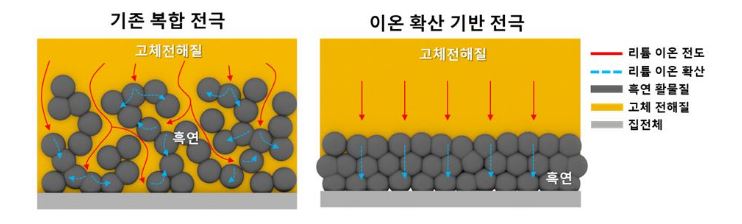
▲ Conventional composite all-solid-state electrode (left) developed by ETRI researchers
Ion diffusion-based all-solid-state electrode (right) [Photo = ETRI]
All-solid-state rechargeable batteries are next-generation batteries that utilize solids as the electrolyte to transfer ions at the battery electrodes. Unlike primary batteries, which cannot be reused after a single use, rechargeable batteries, such as smartphone batteries, can be recharged and used repeatedly even after being discharged. In addition, solid electrolytes are safer than liquid electrolytes, which can potentially cause a fire, and have the advantage of improving energy density by enabling the implementation of bipolar secondary batteries.
The electrode structure of commonly used all-solid-state secondary batteries consists of a solid electrolyte responsible for ion conduction, a conductive material responsible for electron conduction, an active material responsible for energy storage, and a binder that physically and chemically holds them together.
ETRI researchers confirmed through experiments that ions are transferred even between graphite active material particles and proposed a new type of electrode structure for all-solid-state secondary batteries composed of active material and binder, excluding solid electrolytes and conductive agents. This structure was theoretically verified through virtual electrochemical experiments using supercomputer-based modeling by collaborating research team member DGIST, and was successfully implemented experimentally.
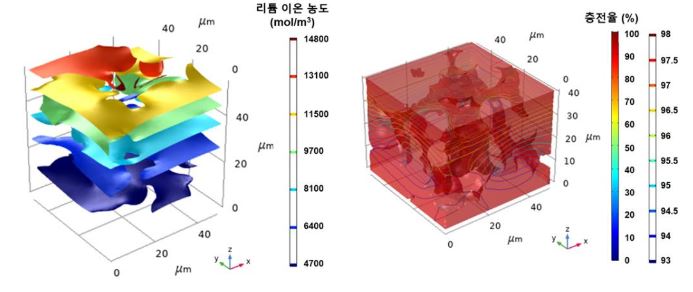
▲ (From left) Supercomputer simulation-based electrode interior
Lithium ion concentration distribution and charging rate results [Photo = ETRI]
Since a solid electrolyte is not required, more active material can be packed into the electrode in the same volume, maximizing the composition to the extent that the active material content in the electrode reaches 98 wt%. As a result, the energy density was increased by approximately 1.5 times compared to a conventional graphite composite electrode.
Changes were also sought in the manufacturing process. Sulfide-based solid electrolyte materials possess high ionic conductivity and excellent moldability, but their high chemical reactivity made the selection of solvents and binders challenging. In contrast, the research team fabricated electrodes by conducting various studies to improve the performance of all-solid-state secondary batteries, as the absence of a solid electrolyte allowed for greater freedom in the selection of solvents and binders.
Dr. Lee Young-ki of ETRI’s Intelligent Sensor Research Lab, the principal investigator of this research, stated, “We will strive to develop secondary batteries with even higher energy density using this technology, secure core source technologies, and achieve commercialization.”
Although this study focused on graphite anode active materials, ETRI plans to conduct applied research on various electrode materials and cathode active materials based on the same concept. In addition, the company plans to simultaneously carry out research to advance the technology by reducing interfacial issues between electrodes and making the electrodes thinner to increase efficiency.
Comments
Related news
Perovskite solar cell moisture vulnerability problem solved.
A material has been developed that solves the moisture vulnerability problem, which was a bottleneck in the commercialization of perovskite solar cells, the next-generation solar cell technology. A joint research team from UNIST and KIER developed a hole transport layer material with superior performance that does not absorb moisture by replacing hydrogen with fluorine in the spiro-structured hole transport layer. It exhibits strong hydrophobicity, a property similar to oil that prevents mixing with water, thereby not absorbing moisture.
2020.09.25by 이수민 기자
KAIST Develops Long-Lasting and Highly Safe Aqueous Battery
A research team led by Professor Kim Hee-tak from the Department of Chemical and Biomolecular Engineering at KAIST has announced successful development of an aqueous zinc-bromine redox flow battery with the longest lifespan. Recently, energy storage systems (ESS) technology capable of improving energy utilization efficiency has been gaining attention. Currently, most ESS systems adopt the inexpensive 'lithium-ion battery' technology; however, it has been pointed out that due to inherent problems, there are concerns about fire hazards and that it is not suitable for ESS applications. In fact, ESS fire accidents caused by lithium-ion batteries that occurred domestically from 2017 to 2019 over a two-year period numbered 33 cases. This accounts for 35% of the total, and when combined with losses from operational shutdowns, it is estimated to exceed approximately 700 billion won.
2020.10.06by 김동우 기자
EV lithium-air battery developed to run 1,000 km on a single charge
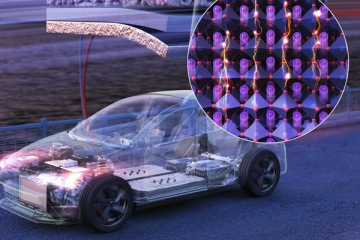
A domestic research team has developed electric vehicle battery technology capable of traveling 1,000km on a single charge. A joint research team from UNIST and Samsung Electronics' Advanced Technology Institute announced that they have solved the battery lifespan degradation problem, which had been pointed out as a commercialization challenge, by replacing organic materials inside lithium-air batteries with ceramic materials.
2020.10.15by 이수민 기자

ESP32 Development Environment Selection and GPS Application Implementation
The ESP32 is a microcontroller that integrates Wi-Fi, Bluetooth, 12-bit ADC, capacitive touch, PWM, DAC, and UART in a single SoC. However, the abundance of features does not by itself solve the designer's problems. The real challenges lie in selecting the appropriate development environment, determining which pins can be used and which must be avoided, and converting raw data from modules into usable information. This document addresses ESP32 peripheral constraints (ADC2 and Wi-Fi coexistence limitation, UART1 occupancy, ADC non-linear regions), the trade-offs between Arduino IDE and ESP-IDF, and the process from connecting NEO-6M/NEO-M8N GPS modules to UART2, parsing NMEA sentences, and visualizing routes in Google Earth, all organized based on documented references.
2026.10.12by 편집부
MIPI CSI-2, DSI-2, C-PHY, D-PHY Test Solution Technical White Paper
The MIPI interface adopts a burst mode that transitions between low-power (LP) and high-speed (HS) states for low-power consumption, and in return, strict timing rules are imposed on state transitions. Additionally, the high-speed section operates as a packet-based protocol with headers, ECC, and CRC, so verification engineers must handle waveforms and protocols simultaneously. Traditional configurations combining general-purpose oscilloscopes and AWGs reveal limitations in setup complexity, measurement uncertainty, and lack of reproducibility when faced with these requirements. This white paper, based on webinar materials, organizes the structure of this problem and describes how the SV5C-DPTXCPTX generator for receiver testing and SV5C-DPRXCPRX analyzer for transmitter testing integrate state transition testing, stressed eye testing, and protocol analysis into a single bench, along with their application boundaries.
2026.10.12by 편집부











