


UNIST Develops Hybrid Tandem Solar Cells That Reduce Costs and Increase Productivity
 Published2020.10.23 10:25
Efficiency is approaching commercialization by absorbing both visible and near-infrared light.
A domestic research team has developed an inorganic perovskite solar cell with an efficiency of 18%, close to the 20% threshold for commercialization.
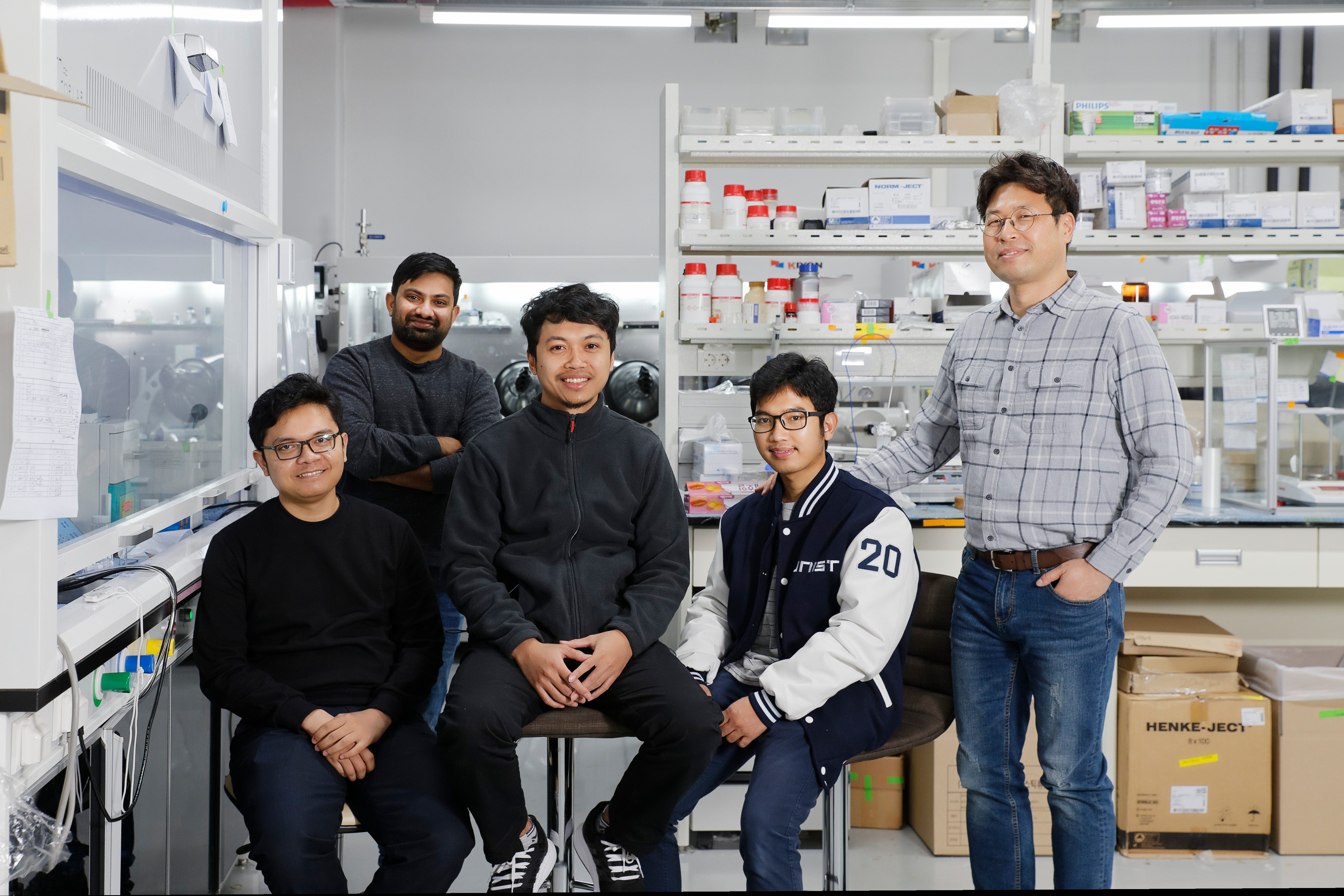
Professor Jang Seong-yeon's team from the Department of Energy and Chemical Engineering at Ulsan National Institute of Science and Technology (UNIST) announced on the 22nd that they have developed a hybrid solar cell using heterogeneous materials. This has increased efficiency from the existing 12.5% to 45%, bringing commercialization closer.
This is a "1+1" technology that links inorganic perovskite solar cells with polymer solar cells of different properties. Efficiency is improved by having the polymer material absorb the near-infrared region of sunlight, which the inorganic perovskite material cannot absorb.
Using inorganic perovskite as a light-absorbing material (photoactive layer) allows the creation of solar cells with much better thermal stability than conventional organic-inorganic mixed perovskite materials. However, when solar cells are made with this material, the efficiency is lower than that of general organic-inorganic mixed perovskite materials.
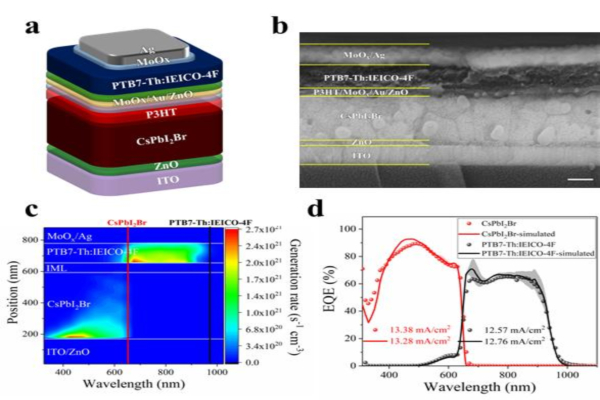
The research team complemented the weaknesses of inorganic perovskite solar cells by using two types of light-absorbing layers together. A '1+1 tandem structure' battery was created by connecting 'perovskite sub-cells' and 'polymer material sub-cells' in series vertically.
The principle is that perovskite unit cells absorb the visible light range of sunlight, and polymer material unit cells absorb the near-infrared range.
Professor Jang explained, “Through optical simulation, we were able to design perovskite and polymer materials with complementary solar absorption regions, and significantly increase efficiency by minimizing the ‘voltage loss’ that occurs when combining two unit cells.”
In particular, the newly developed perovskite-polymer hybrid tandem solar cell can be easily manufactured entirely using a "low-temperature solution process." Therefore, it is advantageous for mass production and offers lower manufacturing costs compared to existing silicon solar cells.
Professor Jang Seong-yeon said, “The hybrid tandem solar cell developed this time has applied technology that maximizes the advantages of each material,” and expressed his expectation, saying, “Through this, we will be able to develop high-efficiency and high-stability inorganic perovskite-based solar cells with an efficiency of over 28% in the future.”
Comments
Related news
Separator technology developed to increase silicon solar cell efficiency using water
A research team led by Professor Choi Kyung-jin from the Department of Materials Science and Engineering at UNIST has developed a silicon solar cell technology utilizing water. The technology involves adding water to a separation membrane located on the rear side of the solar cell, thereby improving performance and simplifying the manufacturing process. The separation membrane is a material that determines the efficiency of solar cells. The research team enhanced performance and reduced manufacturing steps by adding water to an organic-based separation membrane.
2020.09.17by 명세환 기자
Perovskite solar cell moisture vulnerability problem solved.
A material has been developed that solves the moisture vulnerability problem, which was a bottleneck in the commercialization of perovskite solar cells, the next-generation solar cell technology. A joint research team from UNIST and KIER developed a hole transport layer material with superior performance that does not absorb moisture by replacing hydrogen with fluorine in the spiro-structured hole transport layer. It exhibits strong hydrophobicity, a property similar to oil that prevents mixing with water, thereby not absorbing moisture.
2020.09.25by 이수민 기자
ETRI-DGIST Develop New All-Solid State Battery Electrode Structure
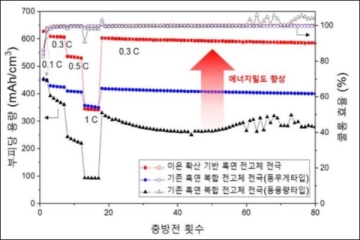
A joint research team from the Electronics and Telecommunications Research Institute (ETRI) and Daegu Gyeongbuk Institute of Science and Technology (DGIST) has announced the design of a new electrode structure for all-solid-state secondary batteries by clarifying the smooth lithium-ion diffusion characteristics between active materials. All-solid-state secondary batteries are next-generation batteries that utilize solid materials as the electrolyte for ion transfer in battery electrodes. Unlike primary batteries, which cannot be reused after a single use, secondary batteries can be repeatedly recharged and used like smartphone batteries even after discharge. Additionally, solid electrolytes offer the advantage of being safer than liquid electrolytes, which can potentially cause fires, and can improve energy density by enabling the implementation of bipolar secondary batteries.
2020.10.15by 김동우 기자

ESP32 Development Environment Selection and GPS Application Implementation
The ESP32 is a microcontroller that integrates Wi-Fi, Bluetooth, 12-bit ADC, capacitive touch, PWM, DAC, and UART in a single SoC. However, the abundance of features does not by itself solve the designer's problems. The real challenges lie in selecting the appropriate development environment, determining which pins can be used and which must be avoided, and converting raw data from modules into usable information. This document addresses ESP32 peripheral constraints (ADC2 and Wi-Fi coexistence limitation, UART1 occupancy, ADC non-linear regions), the trade-offs between Arduino IDE and ESP-IDF, and the process from connecting NEO-6M/NEO-M8N GPS modules to UART2, parsing NMEA sentences, and visualizing routes in Google Earth, all organized based on documented references.
2026.10.12by 편집부

MIPI CSI-2, DSI-2, C-PHY, D-PHY Test Solution Technical White Paper
The MIPI interface adopts a burst mode that transitions between low-power (LP) and high-speed (HS) states for low-power consumption, and in return, strict timing rules are imposed on state transitions. Additionally, the high-speed section operates as a packet-based protocol with headers, ECC, and CRC, so verification engineers must handle waveforms and protocols simultaneously. Traditional configurations combining general-purpose oscilloscopes and AWGs reveal limitations in setup complexity, measurement uncertainty, and lack of reproducibility when faced with these requirements. This white paper, based on webinar materials, organizes the structure of this problem and describes how the SV5C-DPTXCPTX generator for receiver testing and SV5C-DPRXCPRX analyzer for transmitter testing integrate state transition testing, stressed eye testing, and protocol analysis into a single bench, along with their application boundaries.
2026.10.12by 편집부











