


Fire alarms that shed their "boy who cried wolf" image reduce casualties.
 Published2020.10.26 15:01
23% of fire deaths occur in buildings equipped with fire alarms.
An optical module capable of distinguishing between water vapor and dust is needed.
Fire alarms are firefighting devices that guide people to safety when a fire breaks out in a specific location. In Korea, they are required by the Building Code for installation in most buildings. However, this useful firefighting device, which saves lives in the event of a fire, is often stigmatized as an eyesore.
Last November, the National Fire and Disaster Headquarters announced that "the number of dispatches due to malfunctioning fire alarms has increased every year over the past five years: 196 in 2016, 270 in 2017, 576 in 2018, and 616 in 2019 (excluding the fourth quarter)." This represents 7.6% of the total number of fire-related dispatches in 2019 (excluding the fourth quarter).

Countless buildings have turned off their fire alarms altogether, citing reasons like unnecessary firefighter dispatches and complaints from residents about unintended alarms. This situation is occurring not only in Korea but also around the world. Fire alarm malfunctions not only cause serious inconvenience, but also threaten human life.
According to the National Fire Protection Association (NFPA), 60% of fire deaths in the United States occurred in buildings without working smoke alarms, and 23% occurred in buildings with smoke alarms that were intentionally disabled.
The majority of fire deaths are caused by asphyxiation due to smoke inhalation. In February 2018, UL, a U.S. safety standards development and certification company, introduced new requirements in the 8th edition of its smoke alarm standard, UL 217, to reduce false alarms. The 9th edition was also released in February of this year.
It is not easy for manufacturers to produce fire alarms that fully comply with the increasingly complex UL 217 standard. To support these manufacturers, Analog Devices (ADI) launched the ADPD188BI optical module in June 2018, which integrates two LEDs, a photodiode, and an analog front-end (AFE) into a single package.
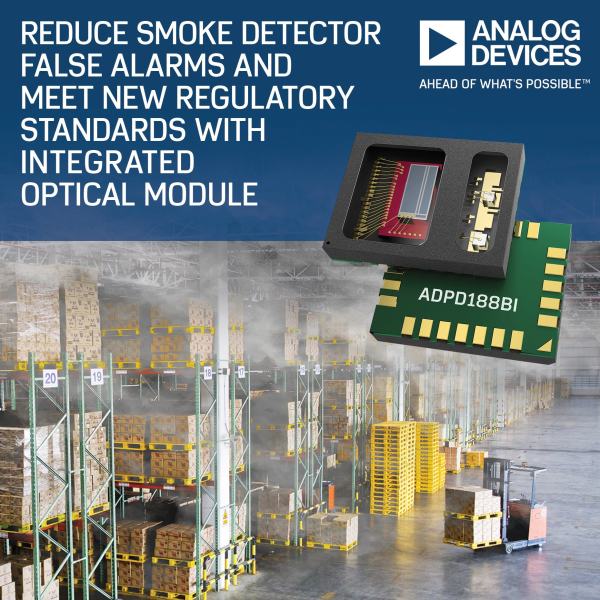
Compliant with the UL 217 standard as well as the EN 54 and EN 14604 standards of the European Committee for Standardization, the ADPD188BI optical module provides ambient light rejection and reduces power consumption to extend battery life.
Two LEDs are useful for reducing occasional false alarm triggers caused by vapor and dust. Using two colors, they distinguish particle size and detect and classify smoke types, allowing the alarm to isolate the source of the smoke.
The ADPD188BI optical module enables a backscattering design, placing the LED closer to the photodiode. This facilitates circuit size reduction, enabling developers to implement compact smoke detectors suitable for residential and commercial applications.
ADI also sells smoke detection chambers to assist developers who face challenges with chamber design. We're also offering new software and algorithms, webinars, and more to help you comply with new regulations and avoid disabling alerts due to false alarms.
“The ADPD188BI, which utilizes an infrared sensor and a photodiode, is a discrete optical module that can withstand field conditions and clearly distinguish between water vapor and dust,” said Kim Ryeong-mo, vice president of ADI Korea. “Its small size reduces the number of design considerations.”
Comments
Related news
ETRI Unveils Software Development Support Program for IoT Devices
The Electronics and Telecommunications Research Institute (ETRI) has constructed and publicly released a software (SW) development environment that enables easy and convenient creation of IoT devices. ETRI is disclosing core SW frameworks for manufacturing IoT devices and advancing their dissemination by facilitating the facile production of device software. This SW framework provides five types of lightweight operating systems (OS), firmware for sensors and communications, and modules for resource management and low-power management. Therefore, all developers can create and connect microservices to easily complete programs. Additionally, experts can reduce the effort of inputting hundreds to thousands of lines by retrieving necessary programs and modifying only certain tasks.
2020.10.19by 김동우 기자
Microchip Launches MCU for Analog System Design
Microchip has launched two MCU product families focused on enhancing MCU integration. Sensor-based IoT devices rely on a combination of analog functions and digital control capabilities to meet requirements such as low cost, small size, performance, and low power consumption. The two product families focus on system integration and reduce signal acquisition time by combining analog peripherals and multi-voltage operation with interconnectivity between peripherals. They are convenient and efficient in a single development environment.
2020.10.22by 김동우 기자
3D profile sensor with built-in reflection compensation algorithm released
A 3D profile sensor offering inline height measurement capabilities for inspection, detection, identification, and indication in the semiconductor, electronics, automotive, and factory automation sectors has been introduced. Teledyne Imaging has launched Z-Trac2, a new 5GigE 3D profile sensor product line for high-speed inline 3D applications.
2020.10.23by 이수민 기자
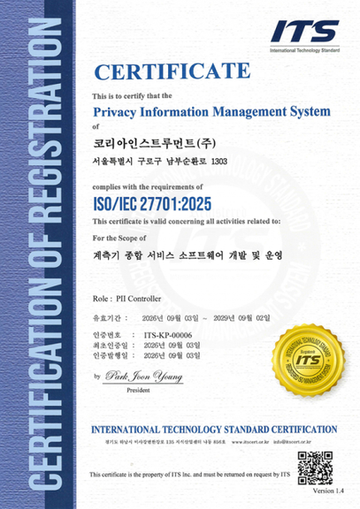
Korea Instrument, KOLAS Accredited Calibration Agency First to Simultaneously Acquire ISO/IEC 27,001·27,701
Korea Instrument has become the first among KOLAS accredited calibration agencies to simultaneously acquire ISO/IEC 27,001 and ISO/IEC 27,701 certifications. Through its proprietary platforms CWIZ Enterprise and CWIZ Partners, the company has embedded information security and personal data protection requirements across all business processes including customer information, equipment data, and calibration reports, with plans to continuously advance its management system through regular audits and security inspections.
2026.10.12by 배종인 기자

TeamViewer One, IT Incident Automation Workflow and Resolution Center Enhanced
TeamViewer has added IT incident automation capabilities and an advanced Resolution Center to its integrated digital workplace management platform 'TeamViewer ONE'. Recurrent service disruptions, configuration errors, and capacity shortages are automatically handled according to preset policies, and device status verification through script deployment can be managed in a unified interface, significantly reducing repetitive tasks for IT teams.
2026.10.12by 배종인 기자











