


Rediscovery of Graphene, the Next-Generation Foldable Quantum Dot Material!
 Published2020.10.27 15:14
Electrons are concentrated at the boundary, creating new energy levels.
Flexible materials such as graphene and hexagonal boron nitride
Next-generation displays that fold or bend can be created
A research team led by Professor Shin Hyun-seok of the Ulsan National Institute of Science and Technology (UNIST) announced on the 27th that they have discovered, for the first time, a blue luminescence phenomenon at the interface between graphene and hexagonal boron nitride, also known as "white graphene." Furthermore, they successfully fabricated a flexible light-emitting device using "graphene quantum dots," demonstrating graphene's potential as a new display light source.
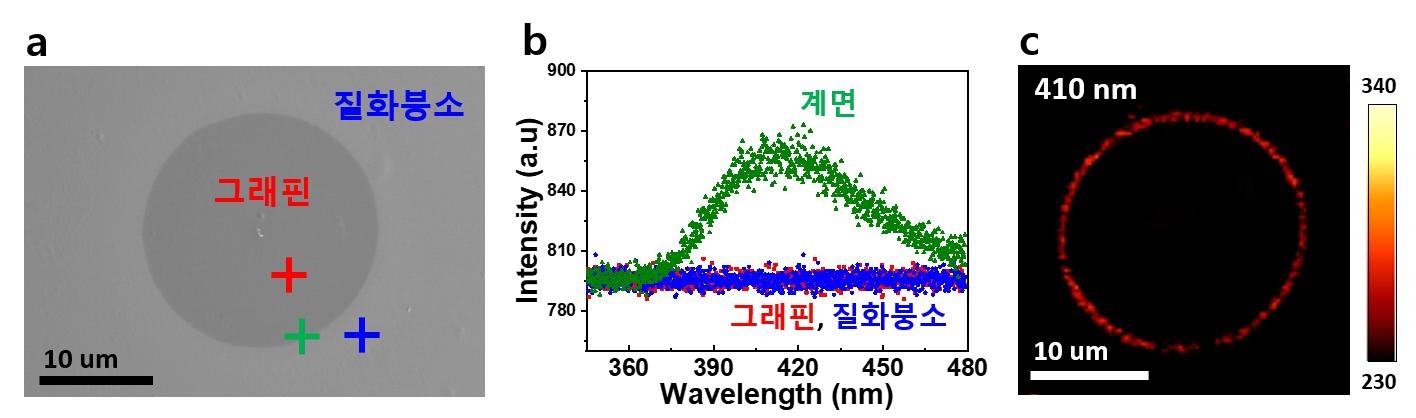
Graphene is a thin film of carbon atoms arranged in a hexagonal pattern. Despite its thinness, it is strong, flexible, and highly conductive, both thermally and electrically. It's often called the "dream material," and research is actively underway across various industries. To increase the density (luminescence intensity) of the interface, the research team used a method of stacking boron nitride films with graphene layers less than 20 nm (nanometers, 10-9 m) thick.
Graphene has not been studied much as a light-emitting material for display devices because it lacks an energy bandgap, which determines the color of light emitted by the material.
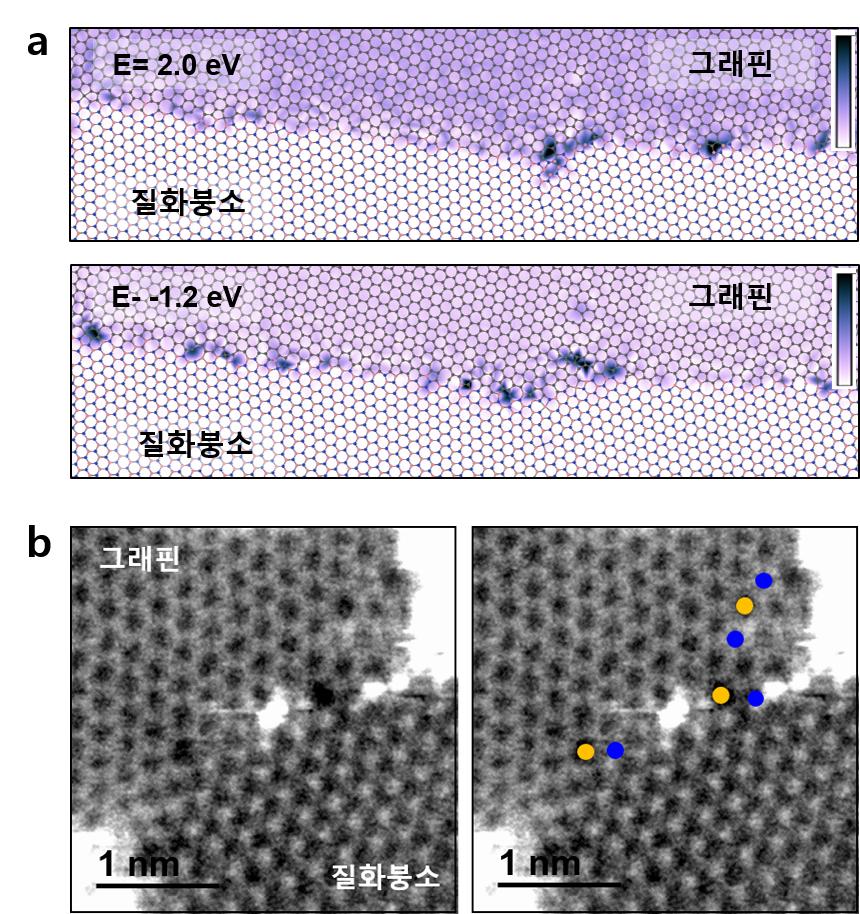
However, the research team analyzed the electron energy within the materials based on the results of observing with an electron microscope that the structure of the two materials, which were originally in a straight hexagonal shape, changed into pentagonal and heptagonal shapes at the boundary. As a result, it was concluded that the cause of the luminescence phenomenon was the creation of a new energy level as electrons (charges) were concentrated at the boundary.
Professor Shin said, “This study is very significant in that it shows that the interface between graphene, a conductor, and boron nitride, an insulator, can be used as a light source material,” and added, “This study is expected to greatly contribute to the development of the flexible display industry by implementing optoelectronic devices such as optical sensors and LEDs based on these two-dimensional composites.”
Meanwhile, the results of this study, in which Professor Jeon Seok-woo of KAIST and Professor Son Byeong-hyeok of Seoul National University participated, were published in the international academic journal 'Nature Communications' on October 23.
Comments
Related news

ETRI Successfully Develops Graphene Composite Material with Excellent Electromagnetic Shielding Capabilities
With the recent surge in electronic devices around us, demand for electromagnetic shielding technology is increasing. The Electronics and Telecommunications Research Institute (ETRI) has developed lightweight electromagnetic shielding material with high electrical conductivity by adding MXene to graphene composite material. The shielding material developed this time achieved the world's highest level of electromagnetic shielding effectiveness (99.9999994%) among nanocomposite users. It can detect resistance changes due to pressure variation with high performance, and can also serve as a pressure measurement sensor. Traditionally, electromagnetic shielding material was developed primarily using metals such as copper. The research team overcame these limitations by adding titanium carbide, a type of MXene, to graphene-polymer composite material.
2019.07.26by 이수민 기자
"Electronic device form factors are becoming more diverse." IBS succeeds in synthesizing large-area single-crystal metal thin films.
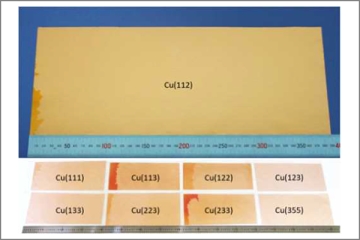
The Institute for Basic Science has succeeded in diversifying the surface patterns of metal substrates for synthesizing high-performance two-dimensional materials such as graphene. Two-dimensional single-crystalline materials are materials with regular atomic arrangements and orientations, and are used as materials for high-performance electronic devices due to their excellent thermal and electrical conductivity. Until now, there had been a limitation in the variety of single-crystalline metal thin film patterns required for synthesizing two-dimensional single-crystalline materials, and this research has found a clue to resolving this issue.
2020.05.28by 이수민 기자

Next-generation wearable devices made with graphene
Graphene is a material composed of a single layer of carbon atoms bonded in a hexagonal honeycomb structure on a two-dimensional plane. It has a thin thickness, high transparency, flexibility, stretchability, and high electrical and thermal conductivity. If materials and components utilizing these characteristics of graphene are commercialized, the wearability of wearable devices will be significantly improved compared to current standards.
2020.08.13by 이수민 기자

Intel Unveils Next-Generation 'Core Ultra Series 3' and vPro Platform for Enterprise PCs
Intel has officially unveiled the "Intel Core Ultra Series 3" for next-generation enterprise PCs and the latest vPro platform, addressing a wide range of demands from enterprise notebooks to high-performance workstations.
2026.03.26by 배종인 기자

ROHM Launches ESD Protection Diode Compatible with High-Speed Interfaces of 10Gbps or Higher
Semiconductor specialist ROHM has developed the 'RESDxVx series' of ESD (electrostatic discharge) protection diodes capable of responding to next-generation high-speed data communication environments exceeding 10Gbps, simultaneously enhancing both signal quality maintenance required in high-speed interfaces and IC protection performance.
2026.03.26by 배종인 기자











