



LGU+ Launches Real-Time Fall Detection Service Based on Radar Sensors
 Published2020.11.03 09:55
Rapid response to emergency situations remotely
Increased convenience through contactless methods
LG Uplus announced on the 3rd that it is conducting a demonstration of a real-time fall detection service based on radar sensors and will begin commercialization next year.
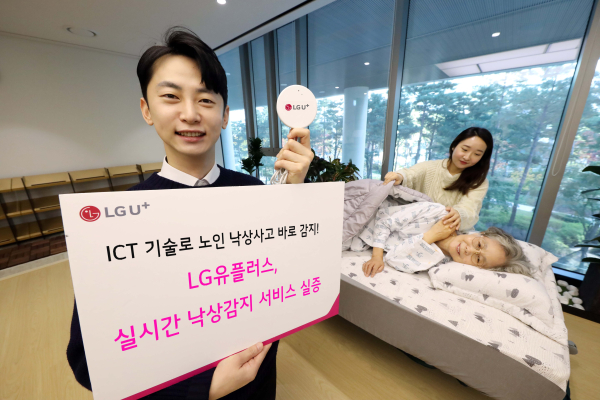
LG U+'s fall detection service uses radar sensors installed on walls and ceilings to monitor the movement of people within a designated space in real time. If a suspected fall occurs, a notification is immediately sent to a guardian via wireless communication. This allows for rapid remote detection of falls 24 hours a day and enables a swift response.
In particular, LG U+'s fall detection service utilizes a non-contact radar sensor, making it more convenient than the fall detection services based on wearable devices or contact sensors that have become widespread so far. Additionally, the main user base, the elderly, complained of discomfort in wearing or touching the device, and the need to periodically charge the device's battery was inconvenient, so it is easy to use.
In addition, unlike existing video monitoring solutions such as CCTV, it is possible to accurately detect even in bedrooms or bathrooms where environmental constraints such as ‘night time’ and humidity exist, and it has the great advantage of not invading privacy.
According to the Korea Centers for Disease Control and Prevention's "In-Depth Survey of Emergency Room Injuries," approximately 72,000 people aged 65 and older visited emergency rooms due to falls between 2015 and 2018. Furthermore, 40.8% of falls injured individuals aged 65 and older were head and neck, and their hospitalization rate was approximately 3.5 times higher than that of patients under 65. Because falls among the elderly often result in serious injuries, prompt detection and swift response are crucial.
LG U+ expects to be able to reduce the number of falls that frequently occur among the elderly population through its real-time fall detection service.
Ahead of commercialization, LG U+ will gather feedback from the medical field to improve service accuracy and usability. The company plans to conduct a demonstration of the service at H+ Nursing Hospital in Guro-gu, Seoul, by the end of the year, with full commercialization slated for next year.
Comments
Related news
Public frequency supply expanded more than eightfold compared to the previous year.
In 2020, a total of 2.8 GHz of public spectrum is allocated for disaster response, anomalous climate observation, and satellite communication network operations. The government is developing information-sharing methods among radar operating agencies and pursuing dedicated band discovery, taking into account the increasing radar demand for drone detection, weather observation, and maritime surveillance purposes. The supply of public spectrum represents more than an 8-fold increase compared to the previous year.
2020.01.17by 최인영 기자
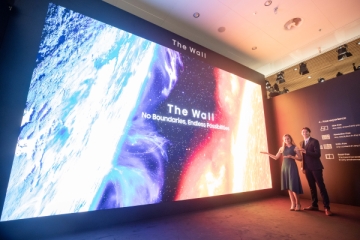
Samsung Electronics unveils a large number of commercial displays in the Netherlands.
Samsung Electronics announced that it will unveil a wide range of new commercial display products at ISE 2020, Europe's largest display exhibition. The newly introduced 2020 QLED 8K signage features durability that enables 24/7 continuous operation. The Wall, equipped with micro LED technology, is manufactured on a modular basis and is a display with no constraints on bezel, size, aspect ratio, or resolution. Samsung will also showcase the upgraded Samsung Flip2 with enhanced functionality and design.
2020.02.10by 이수민 기자
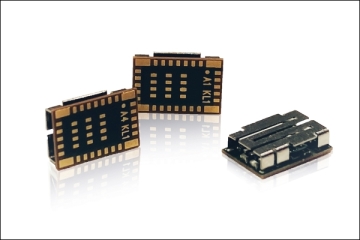
Nordic SoCs Adopted for BLE Modules for "Temperature-Sensitive" IoT Devices
Nordic Semiconductor announced that its nRF52833 and nRF52810 low-energy Bluetooth modules have been adopted for the core processing performance and wireless connectivity features of LG Innotek's ETWBCLU03 and ETWBCLU01 low-energy Bluetooth modules.
2020.11.02by 이수민 기자
ESP32 Development Environment Selection and GPS Application Implementation
The ESP32 is a microcontroller that integrates Wi-Fi, Bluetooth, 12-bit ADC, capacitive touch, PWM, DAC, and UART in a single SoC. However, the abundance of features does not by itself solve the designer's problems. The real challenges lie in selecting the appropriate development environment, determining which pins can be used and which must be avoided, and converting raw data from modules into usable information. This document addresses ESP32 peripheral constraints (ADC2 and Wi-Fi coexistence limitation, UART1 occupancy, ADC non-linear regions), the trade-offs between Arduino IDE and ESP-IDF, and the process from connecting NEO-6M/NEO-M8N GPS modules to UART2, parsing NMEA sentences, and visualizing routes in Google Earth, all organized based on documented references.
2026.10.12by 편집부
MIPI CSI-2, DSI-2, C-PHY, D-PHY Test Solution Technical White Paper
The MIPI interface adopts a burst mode that transitions between low-power (LP) and high-speed (HS) states for low-power consumption, and in return, strict timing rules are imposed on state transitions. Additionally, the high-speed section operates as a packet-based protocol with headers, ECC, and CRC, so verification engineers must handle waveforms and protocols simultaneously. Traditional configurations combining general-purpose oscilloscopes and AWGs reveal limitations in setup complexity, measurement uncertainty, and lack of reproducibility when faced with these requirements. This white paper, based on webinar materials, organizes the structure of this problem and describes how the SV5C-DPTXCPTX generator for receiver testing and SV5C-DPRXCPRX analyzer for transmitter testing integrate state transition testing, stressed eye testing, and protocol analysis into a single bench, along with their application boundaries.
2026.10.12by 편집부











