


Iron Man's Jarvis Becomes Reality… Touchable Hologram Development
 Published2020.11.11 10:50
Liquid crystal combinations that respond to electricity, temperature, and touch
Implementation of optical functions such as invisibility cloaks, super lenses, and negative refractive devices
The National Research Foundation of Korea announced on the 11th that a research team led by Professors Noh Jun-seok and Kim Young-ki of Pohang University of Science and Technology developed an ultra-small holographic device that responds to external stimuli by combining liquid crystal technology with metamaterials.
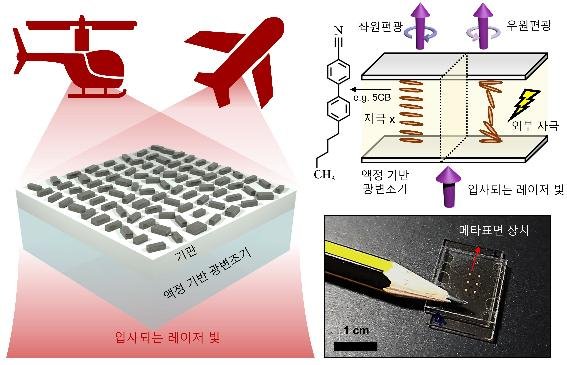
Metamaterials are artificial materials that do not exist in nature, and are called dream materials that can implement new optical functions such as invisibility cloaks, super lenses, and negative refractive devices.
Existing devices utilizing metasurfaces cannot change their optical properties once fabricated, limiting them to displaying only a single, initially programmed image in space. To address this issue, the research team incorporated liquid crystals, which can easily change their optical properties in response to external stimuli, into the metamaterial.
A specially designed liquid crystal-based light modulator is combined with the metasurface, and depending on the material and design of the liquid crystal cell, it is made to respond to various external stimuli such as finger touch, voltage, or heat.
If a liquid crystal designed to react to actual voltage is grafted, a holographic image can be quickly converted within a few milliseconds by applying a voltage of 0.8 V or 1 V.
A device incorporating temperature-responsive liquid crystals switches holographic images when the temperature exceeds 47°C. The device, designed to be touch-responsive, was able to rapidly change the holographic image with just a light finger touch between 10 kPa and 0.01 MPa.
In particular, it has been shown to be capable of producing extremely clear holographic images in the visible light range with a wavelength of 450 nm to 700 nm. Meanwhile, the research team plans to continue research to integrate this device into sensors that detect microorganisms or chemicals.
The developed ultra-small holographic device is expected to serve as a clue to advancing high-definition holographic video playback optical elements, temperature-sensitive holographic sensors, and future interactive/haptic holographic technologies.
Meanwhile, the results of this research were published as a frontispiece in the international academic journal 'Advanced Materials' on November 11.
Comments
Related news
ETRI Develops Hologram 250 Times Sharper Than 8K
Hologram display primarily uses spatial light modulation technology based on liquid crystals. This method creates images by applying voltage to liquid crystals to change the phase of light. To enhance the image quality and viewing angle of hologram displays, the key is to reduce the pixel pitch in the liquid crystal devices. The Electronics and Telecommunications Research Institute announced on the 23rd that it has developed a new pixel structure technology that significantly reduces both pixel size and pixel pitch to the micrometer level, enabling a 30-degree viewing angle and substantially improved image quality. With this technology, it is expected that panel development implementing 72K resolution using the world's smallest 1㎛ pixel pitch device will become possible.
2019.05.26by 이수민 기자
U+ to Build 5G MEC-Based Telepresence Service
Telepresence is a technology that implements people located at a distance as holograms or VR as if they were in the same space. LG U+ announced that it will jointly develop 5G-based real-time telepresence technology with Doublemi, a hologram content production company. To implement telepresence, LG U+ plans to build an MEC network that processes data from users and servers installed in close proximity. Doublemi provides Holoport, a technology that can generate real-time holograms with a single 3D camera.
2019.11.04by 최인영 기자
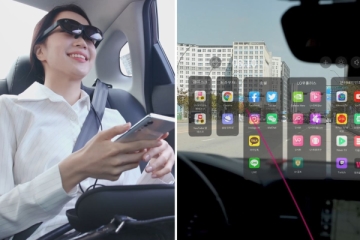
"A 100-inch screen right before your eyes" U+ begins selling AR glasses.
LG U+ announced that it will begin sales of 'U+ Real Glass,' an AR glass device. U+ Real Glass is a wearable device worn like regular eyeglasses that displays desired content through the lens. With transparent lenses, users can see ahead while using the service, and can freely arrange and resize content screens in the 360-degree space surrounding the user.
2020.08.21by 명세환 기자
ESP32 Development Environment Selection and GPS Application Implementation
The ESP32 is a microcontroller that integrates Wi-Fi, Bluetooth, 12-bit ADC, capacitive touch, PWM, DAC, and UART in a single SoC. However, the abundance of features does not by itself solve the designer's problems. The real challenges lie in selecting the appropriate development environment, determining which pins can be used and which must be avoided, and converting raw data from modules into usable information. This document addresses ESP32 peripheral constraints (ADC2 and Wi-Fi coexistence limitation, UART1 occupancy, ADC non-linear regions), the trade-offs between Arduino IDE and ESP-IDF, and the process from connecting NEO-6M/NEO-M8N GPS modules to UART2, parsing NMEA sentences, and visualizing routes in Google Earth, all organized based on documented references.
2026.10.12by 편집부
MIPI CSI-2, DSI-2, C-PHY, D-PHY Test Solution Technical White Paper
The MIPI interface adopts a burst mode that transitions between low-power (LP) and high-speed (HS) states for low-power consumption, and in return, strict timing rules are imposed on state transitions. Additionally, the high-speed section operates as a packet-based protocol with headers, ECC, and CRC, so verification engineers must handle waveforms and protocols simultaneously. Traditional configurations combining general-purpose oscilloscopes and AWGs reveal limitations in setup complexity, measurement uncertainty, and lack of reproducibility when faced with these requirements. This white paper, based on webinar materials, organizes the structure of this problem and describes how the SV5C-DPTXCPTX generator for receiver testing and SV5C-DPRXCPRX analyzer for transmitter testing integrate state transition testing, stressed eye testing, and protocol analysis into a single bench, along with their application boundaries.
2026.10.12by 편집부











