


ETRI Develops 40Gbps Deterministic Network Technology with Guaranteed Latency
 Published2020.11.12 09:55
Guarantees maximum latency and prevents data loss
5G verticals that require real-time precision operations
A domestic research team has developed network technology that prevents delays from increasing indefinitely even when traffic is concentrated on the communication network. We have also developed a technology that transmits data without loss even when a disaster occurs and multiple communication network failures occur.
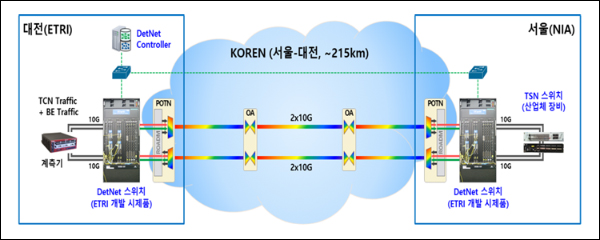
The Electronics and Telecommunications Research Institute (ETRI) announced on the 10th that it has developed a core technology for Deterministic Networking (DetNet) with a data transmission capacity of 40 Gbps, and successfully verified a prototype system using the technology on a 430 km round trip between Seoul and Daejeon by linking it to the hyper-connected Intelligent Research and Development Network (KOREN) on the 6th.
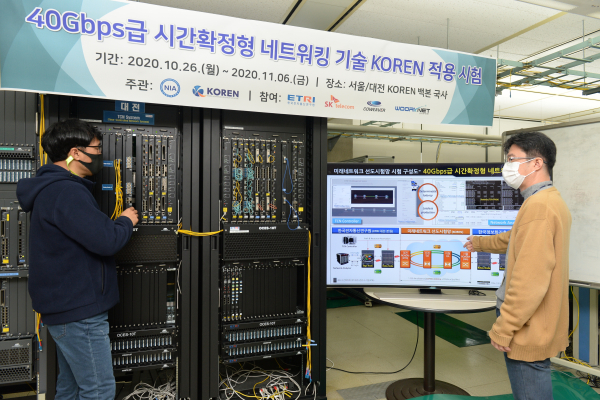
Checking equipment for application [Photo = ETRI]
In November of last year, ETRI developed a time-determined networking core module with a transmission capacity of 8 gigabits per second (Gbps) and applied a prototype equipped with it to KOREN.
At the time, the research team succeeded in sending data without loss even when a failure occurred on a single path, with a low-latency transmission performance of less than one-tenth of a millionth of a second per node.
The research team improved the low-latency performance to less than 4 millionths of a second and ensured lossless data transmission even when failures occur in multiple paths, not just one.
Data transfer speeds have also been increased from 1 Gbps to 10 Gbps. The data transmission capacity that can be processed on a single chip was also able to increase from 8 Gbps (built-in 8 x 1 Gbps last year) to 40 Gbps (built-in 4 x 10 Gbps this year).
This technology is expected to be widely utilized in future realistic communication fields such as smart factory remote control, telemedicine, remote drone control, remote virtual reality, and holograms.
Unlike current communication technologies where it is uncertain how long it will take if a delay occurs, it is suitable for 5G+ vertical industries that require precise work in real time as it guarantees maximum delay time and prevents data loss.
In February of this year, the research team completed technology transfer to Coweaver Co., Ltd. and WooriNet Co., Ltd., joint research institutes and domestic transmission equipment manufacturers, and plans to provide various support for commercialization.
In addition, the transmission capacity performance of this technology will be increased to 100G by 2022, and the Packet Optical Integrated Transport Network System (MPLS), currently at 10 Tbps, will be increased to 16 Tbps to increase industrial utilization.
In addition, we plan to expand the scope of guaranteeing ultra-low latency and lossless performance from the current single operator network to a future nationwide network, and conduct research to integrate it with 6G, the next-generation mobile communications technology.
Comments
Related news

ETRI succeeds in localizing millimeter wave band 5G small cell SW
ETRI has successfully developed 28GHz band-supporting 5G small cell software technology that improves transmission capacity and perceived communication speed in 5G coverage blind spots and densely populated areas. This has opened the path for domestic small and medium-sized enterprises to commercialize Korean-developed software rather than foreign software in 5G small cell communication equipment.
2020.10.28by 이수민 기자
LS Electric Provides Full-Life Support for SMEs Building Smart Factories
LS Electric has entered into an agreement with 14 partner companies selected for the 2020 Smart Factory Construction Support Program to jointly implement the 2020 Large-Small Business Cooperation Smart Factory Construction Support Project. LS Electric operates TechSquare, a win-win cooperation smart factory platform, to support the smooth implementation of smart factories.
2020.11.07by 이수민 기자

IBM and AT&T to Offer Open 5G MEC Control Services
Many enterprises are pursuing hybrid cloud strategies. In particular, as 5G and edge computing technologies continue to advance, high control capabilities in remote environments have become increasingly important. IBM has announced that it will enable enterprise customers to manage applications hosted in hybrid cloud environments through AT&T networks via "IBM Cloud Satellite."
2020.11.10by 이수민 기자
Korea Instrument, KOLAS Accredited Calibration Agency First to Simultaneously Acquire ISO/IEC 27,001·27,701
Korea Instrument has become the first among KOLAS accredited calibration agencies to simultaneously acquire ISO/IEC 27,001 and ISO/IEC 27,701 certifications. Through its proprietary platforms CWIZ Enterprise and CWIZ Partners, the company has embedded information security and personal data protection requirements across all business processes including customer information, equipment data, and calibration reports, with plans to continuously advance its management system through regular audits and security inspections.
2026.10.12by 배종인 기자

TeamViewer One, IT Incident Automation Workflow and Resolution Center Enhanced
TeamViewer has added IT incident automation capabilities and an advanced Resolution Center to its integrated digital workplace management platform 'TeamViewer ONE'. Recurrent service disruptions, configuration errors, and capacity shortages are automatically handled according to preset policies, and device status verification through script deployment can be managed in a unified interface, significantly reducing repetitive tasks for IT teams.
2026.10.12by 배종인 기자











