



Over 70% of Korean companies respond positively to the Digital New Deal policy.
 Published2020.11.19 15:45
Activating data utilization is considered a key digital innovation strategy.
Problems of adapting to a new environment
Both large and mid-sized domestic companies are positively viewing the Digital New Deal, and digital innovation is expected to accelerate across all industries in 2021.
IBM Korea announced this on the 19th, announcing the results of a survey targeting domestic companies on their awareness and response to the government's New Deal policy announcement and their outlook on digital innovation.
From late September to about a month later, IBM Korea, in collaboration with KRG, a domestic IT market research firm, conducted a survey of management innovation and management planning managers at 270 domestic private companies in the manufacturing, distribution, finance, service, telecommunications, and medical sectors.
Companies were found to be most actively adopting or planning to adopt cloud systems for digital innovation. Additionally, many expressed the need for public-private cooperation to specifically support the digital innovation of domestic companies.
◇ In the era of digital innovation, the K-New Deal is the right policy.
Most domestic companies appear to have a positive view of the government's digital new deal policy.
.jpg)
In this survey of domestic private companies with sales of over 100 billion won, 87.4% of respondents were aware of the Korean New Deal policy announced by the government in July, and 77% expressed interest in the Digital New Deal policy. Furthermore, 76.7% of domestic companies responded that they would incorporate the Digital New Deal policy into their future business plans.
These results are consistent with the views of companies already achieving results through digital innovation.
Among companies that responded that they are utilizing digital technology, 63.1% have established a system to respond to the market environment through digital innovation, and 56.7% of companies responded that new work environments and flexible organizational cultures are spreading, indicating that overall, the results of digital innovation are high. In particular, domestic companies are expected to see digital innovation through the Digital New Deal from the perspectives of 'increased productivity' and 'enhanced corporate competitiveness.'
Seven out of ten responding companies believed digital innovation and the Digital New Deal policy would provide opportunities for future business growth and that they were either incorporating the Digital New Deal into their future business plans or considering it. This confirms that positive perceptions are actually translating into business outcomes. Another characteristic found is that mid-sized companies have higher expectations for "employee skill enhancement and internalization" through digital innovation than large companies.
◇ Companies are accelerating their adoption of cloud computing as a digital innovation strategy.
When asked about specific corporate preparations and responses to digital innovation, the majority of companies responded that they are focusing on "remote work and cloud system implementation (63%)." In particular, the financial, distribution, and communications sectors have shown a more proactive approach to building cloud-based infrastructure.
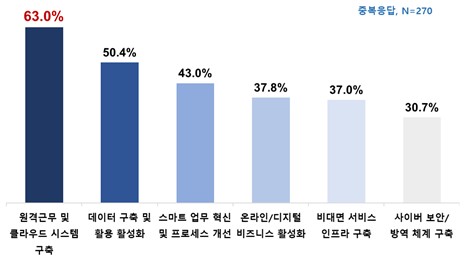
Next, they identified "promoting data construction and utilization," "smart work innovation and process improvement," "activating online business," and "building a non-face-to-face service infrastructure" as key measures. This suggests that, due to the prolonged COVID-19 pandemic, domestic companies are focusing on activating non-face-to-face work structures and services based on technologies like cloud and AI.
In addition, the financial sector cited "human resource development (41.3%)" as a preparatory factor for activating and responding to digital innovation, the telecommunications/media sector cited "discovery of new technologies/digital-based new businesses (43.8%)," and the service sector cited "improvement of digital infrastructure management systems (32.5%)," showing that the preparatory factors for digital innovation differ by industry.
◇ 2021 will be the first year of full-scale digital innovation.
The survey results showed that domestic companies, recognizing that digital innovation can no longer be delayed, responded that they will begin full-scale digital innovation this year and next year. Among companies pursuing digital innovation, 33.9% responded that they plan to pursue and respond in earnest "starting this year," while 45.8% of companies considering it said they plan to pursue and respond in earnest "starting next year."
Additionally, two out of ten companies have already implemented digital innovation, and the remaining six companies have begun developing concrete responses this year, indicating that most domestic companies are expected to fully embrace digital innovation in 2021.
◇ The will is strong, but investment is needed for concrete implementation and results.
Despite domestic companies' strong commitment to digital innovation, they are still in their infancy when it comes to concrete implementation.
Of the 270 companies surveyed, only about half (54.8%) responded that they were "establishing or planning to establish an organization and workforce to respond to digital innovation and New Deal policies." Thirty percent of companies responded that they had "incorporated" Digital New Deal policies into their future business plans, and only 31.5% said they had "prepared a department or management structure" to address these issues, indicating that concrete progress is still in its early stages.
63.7% of companies cited 'cost burden' as the biggest obstacle to fully pursuing digital innovation. Following this, many responses such as ‘lack of experts in new technology fields (53%)’ and ‘problems adapting to new environments (43%)’ were found, indicating that more active investment in technology and human resources is necessary for full-scale promotion and achievement of results.
Domestic companies responded that they plan to invest an average of 1.4% of their total sales in "digital innovation and digital new deal-related areas" over the next five years, still lower than the global average of 3.3%. By industry, the telecommunications/media sector had the highest investment at 3.7%.
Comments
Related news
Dassault Systèmes Launches 'SolidWorks 2021' with Enhanced Collaboration Features
Dassault Systèmes has launched SolidWorks 2021, the latest version of SolidWorks, a 3D design and engineering application. SolidWorks 2021 has improved features and workflows including design, documentation, data management, and validation to increase work productivity. Additionally, it has strengthened collaboration functionality by integrating with the 3DEXPERIENCE Works portfolio, a cloud-based solution that connects the entire manufacturing process from concept and product design, analysis, data management, to production.
2020.11.04by 강정규 기자
.jpg)
SKT Sets Out to Target Cloud Management Platform Market in Earnest
TACO is a cloud management platform developed in-house by SKT, featuring excellent scalability and flexibility through the application of container technology and Kubernetes technology. Container technology enables efficient delivery of software to desired locations within cloud servers. By utilizing Kubernetes technology, service maintenance or updates can be performed without interrupting the system, and self-healing is possible, allowing for flexible service operations.
2020.11.06by 김동우 기자

Cloud proliferation, increased PKI adoption... IoT security capabilities must be improved
As PKI adoption increases, it has been revealed that the scale and scope of enterprises' infrastructure for data protection have also expanded. According to the '2020 Global PKI and IoT Trends Report' released by Entrust, PKI has become a core component of IT infrastructure by providing robust security for major digital initiatives including cloud, mobile devices, identity authentication, and IoT.
2020.11.09by 강정규 기자
.jpg)
SalePoint Signs Multi-Year Partnership Agreement with AWS… Promoting Identity Security that Integrates Even AI Agents
Sailpoint has entered into a multi-year strategic partnership agreement with AWS and is moving forward with establishing an integrated governance system that manages both human and non-human identities together. The plan is to consistently manage access permissions in an environment where AI agents are increasing as work execution entities, while applying the principle of least privilege and automated policy enforcement. The two companies plan to jointly expand capabilities to manage the identities of various entities, including AI agents, within a single layer in the AWS environment. This collaboration is interpreted as a move to design security and governance together in corporate environments where AI adoption is expanding.
2026.03.26by 배종인 기자
.png)
Databricks Unveils Open AI Security Monitoring 'Lakewatch'
Databricks entered the security market on March 24 by unveiling LakeWatch, an open-source agentic SIEM. The core functionality of this product is to integrate and analyze security, IT, and business data in a single environment to support AI-based threat detection and investigation. The company explained that it reduces the limitations of existing security operations centers, which have had to forgo some data due to high cost structures, and enables large-scale data analysis and automation based on open formats and ecosystems. LakeWatch is currently offered as a private preview, with Adobe and Dropbox mentioned as early customers. Databricks also announced an expanded partnership with Anthropic as well as the acquisition of Antimatter and SiftD.ai.
2026.03.26by 배종인 기자











