


VMware Blockchain Platform Overcomes Data Silos
 Published2020.11.24 16:01
The Type of Consensus Mechanism Affects Blockchain Platform Scalability
VMware Platform Separates "Ledger" from Smart Contract Language
Internal corporate data is often siloed, creating inefficiencies and incurring additional costs when sharing and coordinating data across companies. Enterprises are seeking a trusted, multi-party network that can preserve data integrity, maintain security, and provide enterprise-grade resilience to the global ecosystem.
VMware announced on the 23rd that it is commercializing 'VMware Blockchain', which supports the construction of corporate business networks and distributed applications. VMware Blockchain is an enterprise-grade blockchain platform that easily scales and expands, opening up data silos and enabling secure and instantaneous movement of enterprise data.
As the use of blockchain for multi-party transaction processing increases, the consensus mechanism used is becoming a key factor in determining the performance and scalability of blockchain platforms.
VMware Research's proprietary enterprise-grade consensus mechanism, Scalable Byzantine Fault Tolerance (SBFT), addresses the scale and performance challenges inherent in blockchain solutions while maintaining fault tolerance and protecting against malicious attacks. It also maintains distributed trust and supports continuous governance in multiparty networks.
VMware Blockchain leverages the benefits of a layered architecture to separate the ledger from the smart contract language. Furthermore, it supports DAML, an open-source smart contract language developed by VMware's blockchain technology partner, Digital Asset, and features a virtual smart contract execution engine for extending the platform to other languages.
Comments
Related news

IBM, Software Developers Worldwide Take Action on Climate Change
IBM, the UN Human Rights Council, the Linux Foundation, and the David Clark Curz Foundation are launching a global initiative to address climate change with developers worldwide using open source-based technologies. The Call for Code Global Challenge, which will invest $30 million over five years, aims to develop applications for future generations through Red Hat OpenShift, IBM Cloud, IBM Watson, IBM Blockchain, and The Weather Company's data.
2020.02.27by 최인영 기자

'Galaxy A Quantum' Unveiled, First to Equip Quantum Random Number Generation Chipset
SK Telecom and Samsung Electronics unveiled the 5G smartphone "Galaxy A Quantum" equipped with a quantum random number generation chipset. Inside the quantum random number generation chipset, a CMOS image sensor detects light emitted by an LED light source and extracts random numbers by utilizing quantum randomness. The extracted random numbers are used as encryption keys for T ID dual login, SK Pay biometric authentication protection, and the blockchain mobile electronic certificate service "Initial".
2020.05.15by 이수민 기자
LG CNS Developing a Globally Valid ID
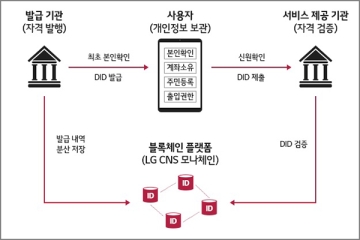
LG CNS has signed an MOU with Evernim, a specialized company providing blockchain-based decentralized identity (DID) technology services, to establish DID global standards. DID is a technology that verifies personal identity using blockchain technology. With a single identity authentication, users can access services from various institutions without requiring additional authentication.
2020.05.27by 강정규 기자
.jpg)
SalePoint Signs Multi-Year Partnership Agreement with AWS… Promoting Identity Security that Integrates Even AI Agents
Sailpoint has entered into a multi-year strategic partnership agreement with AWS and is moving forward with establishing an integrated governance system that manages both human and non-human identities together. The plan is to consistently manage access permissions in an environment where AI agents are increasing as work execution entities, while applying the principle of least privilege and automated policy enforcement. The two companies plan to jointly expand capabilities to manage the identities of various entities, including AI agents, within a single layer in the AWS environment. This collaboration is interpreted as a move to design security and governance together in corporate environments where AI adoption is expanding.
2026.03.26by 배종인 기자
.png)
Databricks Unveils Open AI Security Monitoring 'Lakewatch'
Databricks entered the security market on March 24 by unveiling LakeWatch, an open-source agentic SIEM. The core functionality of this product is to integrate and analyze security, IT, and business data in a single environment to support AI-based threat detection and investigation. The company explained that it reduces the limitations of existing security operations centers, which have had to forgo some data due to high cost structures, and enables large-scale data analysis and automation based on open formats and ecosystems. LakeWatch is currently offered as a private preview, with Adobe and Dropbox mentioned as early customers. Databricks also announced an expanded partnership with Anthropic as well as the acquisition of Antimatter and SiftD.ai.
2026.03.26by 배종인 기자











