


5G will become the foundation of future industries, but the US-China conflict is a stumbling block.
 Published2020.11.30 17:05
The US is moving to exclude Chinese companies from the 5G sector.
Continued monitoring is necessary to improve 5G technology and expand infrastructure.
As social distancing continues, the increasing isolation among members of society is expected to accelerate the development of 5G technology and market expansion.
Market analysis firm IHS Markit's report, "The 5G Economy in a Post-COVID-19 Era," predicts that investments in 5G technology will be revitalized as connectivity and flexibility in communications technology are required to connect society and drive the economy.
In this year's report, IHS Markit projected that global 5G investment and R&D will increase by 10.8% over the next 15 years, from 2020 to 2035, compared to last year's report. By 2035, the 5G ecosystem is expected to generate an economic impact of $3.8 trillion and create 22.8 million jobs.
The report explained that the upward revision was due to the growing recognition that 5G is a disruptive innovation that will shake up industries across the world, despite the pandemic-induced economic downturn, and the rapid digitalization across governments, economies, and societies, leading to a surge in demand for 5G network infrastructure and devices.
The report expects that the continuation and expansion of related products, services, and experiences along with the deployment of 5G will meet and support new demands for connectivity, flexibility, and resilience in the post-COVID-19 era.
5G market share forecast to be China, the US, Japan, South Korea, Germany, the UK, and France.
The report, based on data from market research firm Omdia, projects that the 5G economic impact and job creation in seven countries—China, the United States, Japan, South Korea, Germany, the United Kingdom, and France—will account for 84% and 88%, respectively, in 2035.
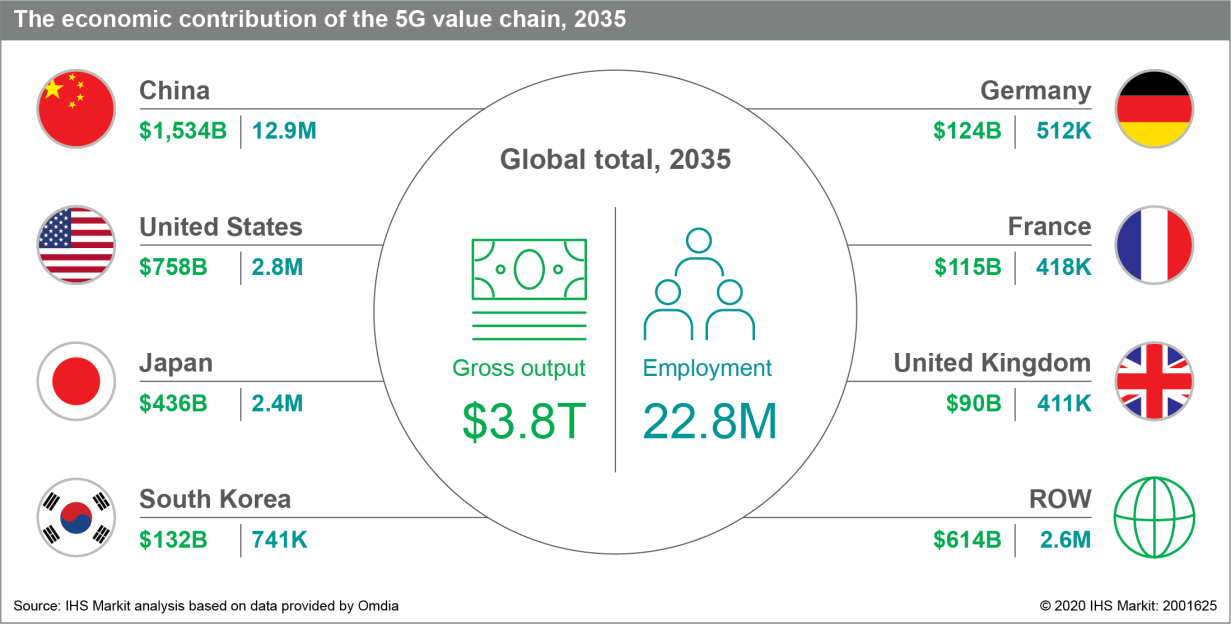
It is expected to be a game-changer [Source: IHS Markit]
In particular, China is expected to lead the market with shares of 40.3% and 56.6%, respectively. It is also projected that China (USD 1.7 trillion) will surpass the United States (USD 1.3 trillion) in 5G facility investment and R&D between 2020 and 2035.
South Korea ranked 4th with a 5G economic effect of $132 billion (KRW 145.9524 trillion) and 741,000 jobs created, ranking higher than Germany, France, and the UK.
Meanwhile, global sales related to 5G are expected to reach $13.098 trillion (KRW 14,485.782 trillion) in 2035, and high sales are expected to be recorded in the following fields: manufacturing, information and communications, wholesale and retail, public services, construction, finance, logistics, professional services, social welfare, agriculture, forestry and fisheries, mining, electricity and water, education, accommodation, and arts and education.
The COVID-19 pandemic is driving digital transformation across all sectors of society and the economy. Communications networks and various internet services are expected to remain the foundation of social and economic activity even in the post-COVID era. 5G is considered a key driver of this transformation. The Korean government is also developing plans to advance 5G networks and expand the ecosystem, building on policies such as the Korean New Deal.
This cannot remain a mere plan. Follow-up measures must be strengthened to ensure it leads to tangible results, such as the development of quality services, content, and devices, as well as job creation. Through these measures, we need to raise 5G performance beyond its marketing goals to an absolute level, thereby offsetting public opposition.
The U.S. is trying to exclude Chinese companies from the 5G sector.
The US-China hegemony competition is expected to pose a stumbling block to the spread and development of 5G technology. On November 19th, the U.S. House of Representatives unanimously passed a bill supporting the construction of a domestic 5G communications infrastructure to curb Chinese telecommunications equipment manufacturers like Huawei and ZTE. The bill provides $750 million to build a domestic 5G infrastructure and eliminates or replaces equipment from Chinese companies.
Both Democrats and Republicans participated in the process of introducing the bill, and explained their reasoning for passing the bill by arguing that “American telecommunications carriers’ reliance on equipment from companies like Huawei poses a significant threat to American security and commercial interests.”
The US's efforts to curb Chinese companies aren't limited to its own borders. On October 23, the US State Department signed an agreement with four Balkan countries—Kosovo, Bulgaria, Slovakia, and North Macedonia—targeting China by stipulating that they consider "foreign government control" when selecting equipment suppliers for 5G deployments.
The Brazilian government plans to launch full-scale 5G deployment in 2022. In response, the U.S. government has indicated financial support to allow Brazilian telecommunications companies to purchase 5G equipment from other manufacturers, with the condition that Huawei be excluded from the project. And on November 10, the Brazilian government joined the anti-Huawei front by announcing its support for the US Clean Network policy.
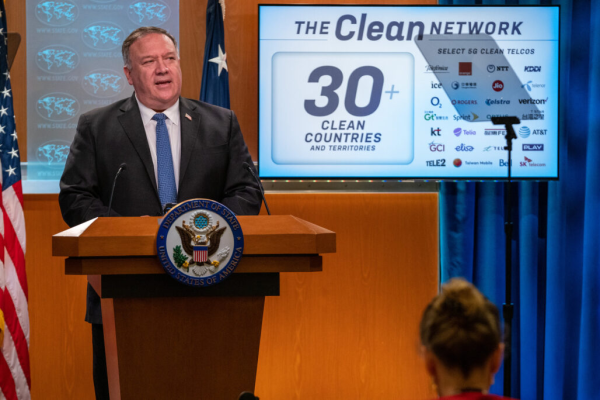
US Secretary of State Michael Pompeo [Photo = US Embassy in Korea]
Clean Network is a policy aimed at excluding products from Chinese companies, such as Huawei and ZTE, that the U.S. deems untrustworthy, from 5G networks, mobile apps, undersea cables, and cloud computing.
Countries Taking Action Against Huawei
Europe is also implementing its own anti-China 5G policy. In July, the UK officially declared a phased-out phase-out of Huawei equipment, announcing at its National Security Council (NSC) meeting that it would halt the purchase of Huawei equipment for 5G starting this year and remove all existing equipment by 2027. France also indirectly hinted at a ban on Huawei and ZTE equipment, citing domestic industry protection and security concerns.
Sweden also announced its exclusionary stance on October 20th, banning Huawei from bidding on its domestic 5G network spectrum auction and requiring companies participating in the spectrum auction to remove Huawei equipment from existing core functions by January 1, 2025. On October 23, Italy blocked 5G product deals between its telecommunications company Fastweb and Huawei.
On November 19, the Canadian House of Commons passed a motion requiring the Justin Trudeau administration to decide within 30 days whether to ban Huawei from its 5G network. Prime Minister Trudeau had been holding off on deciding whether to ban Huawei. However, with the passage of a motion in the House of Commons sponsored by the Conservative Party, which has opposed the introduction of Huawei equipment, Trudeau is now faced with the decision to ban Huawei.
Bell Canada, Canada's leading mobile carrier, announced a partnership with Nokia in February of this year, and then selected Ericsson as an additional supplier. Telus, which had previously planned to use Huawei equipment, also reversed its decision and announced it would now use Ericsson and Nokia products. Rogers also announced its intention to build a 5G network with Ericsson, bringing Canada's three largest mobile carriers to a European partner for 5G.
On November 16, Huawei urged the UK government to reconsider its decision to halt the purchase of Huawei equipment for 5G deployments, arguing that the decision was influenced by the US-China trade dispute and not due to network security or security concerns. Huawei's move is interpreted as a renewed push to enter the European market, anticipating a shift in US policy toward China following the change in administration.
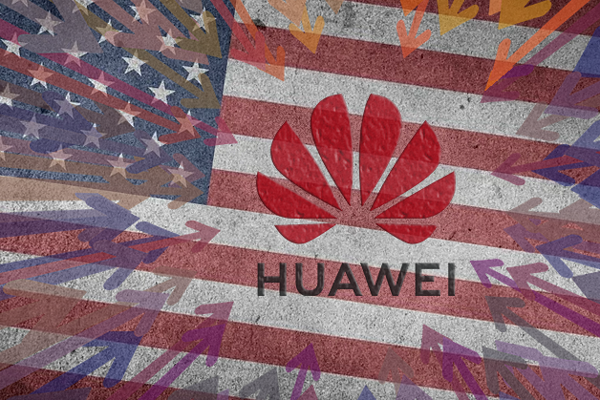
This trend is expected to continue [Image = e4ds News]
However, regardless of the change of government, the US's stance toward China is expected to continue. While incoming US President Joe Biden favors open and free trade, he is reportedly concerned about national security and technology leaks from China. Furthermore, given his emphasis on alliances, he is likely to form a more organic front against China than current US President Donald Trump.
Given that our government and businesses are organically linked to Huawei in their supply chains, it's time to continuously monitor global 5G equipment market trends and establish strategies to foster a secure 5G ecosystem and connect with market opportunities.
Comments
Related news
Even 5G technology can't break through the US's Huawei encirclement: "Biden will continue."
Multiple European countries are refusing to adopt Huawei's 5G equipment and joining the United States in its countermeasures against Huawei and, more broadly, China. Last September, the United States announced severe sanctions that fundamentally block semiconductor supplies to Huawei, citing reasons such as preventing China's acquisition of competitive advantages in advanced sectors and protecting domestic security. The Biden administration, which will succeed the Trump administration, is expected to maintain this policy direction.
2020.11.09by 이수민 기자
The ICT industry in 2020, devastated by COVID-19: "Will 2021 be different?"
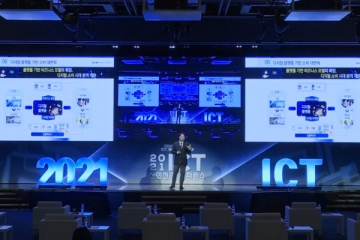
The ICT sector this year was hit by the COVID-19 pandemic, but secured new growth drivers. The center of the 2021 ICT Top 10 Issues announced by IITP was also the COVID-19 pandemic. The top 10 issues include data, AI, 5G, digital twin, non-face-to-face business, digital platforms, home economy, K-content, big tech, and global trade, all of which were strongly affected by the pandemic. Given that the situation's resolution remains distant, policies and plans should be established taking these issues into consideration.
2020.11.16by 이수민 기자
Xilinx and TI Develop GaN-Based 5G Small Cell 'DFE'
5G small cells must support three 5G scenarios including eMBB, mMTC, and URLLC, requiring a scalable adaptive wireless platform. To address this, Xilinx announced that it has developed a scalable adaptive DFE solution together with TI that reduces the number of antennas in small cells and improves energy efficiency.
2020.11.25by 이수민 기자
European Patent Applications Surpass 200,000 for the First Time… South Korea Maintains 5th Place, Led by Batteries and Telecommunications
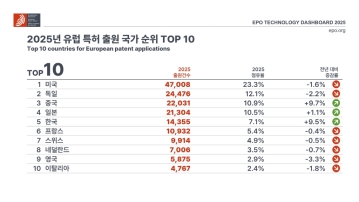
According to the European Patent Office (EPO)'s 'Technology Dashboard 2025', European patent applications last year reached 201,974, surpassing 200,000 for the first time. Korean companies and inventors filed 14,355 applications, representing a 9.5% increase from the previous year and maintaining 5th place by country. Battery, digital communication, and semiconductor technologies led the growth, with Samsung ranking as the top EPO applicant for the second consecutive year and LG reaching 3rd place. The presence of major domestic cities such as Seoul, Suwon, and Yongin was also confirmed. It was also revealed that Korea's European patent strategy is expanding beyond individual technologies to span the entire industry.
2026.03.24by 명세환 기자

SK Telecom First Applies AI-Based Network Operations at Gwanghwamun K-Pop Concert
SK Telecom announced that it applied an AI-based network operation system for the first time at a large-scale K-pop concert held in the Gwanghwamun area of Seoul on March 21st, managing communication quality throughout the event. Mobile data usage during the three hours before and after the concert reached 12.15TB, approximately doubling compared to the same time slot the previous weekend. SK Telecom monitored traffic using the AI system 'A-One' in five-minute and 50-meter units to respond to potential overload situations, while also operating temporary communication facilities and on-site personnel in parallel. This case is interpreted as confirmation of the practical applicability of AI-based autonomous network operation in an environment where demand from dense events and foreign users increases simultaneously.
2026.03.23by 명세환 기자











