



ADI Announces 80V Buck-Boost I2C Battery Charge Controller
 Published2020.12.15 14:10
Provides three selectable CC-CV charging profiles
Built-in all charge termination algorithms, reducing design time
Analog Devices (ADI) announced on the 15th the launch of the 'LT8491' buck-boost battery charge controller supporting maximum power point tracking (MPPT), temperature compensation, and I 2 C interface functions for telemetry and control applications.
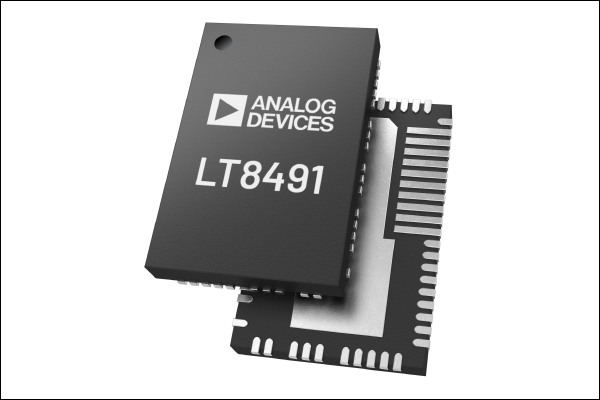
The LT8491 operates regardless of whether the input voltage is above, below, or equal to the regulated battery float voltage. It offers three selectable constant-current, constant-voltage (CC-CV) charge profiles, making it suitable for charging a variety of cell chemistries, including sealed lead-acid batteries, gel cells, flooded cells, and lithium-ion.
All charge termination algorithms are built-in, so users do not need to develop separate software or firmware, reducing design time.
The LT8491 operates over a 6V to 80V input voltage range and can output a battery float voltage from 1.3V to 80V using a single inductor with 4-switch synchronous rectification. Charging currents up to 10A are possible depending on the selection of external components, and multiple 'LT8705' 80V buck-boost controllers can be connected in parallel to support even higher power topologies.
Even if partial shadowing of the solar panel causes a local maximum power point, the true maximum power point can be found by sweeping the entire operating range of the solar panel.
Once the actual maximum power point is found, the system operates at that point using dithering techniques to track slow changes from the maximum point. This allows the system to utilize nearly all of the power generated by the solar panel, even under less-than-ideal operating conditions.
Automatic temperature compensation can also be performed by sensing an external thermistor thermally connected to the battery. The I2C interface controls the input/output voltage, current, and power values, as well as the charger.
The LT8491 is available in a low profile 0.75mm 64-pin 7mm x 11mm QFN package and operates over a -40˚C to 125˚C temperature range.
Comments
Related news

Maxim Launches IC that Implements a Vehicle USB PD Hub with a Single MCU
The number of USB PD chargers built into vehicles is increasing, and the functionality of automotive multimedia hubs—such as rear-seat entertainment modules and head units—is expanding further. Accordingly, the burden on relevant design engineers regarding size, cost, and power is growing. In response, Maxim Integrated Korea has announced the launch of the MAX25430, a 100W USB PD buck-boost controller and protector.
2020.10.14by 명세환 기자

ADI Announces Three Quad-Band VCOs Offering Ultra-Wideband Capability
ADI has introduced a quad-band VCO product family that provides broadband functionality without degrading phase noise performance. The new HMC8074, HMC8362, and HMC8364 quad-band VCOs offer a fundamental frequency range of 8.3 GHz to 26.6 GHz, delivering wider RF response characteristics and greater frequency flexibility compared to narrowband VCOs.
2020.12.04by 강정규 기자
ST Unveils 'Compact High-Voltage Converter IC' That Does Not Require External Components
STMicroelectronics has unveiled VIPer31, a compact high-voltage converter IC. The VIPer31 is optimized for commonly used offline AC/DC converter topologies including isolated and non-isolated flyback, buck, and buck-boost converters. With minimal external components required, it contributes to cost-effective compact PCB designs.
2020.12.09by 강정규 기자

Intel Unveils Next-Generation 'Core Ultra Series 3' and vPro Platform for Enterprise PCs
Intel has officially unveiled the "Intel Core Ultra Series 3" for next-generation enterprise PCs and the latest vPro platform, addressing a wide range of demands from enterprise notebooks to high-performance workstations.
2026.03.26by 배종인 기자

ROHM Launches ESD Protection Diode Compatible with High-Speed Interfaces of 10Gbps or Higher
Semiconductor specialist ROHM has developed the 'RESDxVx series' of ESD (electrostatic discharge) protection diodes capable of responding to next-generation high-speed data communication environments exceeding 10Gbps, simultaneously enhancing both signal quality maintenance required in high-speed interfaces and IC protection performance.
2026.03.26by 배종인 기자











