



A virtual model for verifying the hazards of electromagnetic waves has been released to Data Dam.
 Published2020.12.15 15:15
Expanding research by releasing human model data to the Data Dam
Full-body implementation at 1mm intervals, enabling virtual clinical trials
A human model capable of conducting virtual clinical trials has been released on the public data portal. This released virtual data can be freely utilized by researchers across a wide range of fields, including industry, academia, and research, and is expected to be useful for basic human research.
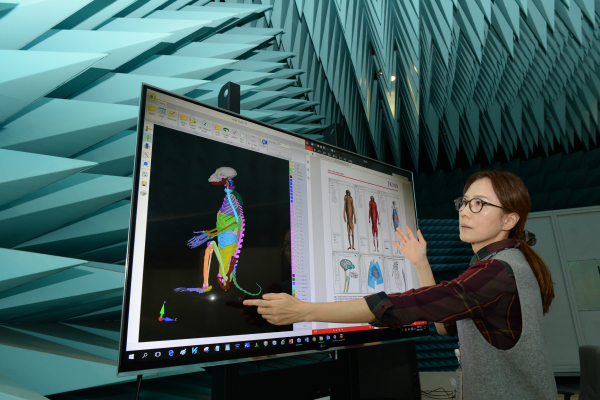
Monitoring a primate model [Photo = ETRI]
The Electronics and Telecommunications Research Institute (ETRI) announced on the 15th that it had developed human and primate models and released them on Data Dam as part of its research into the effects of electromagnetic waves on the human body and protective measures. The data released this time can be used not only for electromagnetic wave-related research but also for virtual biological experiments in other fields, such as radiation. It seems that it will be possible to somewhat alleviate the difficulties and limitations of clinical research conducted on human subjects.
The data released by the ETRI research team includes three types: ▲adult male and female full body model ▲ head model ▲ primate model .
The male and female full-body model sets each consist of approximately 100 body organs and tissues. Using them, users can observe body temperature changes and specific absorption rates (SARs) for each body part exposed to electromagnetic waves. These models can be used in a variety of fields, including assessing exposure to radiation, in addition to electromagnetic waves.
It can be used to study the human body's response to acute radiation and how to respond to it, including understanding the effects of different body parts. Modeling is based on images of the human body dissected at intervals of less than 1 mm (0.2 x 0.2 mm2), allowing for a detailed understanding of the effects on the human body.
The head model set was standardized and recreated from MRI images of 50 individuals from four groups: males aged 6, 9, 15, and 20-24. A total of 70 structures were modeled using average values obtained by measuring approximately 30 dimensions of the head, including head circumference, craniofacial bone, and facial bones.
In addition, the research team unveiled the world's first primate model consisting of approximately 180 structures. This model, which was created based on cross-sectional anatomical images with an interval of less than 1 mm (0.024 x 0.024 mm2) and MRI images with an interval of 0.5 mm of a female rhesus monkey weighing 4.3 kg, is said to be planning to observe behavioral changes according to the specific absorption rate (SAR).
Previously, animal testing to determine the biological effects of radio waves and radiation mostly used rodents, limiting their applicability to humans. This development is expected to overcome some of these limitations and facilitate the use of these models in safety assessments of various experiments. The monkey model can be used in conjunction with actual electromagnetic wave exposure experiments and computer simulations, resulting in efficient experimental verification and cost savings.
These newly released human and primate models were developed in collaboration with Professor Jinseo Park of the Department of Anatomy at Dongguk University. They are provided as text files in addition to STL files, allowing for seamless integration into various simulation programs through coding. The provided 3D data is read and numerical analysis techniques are used to derive the desired values.
Using the model released by the research team, it is possible to quantify and visualize human exposure in three dimensions for a wide range of electromagnetic wave exposure environments, including not only electronic devices such as cell phones and TVs, but also power lines, mobile communication base stations, broadcasting stations, and radar.
ETRI Senior Researcher Choi Hyeong-do said, “We expect that the models being released this time will provide high-quality data to the Data Dam, which is part of the Digital New Deal, thereby popularizing public research results, creating new industries such as digital medicine, and establishing a foundation for assessing doses not only of electromagnetic waves but also of radiation.”
Comments
Related news
Demonstration of "smart city" services based on 5G's low-latency characteristics begins.
ETRI has developed a 5G drone-based control service solution and 5G CCTV-based intelligent road safety support service technology, and completed demonstration for precision control services. It can also be utilized for density analysis for quarantine management within buildings, making it useful for security control within buildings as well.
2020.12.07by 이수민 기자

The foundation for indoor millimeter-wave 5G mobile communication services has been laid.
ETRI has developed an optical repeater technology that can receive millimeter-wave based broadband 5G signals from base stations and deliver them into buildings. A 5G base station interface installed on an apartment rooftop receives 5G signals from nearby base stations, and an apartment terminal box equipped with RoF technology converts them into optical signals, which are then transmitted to antennas distributed throughout each floor indoors.
2020.12.10by 이수민 기자
KETI Develops Augmented Reality AR HUD for Vehicle Infotainment
KETI has developed AR HUD technology that enhances the sense of realism in vehicle HUD technology by utilizing hologram technology. AR HUD technology using hologram technology employs HOE film to display image information on roads and surrounding terrain features through the vehicle's front windshield, enabling the implementation of highly realistic wide field-of-view HUD images.
2020.12.08by 명세환 기자

Intel Unveils Next-Generation 'Core Ultra Series 3' and vPro Platform for Enterprise PCs
Intel has officially unveiled the "Intel Core Ultra Series 3" for next-generation enterprise PCs and the latest vPro platform, addressing a wide range of demands from enterprise notebooks to high-performance workstations.
2026.03.26by 배종인 기자

ROHM Launches ESD Protection Diode Compatible with High-Speed Interfaces of 10Gbps or Higher
Semiconductor specialist ROHM has developed the 'RESDxVx series' of ESD (electrostatic discharge) protection diodes capable of responding to next-generation high-speed data communication environments exceeding 10Gbps, simultaneously enhancing both signal quality maintenance required in high-speed interfaces and IC protection performance.
2026.03.26by 배종인 기자











