


Next year's nanotechnology and materials technology development budget has been set at KRW 287.9 billion, a 25% increase over this year.
 Published2020.12.16 16:10
70% of next year's small business support budget of 417.3 billion won
Support by type, including future/core technologies and fab advancements.
The Ministry of Science and ICT announced on the 16th that it had finalized the '2021 Ministry of Science and ICT Nano and Materials Technology Development Project Implementation Plan' worth a total of 287.9 billion won and would proceed with the project. This plan corresponds to approximately 70% of the Ministry of Science and ICT's 417.3 billion won budget for materials, parts, and equipment support, representing an increase of approximately 25% over the previous year.
Starting in 2021, the Ministry of Science and ICT plans to categorize projects with similar characteristics into ▲future technology ▲core technology ▲commercialization ▲fab advancement ▲research innovation to systematically manage projects and improve convenience and predictability in research fields, and to pursue customized support strategies for each category.
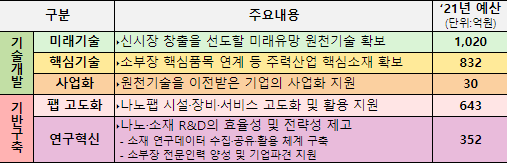
Investing 287.9 billion won in core technology development [Table = Ministry of Science and ICT]
◇ Investing KRW 102 billion in securing promising core technologies that will create new markets.
The Ministry of Science and ICT will invest 102 billion won in securing promising next-generation nano and material technologies that will meet future technology demands and create new markets and industries.
We will provide new support for projects such as prototype production to verify whether the nano-fusion technology we have accumulated so far is industrially feasible, and considering the spread of COVID-19, we plan to give priority support (8 projects, approximately KRW 6 billion) to the bio-fusion field.
We plan to expand the 'Future Technology Research Lab' to develop innovative and challenging research topics (from 8 to about 30, worth 18.1 billion won), such as inorganic photoresists for semiconductor processes below 8 nm, and high-performance electrode materials based on 'MXene', a two-dimensional nanomaterial with titanium and carbon layers, and future-leading items (new, about 4, worth 2 billion won).
Also, accumulated over timeWe are newly supporting a prototype production project to verify whether the nano-fusion technology we have been developing is industrially feasible, and considering the spread of COVID-19, we plan to give priority support (8 projects, approximately 6 billion won) to the bio-fusion field.
We will also continue to support research groups (28, KRW 41.5 billion) on new materials discovery utilizing new research methodologies such as computational science, ongoing projects (approximately 60, KRW 34.4 billion), such as display materials that simultaneously implement image and sound, and flexible electronic devices for implantation in the body.
◇ Investing 83.2 billion won in securing key materials for key industries.
The Ministry of Science and ICT plans to expand the selection of 'National Core Materials Research Groups' (32 in 2020 → 57 in 2021, approximately KRW 83.2 billion) in which industry, academia, and research institutes work together to conduct applied research based on original technology in connection with the core items (100+85) of 'Small and Medium Business (materials, parts, and equipment)' and strengthen inter-ministerial collaboration such as relay and joint running.
The National Core Materials Research Group will be selected into two types: △specialized type, which matches products and technologies 1:1 and supports securing countermeasure technologies for implementing the performance of specific products; and △platform type, which matches products and technologies many:1 and supports securing general-purpose technologies that serve as the basis for improving the performance of multiple products.
In the case of specialized research, 10 research groups will be newly selected in 2021 (15 in 2020 → 25 in 2021), including non-platinum precious metal catalysts, non-carbon carrier-based hydrogen production catalyst materials, and nano-LED display materials. Ten research groups have been designated as dedicated relay-running projects, collaborating with the Ministry of Trade, Industry and Energy from the project planning stage, and commencing commercialization project planning before the project is completed, thereby linking research results to commercialization and supply chain entry.
In the case of the platform type, it is a type that secures complete core technologies by providing package support for materials, processes, and systems, and completes technology transfer within the research period. In 2021, 15 research groups will be additionally selected (17 in 2020 → 32 in 2021). Among these, five research groups are attempting joint R&D for the first time among the Ministry of Science and ICT, the Ministry of Trade, Industry and Energy, and the Ministry of SMEs and Startups on collaborative items that can simultaneously pursue basic and original research and applied and development research.
◇ 3 billion won in support for commercialization of companies transferring core technologies.
The Ministry of Science and ICT will invest 3 billion won in the "Nano Convergence 2020+" project (approximately 9 projects) to support the development of commercialization models and initial market entry for companies that have received nano and material source technologies from public research institutes.
This is a follow-up to the 'Nano Convergence 2020' project, which ended this year and achieved excellent results, such as achieving a cumulative sales figure of 454% of the government investment. Utilizing the know-how accumulated so far, the project will provide support in the form of patent analysis, technical consulting, and continuous monitoring.
◇ KRW 64.3 billion in support for nanofab facility and service advancements.
The Ministry of Science and ICT will invest 64.3 billion won in advancing the national nano infrastructure, including building semiconductor test beds, expanding university fabs, and supporting testing and evaluation for companies and researchers.
Following export restrictions, the 12-inch semiconductor testbed (Nano Comprehensive Technology Institute) and the system semiconductor manufacturing batch process (collaboration between the Nano Comprehensive Technology Institute and the Korea Nanotechnology Institute) were launched to support rapid performance evaluations for small and medium-sized fabless companies. The core equipment was completed this year and a pilot service is scheduled to begin in 2021.
In addition, in addition to existing public fabs, we are newly promoting the advancement of semiconductor fabs facilities, equipment, and services at universities (3 institutions, KRW 9 billion), and we are also newly promoting commercialization consulting using highly experienced personnel from large corporations (10 people, Korea Institute of Nanotechnology).
◇ Investing KRW 35.2 billion to improve nanomaterial R&D efficiency and strategy. />
The Ministry of Science and ICT will continue to support the establishment of a 'material research data collection and sharing platform' linked to the 'Digital New Deal' (KRW 6 billion in '20.9~, '21), and will newly initiate the development of specialized services such as △exploration and design, △process development, and △measurement and analysis to utilize accumulated research data (KRW 7.9 billion in '21).
While continuing to cultivate specialized personnel with hands-on experience in nanoinfrastructure (1,000 personnel annually) and research data platforms (495 personnel annually), new support (KRW 4.5 billion) will be provided for the dispatch of technical personnel from public research institutes to small and medium-sized enterprises (SMEs). This support is based on full-time dispatch and 100% participation, and both personnel and research expenses are eligible for support.
Meanwhile, the Ministry of Science and ICT plans to actively pursue administrative measures, such as establishing a preliminary plan that utilizes the expertise of related organizations to systematically manage the continuously expanding R&D budget in the nano and materials fields, expanding the operation of the provisional selection system, which is a stage in which research plans are supplemented through coordination between PMs and researchers at the National Research Foundation of Korea, and strengthening research ethics by determining extremely poor projects during evaluation.
Kim Bong-soo, Director General of Basic Research Policy at the Ministry of Science and ICT, said, “Materials, components, equipment, and nanotechnology are areas that the government will provide long-term, stable, and ‘unwavering’ support in,” adding, “We will actively reflect industrial demand in research and development so that excellent research results can be turned into products and linked to the supply chain, and we will strengthen cooperation between relevant ministries and industry, academia, and research institutes.”
Comments
Related news
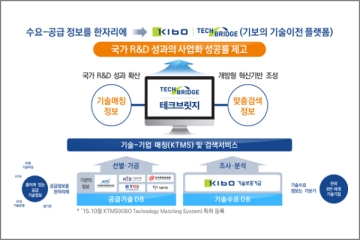
31 R&D Projects Selected to Support Commercialization of Materials, Parts, and Equipment Technologies for SMEs
The Ministry of SMEs and Startups has selected 31 projects in the first round for the Tech Bridge Commercialization Technology Development Project, which provides follow-up commercialization technology development funding to SMEs that have acquired core technologies in the materials, components, and equipment sectors from universities and research institutes.
2020.08.24by 명세환 기자

Over 70% of Korean companies respond positively to the Digital New Deal policy.
Both large domestic enterprises and mid-sized companies are viewing the digital new deal positively, and it is anticipated that digital transformation will begin in earnest across all industries in 2021. IBM Korea announced this assessment while releasing the results of a survey conducted on domestic companies regarding corporate awareness and response status following the government's new deal policy announcement, as well as prospects related to digital transformation.
2020.11.19by 이수민 기자
The Ministry of Science and ICT will invest 17.5 trillion won in the Korean New Deal and post-COVID response.
The Ministry of Science and ICT has finalized the 2021 budget plan totaling 17.5154 trillion won. This represents an increase of 1.2086 trillion won compared to 2020 and was expanded to support the Korean New Deal, basic and fundamental research and development, cultivation of three strategic new industries, realization of an inclusive society, and response to infectious diseases. The government R&D budget increased by 3.1823 trillion won to reach 27.4018 trillion won.
2020.12.03by 이수민 기자

Intel Unveils Next-Generation 'Core Ultra Series 3' and vPro Platform for Enterprise PCs
Intel has officially unveiled the "Intel Core Ultra Series 3" for next-generation enterprise PCs and the latest vPro platform, addressing a wide range of demands from enterprise notebooks to high-performance workstations.
2026.03.26by 배종인 기자

ROHM Launches ESD Protection Diode Compatible with High-Speed Interfaces of 10Gbps or Higher
Semiconductor specialist ROHM has developed the 'RESDxVx series' of ESD (electrostatic discharge) protection diodes capable of responding to next-generation high-speed data communication environments exceeding 10Gbps, simultaneously enhancing both signal quality maintenance required in high-speed interfaces and IC protection performance.
2026.03.26by 배종인 기자











