


U+ Demonstrates 5G Unmanned Valet Parking Service: "Commercialization Not Yet"
 Published2020.12.17 14:05
5G-V2X technology exchanges data between vehicles and surrounding cameras.
High recognition rate even in bad weather... Public demonstration to be held as early as next month.
A self-driving technology that enhances accuracy through communication with surrounding objects has been developed. LG Uplus, Ace Lab, and Controlworks held an online press conference on the 17th and publicly demonstrated autonomous parking technology based on 5G mobile communications.
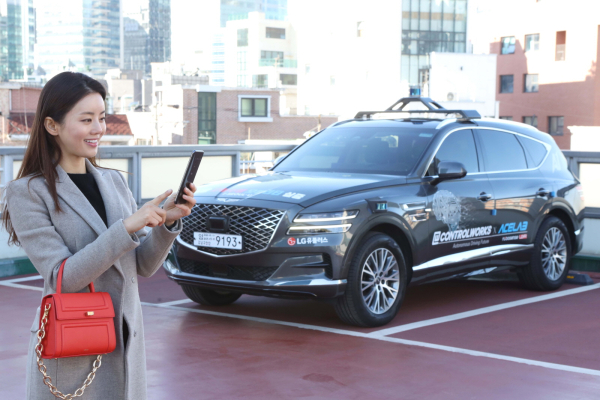
Autonomous parking is a concept of autonomous valet parking where a car finds a nearby parking lot and parks in an empty space. This demonstration comes about a year after LG U+ unveiled its unmanned remote calling technology for vehicles in October last year.
Professor Seonwoo Myeong-ho of Hanyang University's Automotive Electronic Control Laboratory, Ace Lab, said, "Driving is always followed by parking, and autonomous parking is the next step of autonomous driving," adding, "This technology will eliminate the cumbersome parking process."
◇ Reducing signal recognition errors with 5G-V2X technology
The demonstration used the Hyundai Motor Company's 'Genesis GV80' SUV-based 5G autonomous driving vehicle 'A1', which is equipped with ▲5G autonomous driving technology ▲real-time parking space recognition solution ▲5G cloud control service platform ▲mobile app service linkage function, etc.
In a demonstration held at the Sangam 5G autonomous driving pilot zone in Seoul, A1 traveled approximately 800 meters from the YTN News Square building to Sangam 1 Public Parking Lot in 5 minutes, then parked on its own and turned off the engine.
On the way to the parking lot, A1 encountered a total of five crosswalks and three intersections, and communicated with traffic lights and 5G-V2X (Vehicle to Everything) communication to independently determine whether to continue driving or start braking at each moment.
This represents an improvement over last year's demonstration, which used cameras to determine traffic light colors to determine whether to proceed. The likelihood of camera recognition errors due to inclement weather like snow and rain, light refraction, and obstructed view from trees has also been reduced. Lidar and radar were also utilized to help with environmental awareness.
A1 drove through the narrow entrance of Sangam 1 Public Parking Lot and parked in a single reverse maneuver, guided by the demonstrator's mobile app. Here, a deep learning-based real-time parking space recognition system and a 5G cloud control platform were utilized.
The real-time parking space recognition system reads the availability of parking spaces from CCTV installed in the parking lot. It then trains AI to capture images of empty spaces from various angles and saturation levels, identifying them solely from the CCTV footage. This parking space data is then aggregated into a 5G cloud control platform.
The mobile app service also played a diverse role in this demonstration. It basically allowed drivers to check availability in nearby parking lots and send their vehicles to those spots. It also displayed the vehicle's current location in real time on a map, and once parking was complete, a parking completion notification was displayed to confirm the vehicle's successful arrival.
◇ Open to the public as early as January next year
In the case of parking assistance systems currently installed in some commercial vehicles, there is no significant difference in terms of time saving because a person must personally go to the parking lot, select an empty space, and then return.
LG Uplus stated that this 5G autonomous parking demonstration has laid the foundation for future mobility technology, encompassing "unmanned pickup, driving, and parking." The company explained that applying this technology will eliminate delays between boarding and disembarking, enabling autonomous vehicles to function as dedicated call taxis or chauffeurs.
This service requires the installation of numerous CCTV cameras in each parking lot and the construction of a separate 5G network to connect them, so commercialization is expected to take some time. However, as the technology is fully feasible over LTE networks, it may not take long if relevant laws and standards are established.
Meanwhile, A1 has conducted 137 private 5G autonomous parking demonstrations. LG Uplus, Ace Lab, and Control Works plan to begin public demonstrations for the general public as early as January 2021.
Comments
Related news

Palo Alto Networks Unveils 5G-Native Security Offerings
Effective 5G network design enables millions of devices to be deployed in high-density environments, facilitating various innovations such as smart supply chains, autonomous vehicles, smart manufacturing, and large-scale IoT. To realize this, 5G networks and services must provide enterprise-level security. In response, Palo Alto Networks has launched 5G-native security offerings to securely protect 5G-based networks, clouds, and devices.
2020.12.01by 이수민 기자
Object recognition technology that improves autonomous driving safety, "How far has it come?"
Autonomous vehicles require sensors such as cameras, LiDAR, and radar. The object recognition AI model installed in autonomous vehicles interprets information transmitted by multiple sensors based on datasets, recognizes surrounding objects, and determines direction and driving control. Object recognition requires labeled datasets in any field, but the autonomous driving industry has not yet reached consensus on dataset labeling methods, with only basic standards having been established.
2020.12.07by 이수민 기자

Xilinx: "Automotive Semiconductors Should Adopt FPGAs Instead of ASICs"
Automotive semiconductors are being utilized to promote new automotive technologies such as electrification, autonomous driving, functional safety, connected vehicles, AI, IVI, ADAS, MaaS, and TaaS. Vehicle and automotive electronics manufacturers must adopt adaptive computing solutions to ensure their products can properly leverage these new technologies.
2020.12.09by 이수민 기자
[e4ds Tech Day 2026 ⑨] Sim Sang-gyu, Autocrypt CTO: "In the Physical AI Era, Automotive Security Must Extend Beyond the Vehicle"
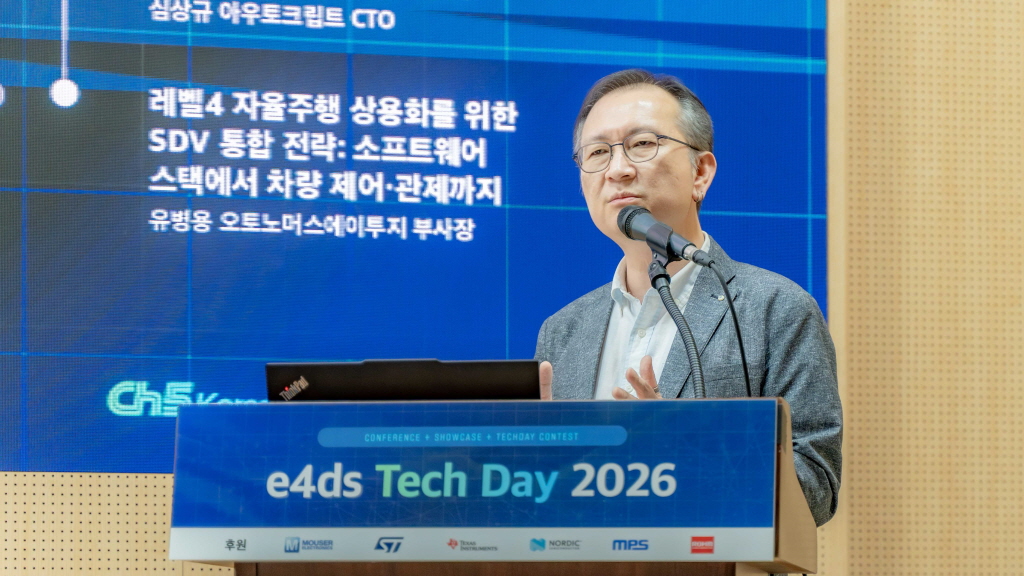
At e4ds Tech Day 2026, Sim Sang-gyu, CTO of Autocrypt, explained automotive cybersecurity strategies in the era of Physical AI and SDV (Software-Defined Vehicle). Automobiles are evolving as part of an ecosystem connected to AI, cloud, chargers, IoT, and robots, and he emphasized that the scope of security must expand beyond the vehicle interior to the entire connected environment. In particular, AI model tampering, adversarial attacks, OTA updates, and EV charger hacking were identified as major threats. He explained that response measures require zero trust, AI model integrity protection, intrusion detection, Security by Design and Default, and full lifecycle security management, and that proactive security system establishment beyond regulatory compliance is critical for securing future mobility competitiveness.
2026.10.12by 배종인 기자

Practical HIL Construction Strategy for Automotive and Off-Highway Controller Validation
As vehicle E/E architecture transitions to zonal structures and shifts to software-defined vehicles (SDV), the number of controllers (ECUs) requiring validation and software complexity are surging dramatically. Meanwhile, real vehicle testing cannot provide repeated verification under identical conditions and entails lead time and safety concerns. This white paper explains the principles of HIL (Hardware-in-the-Loop) validation and the structure of the NI platform composed of PXI, SLSC, and VeriStand, and through two actual implementation cases—Camera Record & Replay HIL for In-Cabin Monitoring Controller (ICMU) and Forklift Controller (VCU) HILS—describes how controller-level regression testing becomes possible. Additionally, it explicitly states application boundaries and limitations, such as lack of A2B support.
2026.10.12by 편집부











