



ETRI Completes Network Mutation Technology to Block Hacker Attacks
 Published2020.12.23 15:55
Development of network mutation technology that causes hacker confusion
Users can enjoy seamless service even when their IP address changes.
A domestic research team has developed a technology to prevent cyberattacks before they occur.
The Electronics and Telecommunications Research Institute (ETRI) announced on the 23rd that it has developed a 'network mutation technology' that blocks cyberattacks by continuously changing server IP addresses, etc.
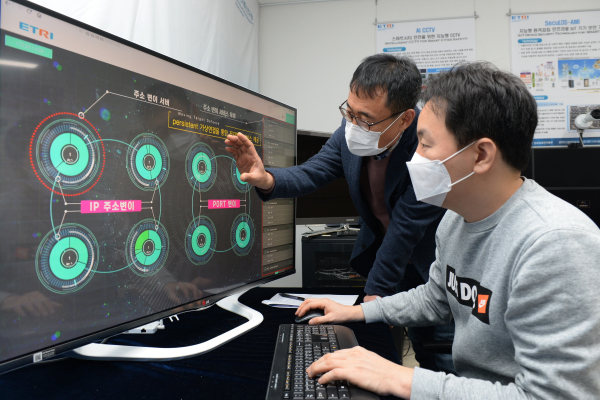
Developed network address mutation technology [Photo = ETRI]
Until now, cyberattack defenses have primarily relied on detection technologies that block hacker intrusions through firewalls or security devices. ETRI's network mutation technology continuously changes server IP addresses and service port numbers while hackers select and prepare their targets, creating confusion and delaying their attack time.
Although it cannot fundamentally prevent hacker infiltration, this technology can block malicious activities after infiltration. It is based on ▲physical and virtual network linkage technology ▲network tunneling technology that forms and maintains a virtual network connection between the server and the user ▲local NAT (Network Address Translation) technology that changes the destination and source IP addresses, port numbers, etc. of network packets.
By utilizing network address mutation technology, users can receive smooth and continuous service without even realizing that the address changes in real time. The server's internal interface is divided into sections with variable addresses and sections with fixed addresses. Hackers can only access the sections with variable addresses. Users can access the server through hidden paths, ensuring safety.
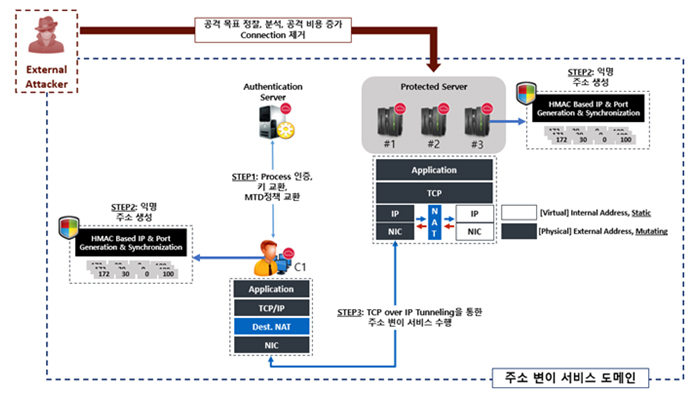
This technology fundamentally blocks exposure of the target system not only to external attackers, but also to scanning and packet sniffing attacks used by attackers inside the network to detect the target. This prevents cyberattacks from ever being launched.
The typical ICT infrastructure used by companies and organizations is prone to vulnerability, as attacker status information is easily exposed. The technology developed by the research team actively modifies ICT infrastructure systems, making vulnerability analysis more difficult.
To enhance the technical perfection, the research team conducted demonstrations at private cloud centers and universities. Furthermore, the technology has been transferred to domestic information security solution developers and is working toward commercialization next year. Furthermore, following selection for the Ministry of National Defense's Defense U-Experimental Project next year, the team plans to conduct demonstrations on military networks targeting Air Force air squadrons and expand the technology across the entire military to strengthen security.
Comments
Related news

Palo Alto Networks Unveils 5G-Native Security Offerings
Effective 5G network design enables millions of devices to be deployed in high-density environments, facilitating various innovations such as smart supply chains, autonomous vehicles, smart manufacturing, and large-scale IoT. To realize this, 5G networks and services must provide enterprise-level security. In response, Palo Alto Networks has launched 5G-native security offerings to securely protect 5G-based networks, clouds, and devices.
2020.12.01by 이수민 기자
Cyber threats next year will focus on manufacturing, healthcare, and the cloud.
SK Infosec's EQST Security Expert Group released a 2021 cyber threat outlook report and announced five major cyber threats likely to occur next year. The five threats include attacks on industrial control systems in the manufacturing sector, defense-bypass ransomware attacks, attacks on the digital healthcare sector, increased security considerations in hybrid cloud environments, and security threats exploiting untact environments.
2020.12.09by 이수민 기자
Lattice Unveils New HRoT FPGA Protecting Firmware
To protect systems from attackers exploiting firmware vulnerabilities, a real-time HRoT supporting strong cryptographic algorithms and data security protocols is required. In response, Lattice Semiconductor has unveiled the "Lattice Mach-NX Security Control FPGA Product Family," which safely maintains firmware through a 384-bit hardware-based encryption engine.
2020.12.10by 이수민 기자
.png)
Databricks Unveils Open AI Security Monitoring 'Lakewatch'
Databricks entered the security market on March 24 by unveiling LakeWatch, an open-source agentic SIEM. The core functionality of this product is to integrate and analyze security, IT, and business data in a single environment to support AI-based threat detection and investigation. The company explained that it reduces the limitations of existing security operations centers, which have had to forgo some data due to high cost structures, and enables large-scale data analysis and automation based on open formats and ecosystems. LakeWatch is currently offered as a private preview, with Adobe and Dropbox mentioned as early customers. Databricks also announced an expanded partnership with Anthropic as well as the acquisition of Antimatter and SiftD.ai.
2026.03.26by 배종인 기자

Kaspersky Unveils Revamped 'NEXT' Combining SOC Integrated Management and AI Analytics
As enterprises increase demand for integrated management and automation in the construction and operation of Security Operations Centers (SOC), Kaspersky has disclosed updates to its B2B security product suite 'Kaspersky Next'. This update expands EPP, EDR, XDR, and SIEM integration through a single console based on OSMP, incorporates AI capabilities such as DLL hijacking detection and suspicious account takeover behavior identification, and includes integration with generative AI assistant tool KIRA. The company stated that in large-scale deployment environments, EDR Expert can reduce resource requirements by up to 30%, and XDR Expert by up to 60%.
2026.03.25by 배종인 기자











