



"No Catuktu Smartphone Coming Soon": Ultra-thin Metalens Released
 Published2021.01.04 10:55
Development of 100x Thinner Metalens and Mass Production Technology
Could smartphone cataracts disappear?
The Ministry of Science and ICT announced on the 2nd that the research team of Professor Noh Jun-seok of the Department of Mechanical Engineering/Department of Chemical Engineering at Pohang University of Science and Technology, together with the research team of Professor Lee Heon of the Department of New Materials Engineering at Korea University and Master Han Seung-hoon of the Imaging Device Lab at Samsung Advanced Institute of Technology, developed an infrared ultra-thin lens that maintains the performance of existing refractive lenses but is 10,000 times thinner, as well as the technology to mass-produce it.
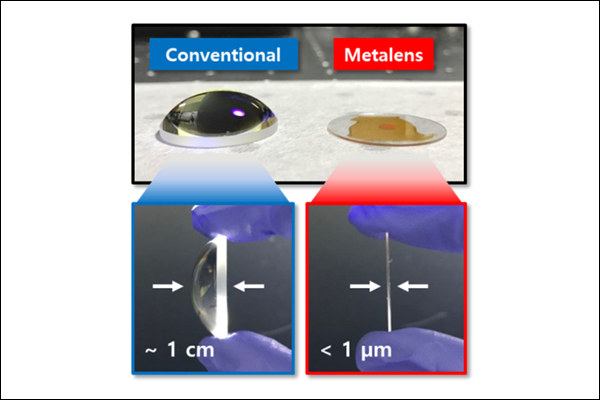
Conventional refractive lenses are large and heavy, and their performance deteriorates as their size decreases. Smartphone cameras use composite lenses composed of eight or nine refractive lenses to reduce image distortion. However, the difficulty in reducing the thickness of these composite lenses leads to the camera protruding from the back of the smartphone.
Researchers have been exploring metamaterial-based lenses to develop high-performance, yet compact lenses. Metamaterials offer the ability to freely control a variety of optical properties, including negative and ultra-high refractive indices, that conventional materials cannot achieve. This allows for the creation of unprecedented optical devices, such as ultra-thin flat lenses, high-resolution holograms, and invisibility cloaks. This has led to extensive research worldwide.
However, the electron beam lithography process used to produce metamaterials is slow and expensive, so the unit price of metamaterials produced through it is also high. To overcome this, the research team succeeded in developing a nano-composite-based nano-molding material that has optical properties suitable for implementing metamaterials and can be freely shaped, as well as a one-step printing technology that can shape it in a single process.
Nano-molded materials are made by mixing nanoparticles with a photosensitive resin, which normally exists in a liquid state but hardens into a hard plastic when exposed to light. This allows for a wide range of control over the optical properties of the nano-molded materials, depending on the type and concentration of nanoparticles. This allows them to replace existing materials commonly used in the production of metamaterials. Furthermore, their unit cost is lower than that of existing materials, making them highly cost-effective.
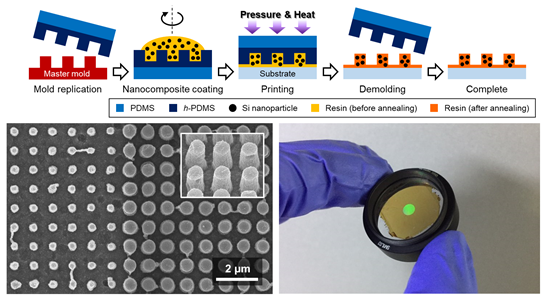
(Bottom left) Metalens seen through an electron microscope. (Bottom right) 1-inch lens.
4mm metalens attached to a tube [provided by the Ministry of Science and ICT]
A new one-step printing technology for nanomaterials can produce metamaterials more than 100 times faster than conventional electron beam lithography. Additionally, metamaterials can be implemented on curved and flexible substrates that are difficult to be compatible with existing processes, making it possible to apply them to wearable devices.
The research team developed an ultra-thin metalens with a thickness of 1 ㎛ (micrometer), which is more than 100 times thinner than the thickness of a human hair, based on silicon nanocomposites and printing technology. They successfully combined this with an actual optical system to achieve imaging, verifying the practical applicability of the research results.
Professor Noh Jun-seok said, “The ultra-thin metalens is 10,000 times thinner than existing infrared refractive lenses with the same optical properties, so it can solve various problems caused by large and heavy refractive lenses. In the future, it is expected to be applied to various fields such as infrared endoscopes, CCTV, and night vision goggles.”
Meanwhile, the results of this study were published in the world-renowned academic journal ACS Nano on January 1, 2021, under the title 'Printable Nanocomposite Metalens for High-Contrast Near-Infrared Imaging.'
Comments
Related news

Magna to Unveil Camera Monitoring System in 2022
CLEARVIEW provides drivers with enhanced visibility through a unique combination of camera and mirror technology. The CLEARVIEW rearview mirror features a frameless design and allows electronic switching between a traditional back mirror and a customized video display capable of showing up to three camera views simultaneously. The CLEARVIEW side mirror integrates cameras with side view mirrors that comply with U.S. regulations to deliver real-time external conditions inside the vehicle. The cameras are mounted at the outermost edge of the mirror, maximizing the driver's field of view while enhancing visibility and safety. The CLEARVIEW side mirror also includes safety and convenience features such as a surround view camera, blind spot indicator, auto-dimming glass, memory function, electronic folding mechanism, and front and rear lighting.
2020.10.28by 명세환 기자
Cognex Unveils Color-Perceiving DL-Based Industrial Camera
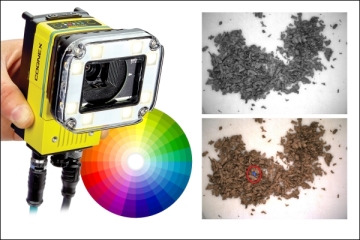
Approximately 30% of deep learning-based inspections require color imaging. Color is a distinguishing factor in feature differentiation across various assembly verification and defect detection inspections in multiple industries. In response, Cognex has launched the In-Sight D900 Color, a deep learning-based industrial smart camera newly equipped with color imaging capabilities.
2020.11.06by 이수민 기자

Object recognition technology that improves autonomous driving safety, "How far has it come?"
Autonomous vehicles require sensors such as cameras, LiDAR, and radar. The object recognition AI model installed in autonomous vehicles interprets information transmitted by multiple sensors based on datasets, recognizes surrounding objects, and determines direction and driving control. Object recognition requires labeled datasets in any field, but the autonomous driving industry has not yet reached consensus on dataset labeling methods, with only basic standards having been established.
2020.12.07by 이수민 기자

Korea Instrument, KOLAS Accredited Calibration Agency First to Simultaneously Acquire ISO/IEC 27,001·27,701
Korea Instrument has become the first among KOLAS accredited calibration agencies to simultaneously acquire ISO/IEC 27,001 and ISO/IEC 27,701 certifications. Through its proprietary platforms CWIZ Enterprise and CWIZ Partners, the company has embedded information security and personal data protection requirements across all business processes including customer information, equipment data, and calibration reports, with plans to continuously advance its management system through regular audits and security inspections.
2026.10.12by 배종인 기자

TeamViewer One, IT Incident Automation Workflow and Resolution Center Enhanced
TeamViewer has added IT incident automation capabilities and an advanced Resolution Center to its integrated digital workplace management platform 'TeamViewer ONE'. Recurrent service disruptions, configuration errors, and capacity shortages are automatically handled according to preset policies, and device status verification through script deployment can be managed in a unified interface, significantly reducing repetitive tasks for IT teams.
2026.10.12by 배종인 기자











