


The spatial information industry has seen a surge in the number of businesses, driven by increased public sector orders.
 Published2021.01.07 14:56
Increase in orders from IT service providers, including system integration companies.
Smart cities and digital twins are seeing a surge in employment.
The spatial information industry is an industry that produces, processes, and distributes digital maps, cadastral maps, and 3D maps related to the location of objects, or provides services through convergence and integration with other fields.
The Ministry of Land, Infrastructure and Transport announced on the 7th, citing the '2020 Spatial Information Industry Statistical Survey', that as of the end of 2019, the domestic spatial information industry's sales were 9.339 trillion won, the number of employees was 65,356, and the number of businesses was 5,589.
From 2013, when the first survey was conducted, the spatial information industry's sales increased by 3.9 trillion won, the number of employees increased by 23,000, and the number of businesses increased by 1.1 thousand, showing an average annual growth rate of 8.0%, 6.2%, and 3.2%, respectively.
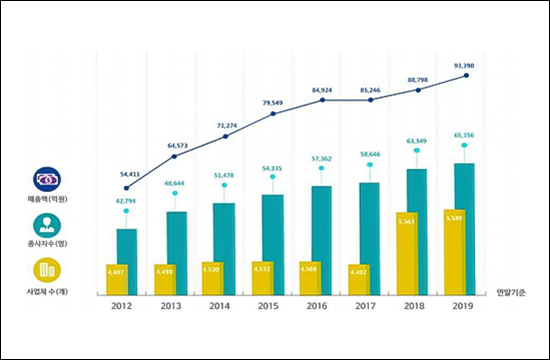
The total sales of the spatial information industry amounted to KRW 9.339 trillion, an increase of KRW 459.2 billion (5.2%) year-on-year, and the operating profit rate (4.2% for the entire industry) and net profit rate (2.7% for the entire industry) were 14.0% and 12.7%, respectively, which were high compared to other industries.
Looking at sales by industry, manufacturing related to spatial information (▲2.3%), wholesale (△0.1%), and technology services (▲1.3%) showed similar levels to the previous year. Publishing and information services (▲17.6%) and associations and organizations (▲11.6%) showed significant increases. In particular, orders for systems integration and other information technology service providers increased, driven by an increase in new projects and research orders from the public sector.
The number of employees in the spatial information industry reached 65,356, an increase of 2,007 (3.2%) from the previous year and an increase of 11,021 over the past five years, demonstrating the industry's consistent contribution to domestic job creation. By industry, publishing and information services (12.5%) saw an increase compared to the previous year. This increase appears to have been driven by new projects related to smart cities and digital twins.
The number of businesses in the spatial information industry remained similar to the previous year, reaching 5,589, an increase of 26 (0.5%) from the previous year. While growth was observed in spatial information-related manufacturing, publishing and information services, and engineering services, the decline was comparable to that observed in spatial information-related technical service industries, such as exploration and surveying. By size, 62.5% (3,493 businesses) had sales of less than KRW 1 billion, and 60.7% (3,395 businesses) employed fewer than 10 people, indicating that small businesses still dominate the market.
The survey results show that manufacturing, publishing, and information service industries related to spatial information contributed to the increase in the overall sales and number of employees and businesses in the spatial information industry. In particular, digital-related industries such as software development and supply, programming, system integration, and other information technology services, and data processing, database, and online information provision are showing rapid growth. However, industries such as surveying and map production have stabilized and are maintaining a similar scale to the previous year.
Nam Young-woo, Director General of Land, Infrastructure and Transport's Land Information Policy Bureau, stated, "We expect the spatial information industry to grow into a core industry of the Korean New Deal policy," adding, "We will continue to conduct surveys on the spatial information industry and conduct basic research necessary for its development." The results of this survey can be found on the Ministry of Land, Infrastructure and Transport's Statistics website and the Korea Spatial Information Industry Promotion Agency website .
Comments
Related news
The ICT industry in 2020, devastated by COVID-19: "Will 2021 be different?"
The ICT sector this year was hit by the COVID-19 pandemic, but secured new growth drivers. The center of the 2021 ICT Top 10 Issues announced by IITP was also the COVID-19 pandemic. The top 10 issues include data, AI, 5G, digital twin, non-face-to-face business, digital platforms, home economy, K-content, big tech, and global trade, all of which were strongly affected by the pandemic. Given that the situation's resolution remains distant, policies and plans should be established taking these issues into consideration.
2020.11.16by 이수민 기자

KETI-RIST Begins Demonstration Testing of 'Augmented Reality' Technology in Manufacturing
In the manufacturing industry, demand for digital twin-based extended reality (XR) technology is increasing due to increasingly complex factory equipment and a shortage of skilled workers. KETI and RIST have begun solution demonstration and pilot testing by applying digital twin-based XR technology, which they are developing to enhance corporate productivity and workers' job competency, to a secondary battery material pilot manufacturing facility of POSCO Chemical within RIST.
2020.11.27by 이수민 기자
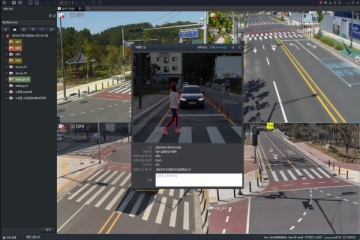
Demonstration of "smart city" services based on 5G's low-latency characteristics begins.
ETRI has developed a 5G drone-based control service solution and 5G CCTV-based intelligent road safety support service technology, and completed demonstration for precision control services. It can also be utilized for density analysis for quarantine management within buildings, making it useful for security control within buildings as well.
2020.12.07by 이수민 기자

Korea Instrument, KOLAS Accredited Calibration Agency First to Simultaneously Acquire ISO/IEC 27,001·27,701
Korea Instrument has become the first among KOLAS accredited calibration agencies to simultaneously acquire ISO/IEC 27,001 and ISO/IEC 27,701 certifications. Through its proprietary platforms CWIZ Enterprise and CWIZ Partners, the company has embedded information security and personal data protection requirements across all business processes including customer information, equipment data, and calibration reports, with plans to continuously advance its management system through regular audits and security inspections.
2026.10.12by 배종인 기자
TeamViewer One, IT Incident Automation Workflow and Resolution Center Enhanced
TeamViewer has added IT incident automation capabilities and an advanced Resolution Center to its integrated digital workplace management platform 'TeamViewer ONE'. Recurrent service disruptions, configuration errors, and capacity shortages are automatically handled according to preset policies, and device status verification through script deployment can be managed in a unified interface, significantly reducing repetitive tasks for IT teams.
2026.10.12by 배종인 기자











