



Poly Announces Six Workplace Technology Trends to Watch This Year
 Published2021.02.03 12:45
To ensure the same work efficiency wherever you are
Future prospects for audio/video/communications technology development
Last year was a year of change, with countless workers forced to work from home due to the COVID-19 pandemic. This year, companies are expected to continue developing new work methods and pursuing ongoing change.
Audio/video company Poly announced on the 2nd six notable work environment technology trends for this year.
.jpg)
[Graphics = Poly]
The first is the establishment of hybrid work arrangements . This year, more companies are expected to adopt hybrid work arrangements and focus on providing a more consistent work environment, whether in the office, at home, or anywhere else. Work will no longer be judged by the time spent, but by the results achieved.
“The key to successfully establishing a hybrid work arrangement will be employee well-being, which allows employees to separate their work and home lives to prevent burnout,” said Samir Sayed, managing director of ASEAN-Korea at Poly. “Companies need to find the right balance between time away from the office and time spent in person.”
The second is to promote business agility through XaaS . Digital transformation will be fueled by Anything-as-a-Service (XaaS). As providers shift their value offerings to services, digital service subscription models are proliferating. This allows businesses to deploy and scale on demand, achieving the agility to operate seamlessly and continuously without interruption.
“Businesses expect technology vendors to provide more than just hardware and software, they also need solution providers to provide support services,” said Sayed. “Downtime due to technology failures can be overwhelming for staff, so they need business-critical support services that can quickly diagnose and resolve issues.”
The third is the rise of prosumers . Employees who can't get the performance they need from consumer devices need to upgrade their remote work environment with technologies that enable seamless collaboration, such as fiber optic internet connections, noise-canceling headsets, and audio/video conferencing solutions that allow them to join video conferences with the push of a button.
“With the continued shift to working from home, professional consumers, or prosumers, are transforming their home environments for the long term,” said Sayed. “They are building their home offices with high-speed internet, comfortable headsets with noise-canceling capabilities, and clear audio and video conferencing solutions that allow them to access collaboration platforms at the push of a button.”
.jpg)
Transforming the Office Landscape [Graphic = Poly]
The fourth is the transformation of the office . The office will become a crucial meeting place for employees, and most work will continue to be done remotely. Workspaces will accommodate the work styles of all employees and provide collaboration and technology support to enable business to be conducted from anywhere.
While some companies are reducing their on-site workforce and seeking to cut real estate costs, many are still reluctant to downsize their office space. Employers and businesses must move beyond the traditional concept of a headquarters office and focus on creating workspaces that accommodate the work styles of all employees and enable collaboration and technology support across multiple locations, enabling business to be conducted from anywhere.
“As more companies adopt hybrid work arrangements, this year will be a year where we must focus on optimizing productivity through collaboration,” said Sayed. “Companies will need to transform their physical environments to create collaborative environments, including increasing the number and size of meeting rooms. This will also lead to the emergence of new digital collaboration and remote meeting tools.”
Fifth, the key to success is video . Video is becoming more prevalent as a core conferencing tool than ever before, and technological advancements over the past few years have enabled a whole new level of collaboration. It is also becoming increasingly important in everyday business, as new business models are being adopted in industries like telemedicine and education.
“Video is already a common standard in meetings, and it’s becoming a standard in many industries that didn’t use video before,” said Syed. “With faster internet connections and improved video compression, the addition of HD/4K video mixes is taking collaboration to the next level.”
The sixth is that advancements in connectivity technology will enable better collaboration environments . Companies will consider technologies like 5G to create enhanced collaboration environments, enabling seamless connectivity that feels like meeting in person. Additionally, digital transformation efforts are expected to focus on technologies that are more easily adaptable to end users.
“As connectivity technologies improve, especially audio/video-based collaboration applications, we will see a significant shift in how employees approach their daily lives, offering significant benefits,” said Sayed. “Technologies like 5G will play a key role in supporting a remote workforce by providing faster connectivity.”
The traditional office environment will become obsolete. Many companies are seeking to transform their workforce by equipping them with the right tools to remain productive wherever they work. Furthermore, policies to prevent burnout and promote physical and mental well-being will become a top priority for companies.
Comments
Related news

Aviva and OEG Partner to Strengthen Cloud-Based "Non-Face-to-Face Industrial Training"
Aveva has established a strategic partnership with OEG, an industrial education platform and content company based in Texas, USA. Through this partnership, OEG's remote 3D educational content will be integrated into Aveva's industrial education solution, Unified Learning. Additionally, a customizable, experiential training course library will be built in conjunction with OEG's learning management system and operator training simulator.
2020.12.17by 강정규 기자
The pandemic has taught us a lesson: We must secure organizational operational resilience.
The COVID-19 pandemic has brought unexpected prosperity and opportunities to the ICT industry through the activation of remote work and accelerated digitalization. With expectations that the current situation will continue into next year, Gartner has selected promising strategic technologies with emphasis on organizational operational resilience. Let us prepare for the coming year of 2021 through nine technologies including the Internet of Behavior and distributed cloud.
2020.12.28by 이수민 기자

[CES 2021] Intel Introduces Processors Specialized for Remote Work and Education
With the COVID-19 pandemic increasing demand for remote work and education, PC sales volumes showed growth for the first time in a while. At CES 2021, held entirely online, Intel announced new Core vPro processors, Evo vPro platform, Pentium Silver processors, Celeron processors, and Core H-series mobile processors. Additionally, Intel stated that it would launch next-generation Rocket Lake S and Alder Lake S processors later this year.
2021.01.13by 이수민 기자
European Patent Applications Surpass 200,000 for the First Time… South Korea Maintains 5th Place, Led by Batteries and Telecommunications
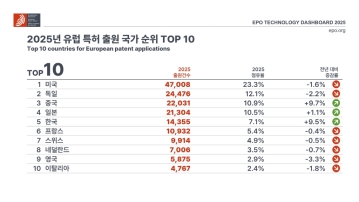
According to the European Patent Office (EPO)'s 'Technology Dashboard 2025', European patent applications last year reached 201,974, surpassing 200,000 for the first time. Korean companies and inventors filed 14,355 applications, representing a 9.5% increase from the previous year and maintaining 5th place by country. Battery, digital communication, and semiconductor technologies led the growth, with Samsung ranking as the top EPO applicant for the second consecutive year and LG reaching 3rd place. The presence of major domestic cities such as Seoul, Suwon, and Yongin was also confirmed. It was also revealed that Korea's European patent strategy is expanding beyond individual technologies to span the entire industry.
2026.03.24by 명세환 기자

SK Telecom First Applies AI-Based Network Operations at Gwanghwamun K-Pop Concert
SK Telecom announced that it applied an AI-based network operation system for the first time at a large-scale K-pop concert held in the Gwanghwamun area of Seoul on March 21st, managing communication quality throughout the event. Mobile data usage during the three hours before and after the concert reached 12.15TB, approximately doubling compared to the same time slot the previous weekend. SK Telecom monitored traffic using the AI system 'A-One' in five-minute and 50-meter units to respond to potential overload situations, while also operating temporary communication facilities and on-site personnel in parallel. This case is interpreted as confirmation of the practical applicability of AI-based autonomous network operation in an environment where demand from dense events and foreign users increases simultaneously.
2026.03.23by 명세환 기자











