


Innovation in industrial wireless infrastructure begins with fostering a private 5G ecosystem.
 Published2021.02.15 17:35
Basic 5G characteristics such as ultra-high speed, ultra-low latency, and ultra-connectivity
Key features such as network slicing are also available.
Fifth-generation mobile communications technology (5G) theoretically enables ultra-high speeds (up to 20 Gbps), ultra-low latency (up to 1 ms), and hyper-connectivity (up to 1 million connections). It was anticipated that 5G would be utilized in various industries requiring real-time, precise control. However, specific use cases have yet to emerge.
In every country, mobile network operators (MNOs) own the 5G infrastructure, and related laws are enacted to target them. Consequently, there have been limitations on specific organizations and companies building 5G services and coverage that are suitable for their specific needs, with clear responsibilities and easy control.
[Photo = Pixabay]
As an alternative, 'private 5G' is emerging. Private 5G is a type of private wireless network (PWN) that is a 5G-based local area network (LAN) that ensures optimized services and secure communication in specific areas.
It is a private network for exclusive use by a specific entity that directly builds a 5G network or uses MNO facilities, and is the opposite concept of MNO's 'public 5G' that provides services to all citizens and can be used by anyone.
◇ Private 5G components similar to public 5G
Private 5G is referred to by various terms, including "local 5G," "5G LAN," "Enterprise 5G," and "non-public 5G." Like public 5G, private 5G consists of three components: frequency, a radio access network (RAN), backhaul, and a core network.
Frequency is a medium that wirelessly connects various devices and facilities. Private 5G operators can use licensed bands that are allocated by the government for a fee, or they can use unlicensed bands that are free to use but shared with multiple users.
RAN is a network that connects devices and equipment to other devices and equipment via frequencies so that they can access private 5G, including base stations and repeaters. RAN accounts for a significant portion of private 5G costs, as investment and operating costs increase depending on the coverage area when configuring private 5G.
The core network is responsible for exchanging and transmitting signals within the private 5G coverage area or from external networks, and the backhaul refers to the equipment that connects the core network and RAN.
◇ Private 5G with network ownership control
Private 5G functions similarly to a LAN, forming a network in a specific area, but differs technologically. First, it allows for wireless connection of numerous small devices without the need for wired Ethernet equipment, allowing for greater flexibility in the placement of equipment connected to the network.
Because it features ultra-high speed, ultra-low latency, and hyper-connectivity similar to public 5G, it also enables precise control and massive data transmission. Network slicing technology can also create diverse logical networks tailored to specific needs.
Since private 5G provisioning is performed by the network owner, it can independently determine and operate network and security policies, various resource allocations, and traffic processing priorities.
Private 5G, which is separated from the external network, can operate even if public 5G fails, and if private 5G fails, this can be minimized through a bypass connection to public 5G. It is also advantageous for data protection due to the aforementioned self-security policy and local data storage.
◇ Private 5G deployment levels differentiated by the degree of MNO involvement
The 5G Alliance for Connected Industries and Automation (5G-ACIA), which was launched to accelerate the adoption of 5G in the manufacturing industry and other sectors, categorized private 5G into four types based on the level of self-construction of the network and the degree of sharing with MNOs.
The first is the "Deployment as Isolated Network." This model involves building 5G base stations and core 5G facilities (gateways, user databases, etc.) independent of the public network. This allows all 5G functions within the geographic range covered by private 5G to be provided independently, separate from the public 5G network. Only a roaming agreement with an MNO is required for interworking with the public 5G network.
The second is the "Deployment with Shared RAN." This involves sharing private 5G RAN equipment with MNOs operating public 5G networks. Additional base stations accessible only to private 5G users can also be configured. In this case, the shared RAN equipment is mostly built by the MNO, with the remaining network elements built and operated by the private 5G operator.
As with the standalone deployment model, a separate identification scheme (numbering scheme) is required, and roaming agreements for interworking with public 5G are typically concluded with MNOs that share RAN.
The third is the 'Deployment with Shared RAN & Control Plane' model. By sharing RAN and network control with MNOs to control private 5G, private 5G operators only build their own gateways and service platforms within specific areas. Subscriber databases are stored alongside the MNO's database for subscriber identification, requiring a subscription database sharing agreement with the MNO.
This model inevitably reduces the independent operational rights and control of private 5G operators, as MNOs exercise actual network control. This approach utilizes slicing technology to divide a single physical network into two logical networks (public 5G and private 5G).
The fourth is "NPN Deployed by Public Network," which involves transmitting all 5G traffic generated within a private 5G operating area to an external public 5G operator, while private 5G traffic is sent to the private 5G operator. Therefore, there is no significant difference in practice between specific organizations and companies using 5G services through an MNO.
◇ There is no right answer, but you need to prepare the options quickly.
Germany's Federal Network Agency (Bundesnetzagentur; BNetzA) has introduced a regional licensing system to allow users to use 5G on a regional basis according to their needs, in addition to the 5G services using the 2 GHz and 3.6 GHz bands allocated to MNOs. The system has been accepting applications since November 2019.
With the rapid allocation of dedicated private 5G spectrum, Germany's industrial sector is actively adopting private 5G, led by major companies like Mercedes-Benz, Siemens, and Bosch. Mobile network operators (MNOs) like Deutsche Telekom, Telefónica, and Vodafone have also entered the newly opened private 5G market, securing clients like BASF, e.Go, and Lufthansa. The UK and Japan also have private 5G legislation in place, with regulators already in place.
5G has the potential to drive industrial innovation and intelligence by enabling the transmission of high-capacity data in near-real time compared to previous generations. Private 5G is key to resolving the persistent lack of 5G coverage and the delay in the introduction of 5G B2B services. While South Korea was the first country in the world to commercialize public 5G, it wasn't until January of this year that it finalized its "5G Specialized Network Policy Plan" and began building private 5G networks. Even then, these were limited to the 28 GHz band.
Of course, there's no definitive answer as to whether public or private 5G is more appropriate in real-world industrial settings. If the network functions required and the application locations are common, public 5G is likely to be appropriate. If diverse network functions are required and the application locations are unique, private 5G is likely to be more appropriate.
This is a time when technological exchanges are needed between the three mobile carriers with the most advanced 5G capabilities in the country and companies seeking to develop specialized 5G services. Furthermore, the relevant authorities must swiftly provide and determine frequency zones to prevent overlap between the two groups' business areas.
Comments
Related news

Samsung Electronics Receives CC International Security Certification for 5G Mobile Communications Equipment
Samsung Electronics has obtained Common Criteria (CC) certification for 5G mobile communication equipment. CC certification is based on the ISO 15408 international standard that evaluates the security of IT products. It can be obtained by verifying compliance with common evaluation items among security assessment standards managed by various countries worldwide.
2021.01.22by 이수민 기자

"A thirsty deer finds its way to a well": 5G 28GHz specialized network construction entities are expanding.
The 5G+ Strategy Committee has finalized policy measures for domestic 5G private networks. Currently in Korea, only the three telecom operators are capable of operating 5G private networks. The committee proposed this measure, noting that the current policy carries significant risk of reducing investment in 5G private networks, causing delays, and failing to secure early-mover advantage in the global 5G B2B market. The Ministry of Science and ICT has accepted the measure and decided to expand the entities responsible for constructing 5G private networks from the three telecom operators to regional 5G operators. The 28GHz band with a 600MHz bandwidth will be provided as the frequency for 5G private networks.
2021.02.01by 이수민 기자
Xilinx and Fujitsu Partner to Build 6GHz 5G Infrastructure in the US
Xilinx provides UltraScale+ FPGA technology to Fujitsu's 5G O-RU. Fujitsu's O-RU is set to be deployed in the United States' first O-RAN compatible 5G greenfield (6GHz unlicensed band) network. Fujitsu is currently evaluating Xilinx RFSoC technology in preparation for additional field deployments.
2021.02.08by 이수민 기자
European Patent Applications Surpass 200,000 for the First Time… South Korea Maintains 5th Place, Led by Batteries and Telecommunications
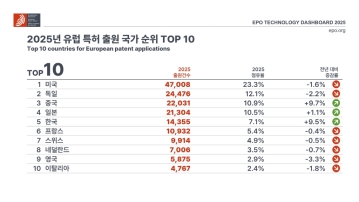
According to the European Patent Office (EPO)'s 'Technology Dashboard 2025', European patent applications last year reached 201,974, surpassing 200,000 for the first time. Korean companies and inventors filed 14,355 applications, representing a 9.5% increase from the previous year and maintaining 5th place by country. Battery, digital communication, and semiconductor technologies led the growth, with Samsung ranking as the top EPO applicant for the second consecutive year and LG reaching 3rd place. The presence of major domestic cities such as Seoul, Suwon, and Yongin was also confirmed. It was also revealed that Korea's European patent strategy is expanding beyond individual technologies to span the entire industry.
2026.03.24by 명세환 기자

SK Telecom First Applies AI-Based Network Operations at Gwanghwamun K-Pop Concert
SK Telecom announced that it applied an AI-based network operation system for the first time at a large-scale K-pop concert held in the Gwanghwamun area of Seoul on March 21st, managing communication quality throughout the event. Mobile data usage during the three hours before and after the concert reached 12.15TB, approximately doubling compared to the same time slot the previous weekend. SK Telecom monitored traffic using the AI system 'A-One' in five-minute and 50-meter units to respond to potential overload situations, while also operating temporary communication facilities and on-site personnel in parallel. This case is interpreted as confirmation of the practical applicability of AI-based autonomous network operation in an environment where demand from dense events and foreign users increases simultaneously.
2026.03.23by 명세환 기자











