This page was machine-translated and may differ from the original. View original
Actuator analog modules must be robust and precise
ADI AD5423 DAC and ADG5401F switch combination,
Meets harsh industrial process application requirements
In industrial settings, precise actuator control is required to manage process parameters such as pressure, temperature, and flow rate. Precision analog output modules such as programmable logic controllers (PLCs) and distributed control systems (DCSs) can be used to create voltage and current outputs to control actuators.
The analog output module used at this time must be able to withstand harsh industrial environments and provide reliable, precise output. These requirements can be met by using the △AD5423 single-channel 16-bit I/V output DAC and △ADG5401F overvoltage protection SPST switch from Analog Devices (ADI).
Precision
The most notable feature of the AD5423 is its precision. The TUE is as low as ±0.01% at 25°C (±0.05% average over the entire temperature range), and the rated output drift is 0.35ppm FSR/°C. In current output mode, the TUE is also ±0.01% at 25°C, and the rated output drift is 2ppm FSR/°C. Differential nonlinearity (DNL) is ±1 LSB in all output modes and guarantees monotonicity.
The ADG5401F has an on-resistance (R ON ) specification of 6Ω and includes an internal secondary feedback channel that connects channel I OUT /V OUT to the +V SENSE input of the AD5423. This eliminates any errors due to the on-resistance variation of the ADG5401F. The maximum on-leakage of the ADG5401F over temperature is 40nA. This leakage is less than 1 LSB for a 16-bit 4mA to 20mA current output DAC, which maintains precision and maximizes dynamic range in the output signal chain.
Robustness
The ADG5401F is used at the analog output of the AD5423 to provide protection against overvoltage conditions in both powered-on and powered-off states. It can withstand overvoltages of up to ±60 V on the Source (S) and Source Feedback (SFB) pins, protecting precision analog output nodes from damage caused by system power outages, wiring mistakes, or power sequencing issues.

The supply voltage of the ADG5401F sets the overvoltage fault threshold. Therefore, if the voltage on the S or SFB pin is higher than the supply voltage of the ADG5401F, it detects a fault and automatically opens the main switch channel and the secondary feedback channel. During a fault, these switch channels are opened to prevent any high fault current from flowing to the DAC output or the system power supply.
Since no high fault current flows during an overvoltage event, there is no problem due to power consumption during a fault. Therefore, the effort in designing the system power supply can be reduced. The ADG5401F can eliminate the current-limiting resistors in the output signal path. However, in some applications, these resistors can cause headroom issues.
The ADG5401F includes an open-loop protection switch. When an overvoltage signal of up to ±60 V is applied to the V OUT /I OUT node, the ADG5401F enters overvoltage protection mode, which opens the main channel and secondary feedback channel switches. At the same time, an internal open-loop prevention switch connected between D and DFB closes. This open-loop prevention switch protects the DAC output feedback loop from damage and prevents the DAC from driving its output all the way to the rails.

To protect against high-voltage transients such as IEC 61000-4-2 ESD, IEC 61000-4-4 Electrical Fast Transients (EFT), and IEC 61000-4-5 Surge, the circuit should be implemented as above using discrete resistors and transient voltage suppression (TVS) devices. To prevent this resistor from adding error to the system output, it should be placed inside the feedback loop of the system.

diagnosis
The AD5423 contains a 12-bit internal diagnostic ADC that provides diagnostic information for user-selectable inputs such as power, ground, internal die temperature, and reference. The onboard diagnostic registers contain flags that indicate various fault conditions, which trigger the FAULT pin when a fault occurs.
In voltage output mode, it monitors short circuit detection, and in current output mode, it monitors open circuit detection. It also provides a cyclic redundancy check (CRC) function. This function checks the received data and triggers the FAULT pin if the current data package is determined to be improper. Temperature monitoring is also possible, and a fault is declared if the die temperature exceeds a specified limit.

Conclusion
By using the AD5423 DAC and ADG5401F switch together, the precision and robustness required in industrial process applications can be achieved. The AD5423's 16-bit I/V output provides the precise control signals required for modern analog output modules, while the ADG5401F maintains precision even in harsh environments and provides robust protection against external stress.
This article is an adaptation of “Precision Solutions with Protection and Robustness for Analog Outputs in Process Control,” co-authored by David Forde, Applications Engineer, Claire Croke, Marketing Engineer, and Jean McAdam, Strategic Marketing Manager, Analog Devices (ADI).
ADI AD5423 DAC and ADG5401F switch combination,
Meets harsh industrial process application requirements
In industrial settings, precise actuator control is required to manage process parameters such as pressure, temperature, and flow rate. Precision analog output modules such as programmable logic controllers (PLCs) and distributed control systems (DCSs) can be used to create voltage and current outputs to control actuators.
The analog output module used at this time must be able to withstand harsh industrial environments and provide reliable, precise output. These requirements can be met by using the △AD5423 single-channel 16-bit I/V output DAC and △ADG5401F overvoltage protection SPST switch from Analog Devices (ADI).
Precision
The most notable feature of the AD5423 is its precision. The TUE is as low as ±0.01% at 25°C (±0.05% average over the entire temperature range), and the rated output drift is 0.35ppm FSR/°C. In current output mode, the TUE is also ±0.01% at 25°C, and the rated output drift is 2ppm FSR/°C. Differential nonlinearity (DNL) is ±1 LSB in all output modes and guarantees monotonicity.
The ADG5401F has an on-resistance (R ON ) specification of 6Ω and includes an internal secondary feedback channel that connects channel I OUT /V OUT to the +V SENSE input of the AD5423. This eliminates any errors due to the on-resistance variation of the ADG5401F. The maximum on-leakage of the ADG5401F over temperature is 40nA. This leakage is less than 1 LSB for a 16-bit 4mA to 20mA current output DAC, which maintains precision and maximizes dynamic range in the output signal chain.
Robustness
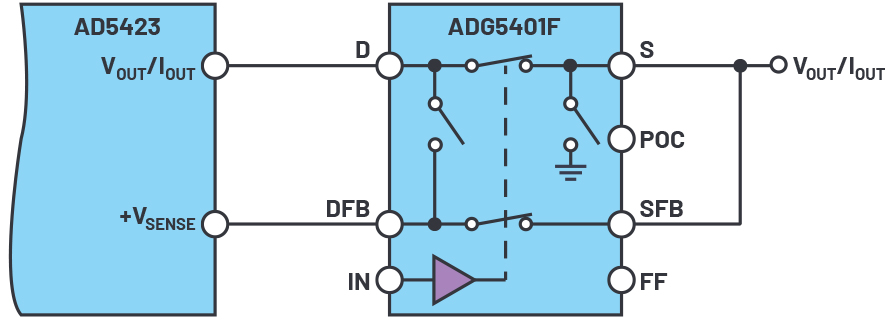
The ADG5401F is used at the analog output of the AD5423 to provide protection against overvoltage conditions in both powered-on and powered-off states. It can withstand overvoltages of up to ±60 V on the Source (S) and Source Feedback (SFB) pins, protecting precision analog output nodes from damage caused by system power outages, wiring mistakes, or power sequencing issues.

▲ Connecting AD5423-ADG5401F to analog output module [Image = ADI]
The supply voltage of the ADG5401F sets the overvoltage fault threshold. Therefore, if the voltage on the S or SFB pin is higher than the supply voltage of the ADG5401F, it detects a fault and automatically opens the main switch channel and the secondary feedback channel. During a fault, these switch channels are opened to prevent any high fault current from flowing to the DAC output or the system power supply.
Since no high fault current flows during an overvoltage event, there is no problem due to power consumption during a fault. Therefore, the effort in designing the system power supply can be reduced. The ADG5401F can eliminate the current-limiting resistors in the output signal path. However, in some applications, these resistors can cause headroom issues.
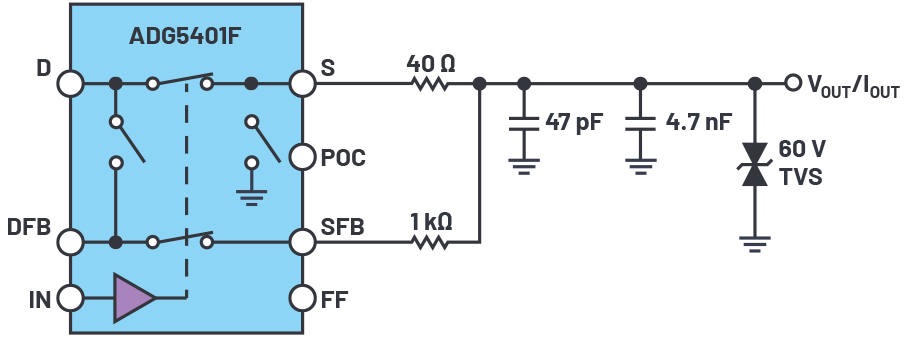
The ADG5401F includes an open-loop protection switch. When an overvoltage signal of up to ±60 V is applied to the V OUT /I OUT node, the ADG5401F enters overvoltage protection mode, which opens the main channel and secondary feedback channel switches. At the same time, an internal open-loop prevention switch connected between D and DFB closes. This open-loop prevention switch protects the DAC output feedback loop from damage and prevents the DAC from driving its output all the way to the rails.

▲ ADG5401F circuit diagram [Image = ADI]
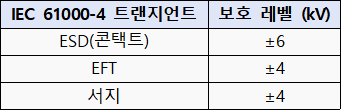
To protect against high-voltage transients such as IEC 61000-4-2 ESD, IEC 61000-4-4 Electrical Fast Transients (EFT), and IEC 61000-4-5 Surge, the circuit should be implemented as above using discrete resistors and transient voltage suppression (TVS) devices. To prevent this resistor from adding error to the system output, it should be placed inside the feedback loop of the system.

▲ High voltage transient protection [Table = ADI]
diagnosis
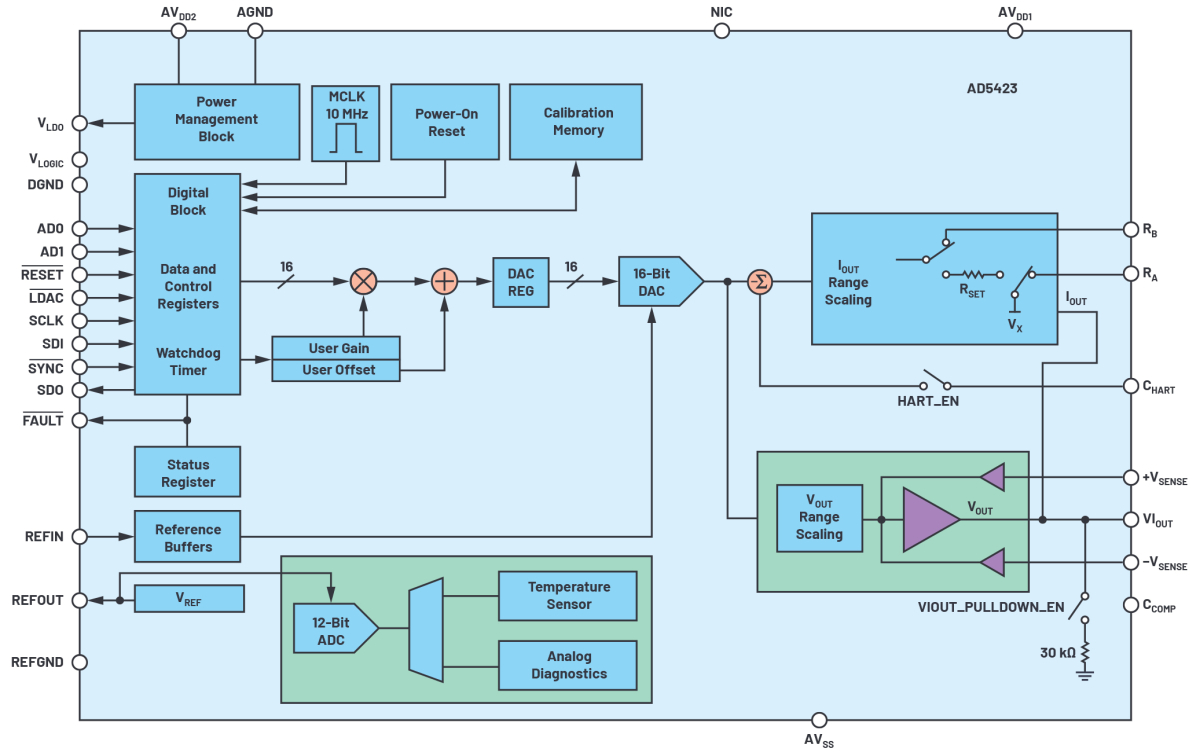
The AD5423 contains a 12-bit internal diagnostic ADC that provides diagnostic information for user-selectable inputs such as power, ground, internal die temperature, and reference. The onboard diagnostic registers contain flags that indicate various fault conditions, which trigger the FAULT pin when a fault occurs.
In voltage output mode, it monitors short circuit detection, and in current output mode, it monitors open circuit detection. It also provides a cyclic redundancy check (CRC) function. This function checks the received data and triggers the FAULT pin if the current data package is determined to be improper. Temperature monitoring is also possible, and a fault is declared if the die temperature exceeds a specified limit.

▲ AD5423 functional block diagram [Figure = ADI]
Conclusion
By using the AD5423 DAC and ADG5401F switch together, the precision and robustness required in industrial process applications can be achieved. The AD5423's 16-bit I/V output provides the precise control signals required for modern analog output modules, while the ADG5401F maintains precision even in harsh environments and provides robust protection against external stress.
This article is an adaptation of “Precision Solutions with Protection and Robustness for Analog Outputs in Process Control,” co-authored by David Forde, Applications Engineer, Claire Croke, Marketing Engineer, and Jean McAdam, Strategic Marketing Manager, Analog Devices (ADI).
본 기사에 대한 정정·반론·추후보도 청구는 보도 청구 안내를, 그간 게재된 보도문은 정정·반론보도 모아보기를 참고해 주세요.