



Fast charging of large-capacity lithium-ion batteries becomes possible.
 Published2021.02.16 11:35
Preventing silicon-based cathode degradation due to volume expansion
Removing hydrofluoric acid suppresses nickel dissolution and extends service life.
As demand for large-capacity batteries, including those for electric vehicles (EVs), increases, research is actively underway to replace the electrodes of commercial lithium-ion batteries with high-capacity materials such as silicon and high-nickel.
However, the silicon cathode has weak mechanical durability as its volume increases more than three times during charging and discharging, and the high-nickel cathode is also chemically unstable.
A research team consisting of Professors Choi Nam-soon and Kwak Sang-kyu of the Department of Energy and Chemical Engineering at Ulsan National Institute of Science and Technology (UNIST) and Professor Hong Seong-yu of the Department of Chemistry announced on the 14th that they have developed a battery electrolyte additive that solves the instability of electrode materials, a challenge in the development of large-capacity lithium-ion batteries.

Professor Hong Seong-yu, Researcher Park Se-won, and Researcher Jeong Seo-young [Photo = UNIST]
The research team developed two functional electrolyte additives (△DMVC-OCF3, △DMVC-OTMS) that form a stable and flexible polymer protective film on silicon-based cathodes and effectively remove hydrofluoric acid, a cause of battery deterioration. Its performance was also confirmed by introducing it to a lithium-ion battery with a high-capacity silicon-based cathode and a nickel-rich anode.
The additives prevent deterioration due to volume expansion of the silicon-based anode (DMVC-OCF3) and suppress nickel dissolution from the nickel-rich anode through hydrofluoric acid removal (DMVC-OTMS), thereby extending battery life. The protective film formed on the silicon anode increases lithium-ion permeability, enabling rapid battery charging.
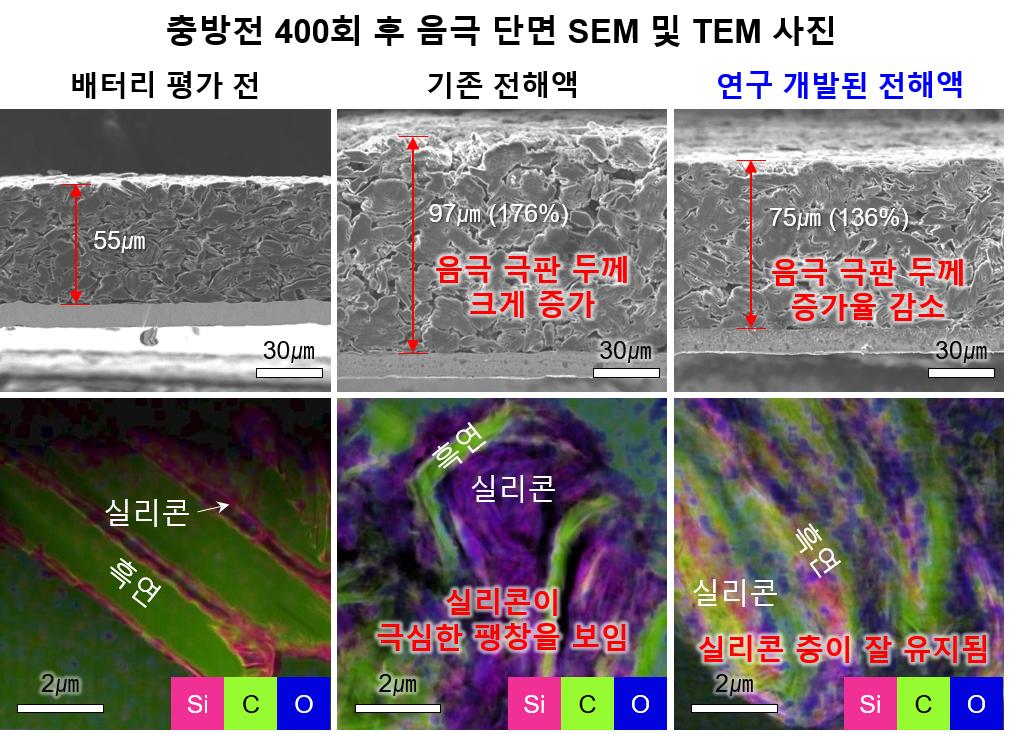
The research team added two types of additives to a large-capacity battery composed of a high-nickel cathode and a silicon-mixed cathode, and confirmed that it maintained 81.5% of its initial capacity even after 400 charge and discharge cycles. This is a 10% to 30% improvement in performance compared to commercial additives such as fluoroethylene carbonate (FEC) or vanylene carbonate (VC).
“Even in experiments where the battery was fast-charged in less than 20 minutes, only a 1.9% capacity loss was observed after 100 cycles,” added co-first author Sewon Park, a doctoral candidate in the Department of Energy and Chemical Engineering at UNIST.
The results of this study, which was supported by the Korea Institute of Energy Technology Evaluation and Planning (KETEP)'s 'Energy Technology Development Project' and the National Research Foundation of Korea (NRF)'s 'Climate Change Response Technology Development Project', were introduced as an influential paper (Editor's Highlights) in the February 5th issue of the international academic journal 'Nature Communications'.
Comments
Related news
Implementing Next-Generation EV Batteries Requires Attention to Everything from Materials to Software
The global electric vehicle market is expected to grow from approximately 2.5 million units in 2020 to around 30 million units by 2030. As the EV market expands, battery demand is also increasing, and replacement demand for aging batteries is projected to rise over time. On the 17th, MicesForum hosted the '2020 Next-Generation Battery Latest Technology Seminar' by inviting six battery experts and shared relevant insights.
2020.12.18by 이수민 기자
Preventing ESS Fire Accidents with Micro-Arc Detection System
An ESS is a combination of numerous batteries, connectors, and other components. Therefore, if a micro-arc, which is a small spark, occurs in one battery, it can easily spread to other batteries and cause a large-scale fire. To prevent this, it is first necessary to reduce the occurrence of micro-arcs themselves, and secondly, it is necessary to establish a system that detects micro-arcs early and prevents them from leading to fire.
2021.01.07by 이수민 기자
Maxim Launches ASIL-D Compliant 14-Channel Battery Monitoring IC
Maxim Integrated has released the MAX17852, an ASIL-D rated 14-channel high-voltage battery data acquisition system. It enables typical cell voltage measurement of ±0.45mV at room temperature, with a maximum error range of ±2mV in the 5~40℃ temperature range. Designed for integration into various vehicle applications, it is suitable for smart junction boxes, 48V electrical systems, and 400V charging systems.
2021.02.04by 강정규 기자

Intel Unveils Next-Generation 'Core Ultra Series 3' and vPro Platform for Enterprise PCs
Intel has officially unveiled the "Intel Core Ultra Series 3" for next-generation enterprise PCs and the latest vPro platform, addressing a wide range of demands from enterprise notebooks to high-performance workstations.
2026.03.26by 배종인 기자
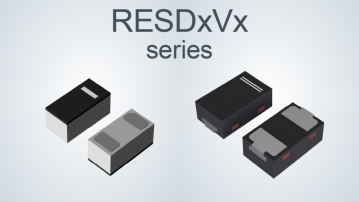
ROHM Launches ESD Protection Diode Compatible with High-Speed Interfaces of 10Gbps or Higher
Semiconductor specialist ROHM has developed the 'RESDxVx series' of ESD (electrostatic discharge) protection diodes capable of responding to next-generation high-speed data communication environments exceeding 10Gbps, simultaneously enhancing both signal quality maintenance required in high-speed interfaces and IC protection performance.
2026.03.26by 배종인 기자











