



Enhancing Cloud Competitiveness Depends on Building a Single DevOps Environment
 Published2021.02.23 16:45
It puts a significant burden on the system and reduces efficiency.
Therefore, it is necessary to build a single integrated DevOps platform.
As various companies and organizations pursue digitalization, cloud capabilities are becoming a key indicator of organizational competitiveness across various industries. GitLab, which has implemented the entire DevOps lifecycle into a single application, held an online press conference on the 23rd to discuss last year's achievements and the challenges ahead for this year.
DevOps provides an environment where companies can integrate people, processes, and tools to achieve adaptive IT and business agility. However, the current software DevOps toolchain is complex. Building an entire DevOps environment with point solutions—in other words, individual software—requires the use of hundreds of tools, placing a significant burden on the system.
These burdens lead to system vulnerabilities, increased integration complexity, strengthened business silos, and reduced sourcing and management efficiency. Therefore, building a single, application-based DevOps platform that can achieve efficiency, productivity, security, compliance, and governance is necessary.
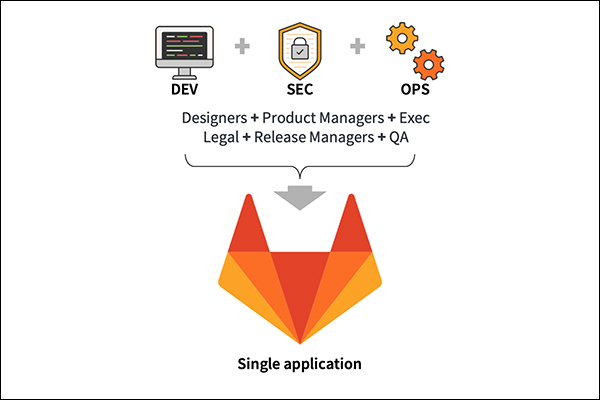
It's a DevOps platform [Image = GitLab]
GitLab forecasts that the overall market size of the DevOps integrated single platform will expand from $14 billion in 2020 to $60 billion in 2023. “The GitLab platform is a DevOps platform with a single data repository, making it more scalable than the most widely used multi-tool-based solutions on the market today,” said Taeho Hyun, CEO of GitLab Korea.
He explained, "The GitLab platform provides a single interface and data model, as well as a single process for authorization, control, and security, across multi-cloud and hybrid deployment environments." GitLab currently boasts a 70% market share in the self-managed DevOps repository space.
Gartner predicts that the number of enterprises adopting a single, integrated DevOps platform will increase from less than 10% in 2020 to 40% in 2023. IDC forecasts that the global DevOps software tools market will reach $17.07 billion by 2024.
“The GitLab platform can replace multi-vendor solutions across the DevOps lifecycle,” said CEO Hyun Tae-ho. “Workers don’t have to stop using their tools when generating and verifying code or switching tools, so they can move work pieces along the software development lifecycle and expand downstream.”
The GitLab platform features 10 levels of functionality and has been releasing platform updates for 100 consecutive months, backed by open source community support.
CEO Hyun Tae-ho said, “The GitLab platform, which is provided as a single application, has annual recurring revenue (ARR) of 150 million dollars and an annual ARR growth rate of 74%,” and “In particular, it maintains a net retention rate of over 130% through continuous quality improvement based on open source and provision of subsets.”
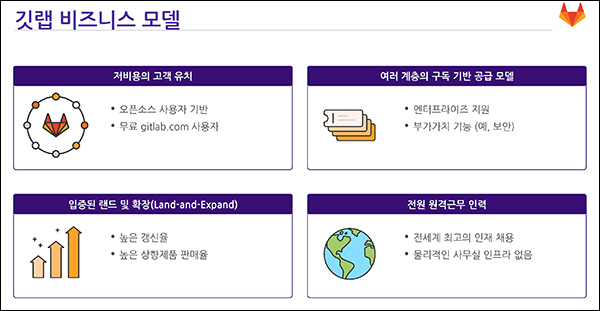
Software accelerates innovation and enhances competitiveness across all industries, but by its very nature, it also allows for rapid emergence of competitors. To respond quickly to market demands, software development departments must adopt new methodologies to shorten development cycles and increase speed.
In June 2020, Forrester Consulting announced in its study, "The Total Economic Impact™ of GitLab," that customers using the GitLab platform achieved, on average, the following results: △ an 87% reduction in development cycles, △ a 12x increase in the number of updates and new releases deployed, and △ an 80% reduction in defects.
CEO Hyun Tae-ho stated, "There are numerous steps from defining a software concept to launching it," and added, "Using new tools at each stage undermines market competitiveness." He emphasized, "The GitLab platform addresses these needs as a DevSecOps platform for cloud-native implementation."
“The GitLab platform enables all phases of the DevOps Software Development Lifecycle (SDLC) through a single application, contributing to collaboration and transparency across development, operations, and security teams,” added Anthony McMahon, managing director of GitLab APAC.
Comments
Related news

How to establish a remote work system that will remain effective even in the post-COVID era?
GitLab, which was already the world's largest fully remote-work company before COVID-19 emerged, shared its remote work expertise and experience with Korean companies. GitLab demonstrated that remote workers can collaborate through collaboration software, video conferencing platforms, and shared documents.
2020.10.16by 이수민 기자
GitLab Completes Integration of Fuzzing Solutions, Strengthening DevSecOps Capabilities
GitLab has completed its integration of Fuzz Tech, a security software development company specializing in protocol fuzz testing and DAST API testing security, and Fuzzitech, a continuous fuzz testing solution provider offering coverage-guided testing. Through this integration, GitLab now delivers a comprehensive and integrated security solution to its security features customers, spanning from automated DevOps security testing deployment to vulnerability management and remediation.
2020.12.03by 이수민 기자
SKT and AWS Commercialize Korea's First '5G Edge Cloud Service'
SK Telecom has commercialized SKT 5GX Edge, Korea's first 5G edge cloud service, in partnership with Amazon Web Services (AWS). SKT 5GX Edge is a service that applies AWS Wavelength to 5G MEC infrastructure, enabling customers to build ultra-low latency mobile applications.
2020.12.26by 명세환 기자
.jpg)
SalePoint Signs Multi-Year Partnership Agreement with AWS… Promoting Identity Security that Integrates Even AI Agents
Sailpoint has entered into a multi-year strategic partnership agreement with AWS and is moving forward with establishing an integrated governance system that manages both human and non-human identities together. The plan is to consistently manage access permissions in an environment where AI agents are increasing as work execution entities, while applying the principle of least privilege and automated policy enforcement. The two companies plan to jointly expand capabilities to manage the identities of various entities, including AI agents, within a single layer in the AWS environment. This collaboration is interpreted as a move to design security and governance together in corporate environments where AI adoption is expanding.
2026.03.26by 배종인 기자
.png)
Databricks Unveils Open AI Security Monitoring 'Lakewatch'
Databricks entered the security market on March 24 by unveiling LakeWatch, an open-source agentic SIEM. The core functionality of this product is to integrate and analyze security, IT, and business data in a single environment to support AI-based threat detection and investigation. The company explained that it reduces the limitations of existing security operations centers, which have had to forgo some data due to high cost structures, and enables large-scale data analysis and automation based on open formats and ecosystems. LakeWatch is currently offered as a private preview, with Adobe and Dropbox mentioned as early customers. Databricks also announced an expanded partnership with Anthropic as well as the acquisition of Antimatter and SiftD.ai.
2026.03.26by 배종인 기자











